Get Full Government Meeting Transcripts, Videos, & Alerts Forever!
Get email alerts on the Drainage Cd61 topic
No spam. Unsubscribe anytime.
Drainage authority orders detailed survey, appoints viewers after Nicollet County Ditch 61 hearing
Summary
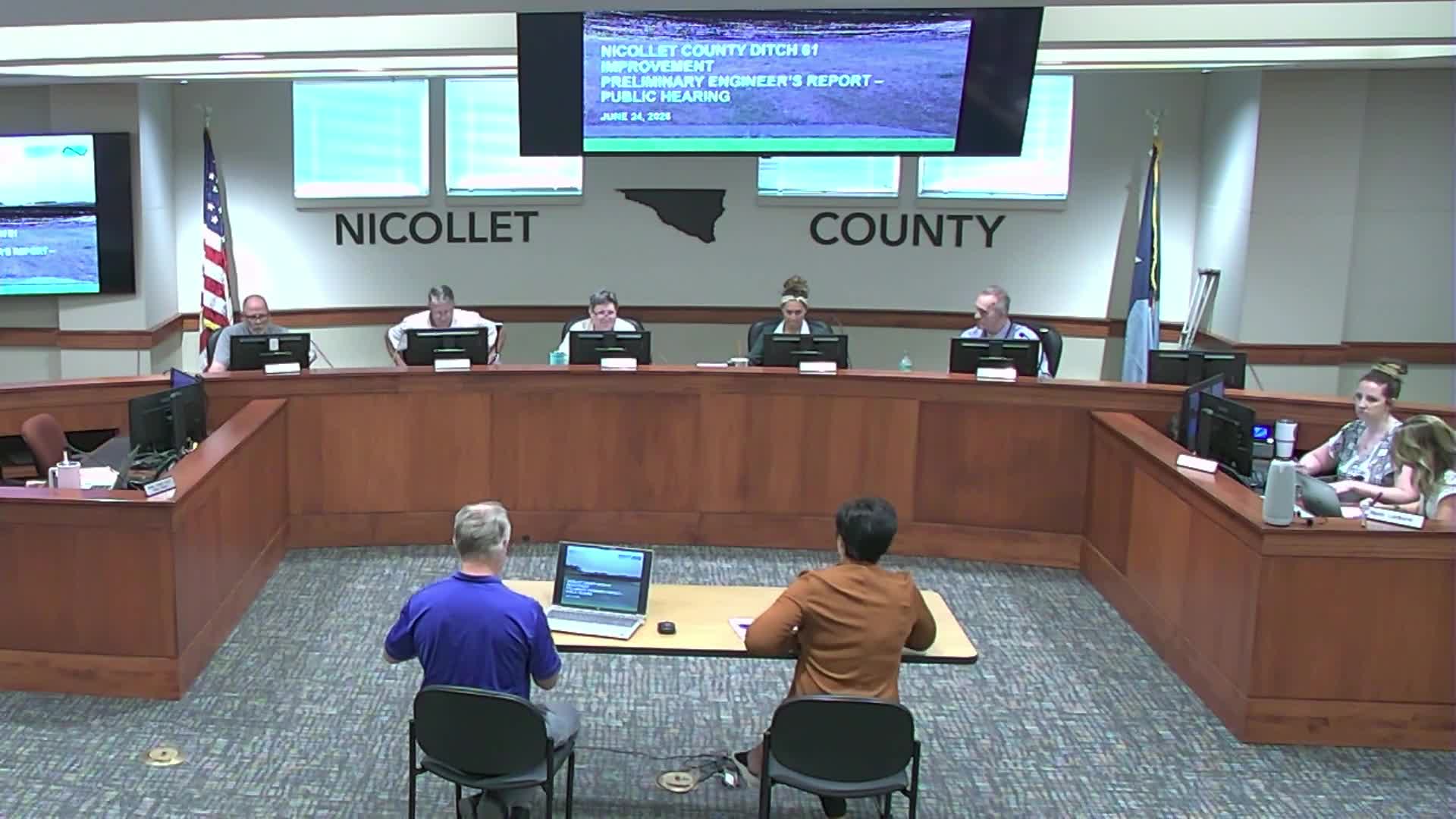
Nicollet County’s drainage authority held a public hearing June 24 on a petition to improve Nicollet County Ditch 61 and voted to proceed to a final engineer’s report and to appoint viewers to assess benefits and damages.
Nicollet County’s drainage authority held a public hearing June 24 on a petition to improve Nicollet County Ditch (CD) 61 and voted to proceed to a final engineer’s report and to appoint viewers to assess benefits and damages.
Background and petition: Jacqueline (Jackie) Kopit, Nicollet County property and public services director, said the petition was presented to county public services on Aug. 9, 2024, reviewed by the county attorney and approved by the board on Sept. 10, 2024; Houston Engineering was appointed engineer on May 15, 2025. Kopit said notice of the hearing was mailed to landowners on June 9, 2025 as required by Minnesota Statute 103E.261.
Engineer’s findings: Chris Otterness of Houston Engineering presented the preliminary engineer’s report. He said CD 61’s main trunk is nearly all tile, drains roughly 700 acres (about 1.13 square miles), and was originally constructed about 1916. Televising identified collapsed pipe and failures along the system; the petition is limited to replacing the main trunk to achieve a 0.5-inch drainage coefficient (half-inch over 24 hours). Existing tile sizes range from 10 to 16 inches; proposed new tile would range from 15 to 36 inches with reconnection of lateral tiles and placement of inlets where needed.
Alternatives and environmental review: Otterness said alternatives (do-nothing, repair-in-kind) were considered; repair-in-kind would not address modern capacity needs. He reported potential wetland constraints in one area where the project proposes replacing buried tile through a wetland with a short open ditch to avoid placing fill that would trigger Wetland Conservation Act mitigation. Otterness said the outlet is into a backwater area of Swan Lake and that increasing flow is estimated to have a negligible effect on lake elevation (much less than a tenth of an inch in their calculation). He said the outlet elevation is 980.36 and Swan Lake’s ordinary high water level is 981.86.
Costs: The engineer estimated construction cost (with 20% contingency) at about $646,000 and additional legal/engineering/admin costs of roughly $169,000, yielding a probable project cost of about $814,000. He also estimated separable maintenance (repair-in-kind to restore function) at about $605,000.
DNR advisory letter: Jackie Kopit read a June 6, 2025 advisory letter from the Minnesota Department of Natural Resources (DNR) (region 4), which noted Swan Lake’s sensitive designation and recommended considering storage or wetland restoration; DNR raised questions about wetland exemption claims under recent statute changes and asked for additional flow-comparison tables in the final report. Otterness said he would add the requested flow-change data and coordinate with the local government unit (LGU) on WCA compliance.
Public comment and landowner concerns: The petitioners’ attorney, Dean Zimmerli, urged the authority to find the project necessary, feasible and in the public interest, asking the board to direct the engineer to finalize the report and to appoint viewers. Landowner Troy Havenmeier testified with concerns about converting buried tile to an open ditch through a wetland, mosquito/flies potential, access across new ditch, and the site’s history of wetland designation after earlier tile repairs. Otterness and staff said they would continue post-hearing conversations with the landowner and that alternative alignments or a small pond could be discussed.
Board action: The drainage authority answered “yes” to the required preliminary questions (petition properly filed; notice provided; project would promote the public benefit after considering environmental and land-use criteria; project feasible; outlet adequate). The authority ordered the detailed survey and directed the engineer to prepare the final engineer’s report for consideration at the next scheduled drainage authority meeting (July 8). The board also appointed viewers (Mark Behrens and his team were identified as willing) to assess benefits and damages. Motions were made, seconded and carried by voice vote.
Ending: The public hearing was closed and the drainage authority adjourned; staff will prepare a final engineer’s report and viewers’ assessment in advance of the July 8 meeting. Landowners were advised to coordinate with Houston Engineering and county staff on private laterals, wetland concerns and potential conservation funding avenues.