Get Full Government Meeting Transcripts, Videos, & Alerts Forever!
Get email alerts on the Housing Supportive Housing topic
No spam. Unsubscribe anytime.
St. Paul council delays one supportive-housing appeal, denies another as state rules shift licensing
Summary
The Saint Paul City Council on July 9 laid over an appeal for 418 Sherburne Ave. and denied an appeal for 438 Daley St., as staff and the Board of Zoning Appeals found required variance criteria unmet and council members flagged statewide licensing changes that are driving a surge of reclassifications to "supportive housing."
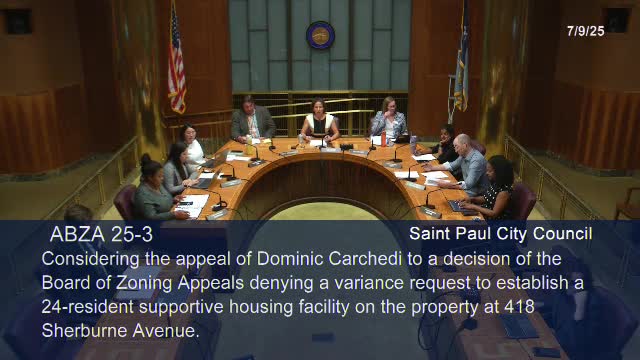
The Saint Paul City Council on July 9 took opposite actions on two appeals of Board of Zoning Appeals decisions about supportive‑housing conversions: it laid over the appeal for 418 Sherburne Ave. to Aug. 6 to allow legal and policy review, and it denied the appeal for 438 Daley St., upholding the BZA's finding that the variance standards were not met.
City staff summarized the legal framework and the BZA findings. David Ayd, a staff member with the Department of Safety and Inspections, told the council that both appeals asked the council to overturn denials of zoning variances needed to classify long‑running congregate residences as supportive housing. Ayd said staff and the BZA concluded that three of the six findings required for a variance — that the hardship is not self‑created, that the hardship is unique to the property, and that granting the variance would not alter neighborhood character — were not met in both cases. He noted the code includes a quarter‑mile separation requirement between higher‑intensity congregate uses and caps on resident counts in some zoning districts.
The Sherburne property owner, Dominic Carchetti, told the council he has operated what he described as a sober house at 418 Sherburne for about 16 months and said recent state regulation changes effectively reclassified his operation as supportive housing because certain services (for example, food provision) are now required. “It was put upon me by the state of Minnesota,” Carchetti said, adding he runs a “very clean” operation and submitted neighborhood signatures in support. Neighbors who spoke opposed the reclassification and said they were not informed of a plan to house 24 adult residents; Robert McLean of 437 Sherburne said the scale “may pose a cultural shock to neighbors,” and Jackie Burgoon said safety was her primary concern.
Councilmember Bowie moved to lay the Sherburne appeal over to Aug. 6 to allow council attorneys and staff to review zoning interpretations and potential policy responses. Bowie said the council needs time to reconcile state licensing changes with the city’s zoning code so decisions do not create “bigger problems in our neighborhood.” The motion passed unanimously.
On the Daley Street appeal, staff described the property as an existing rooming house in a B2 Community Business district that operates with 22 residents. Staff said the applicant sought two variances: one to exceed the district limit on supportive‑housing facility residents and one for the required separation distance from another large congregate facility. Staff and the BZA concluded the applicant’s request was primarily financially driven, that the hardship was not unique to the parcel, and that granting the variances would create clustering that undermines community integration. No appellant representatives appeared at the public hearing before the council. After deliberation, a councilmember moved to deny the appeal; the motion carried unanimously.
Council discussion repeatedly acknowledged that recent state rule changes affecting licensure and service requirements for recovery/sober housing are producing a surge of zoning questions. Several councilmembers said the city needs a short‑term policy response or code amendment to prevent repeated case‑by‑case conflicts between state licensing requirements and local zoning standards.
What happened (formal actions) - 418 Sherburne Ave. (ABZA appeal): Motion to lay over the appeal to Aug. 6 for further legal and policy review. Mover: Councilmember Bowie. Vote: 7‑0; motion adopted. - 438 Daley St. (ABZA appeal): Motion to deny the appeal (upholding the BZA denial of variances). Mover: not specified on record. Vote: 7‑0; appeal denied.
Why it matters City staff and multiple councilmembers warned that the state’s change in how recovery‑oriented residential programs are regulated is pushing many existing providers into a “supportive housing” classification that triggers separation distances and resident limits in Saint Paul’s zoning code. Councilmembers said the city must resolve the mismatch — through interim guidance or ordinance changes — because they expect more appeals and potential disruptions to housing providers and neighborhoods if the conflict persists.
Next steps The Sherburne appeal will return to the council on Aug. 6. Council members asked DSI and other relevant staff to prepare policy options and a recommended path forward — whether a narrow zoning tweak, a new local classification to mirror state licensure, or another remedy — before that date. The council also signaled it will schedule a policy session to consider broader changes to the congregate‑living sections of the legislative code.