Get Full Government Meeting Transcripts, Videos, & Alerts Forever!
Get email alerts on the School District Budget topic
No spam. Unsubscribe anytime.
School district projects roughly $19 million shortfall for 2025–26; staff propose program shifts and cuts
Summary
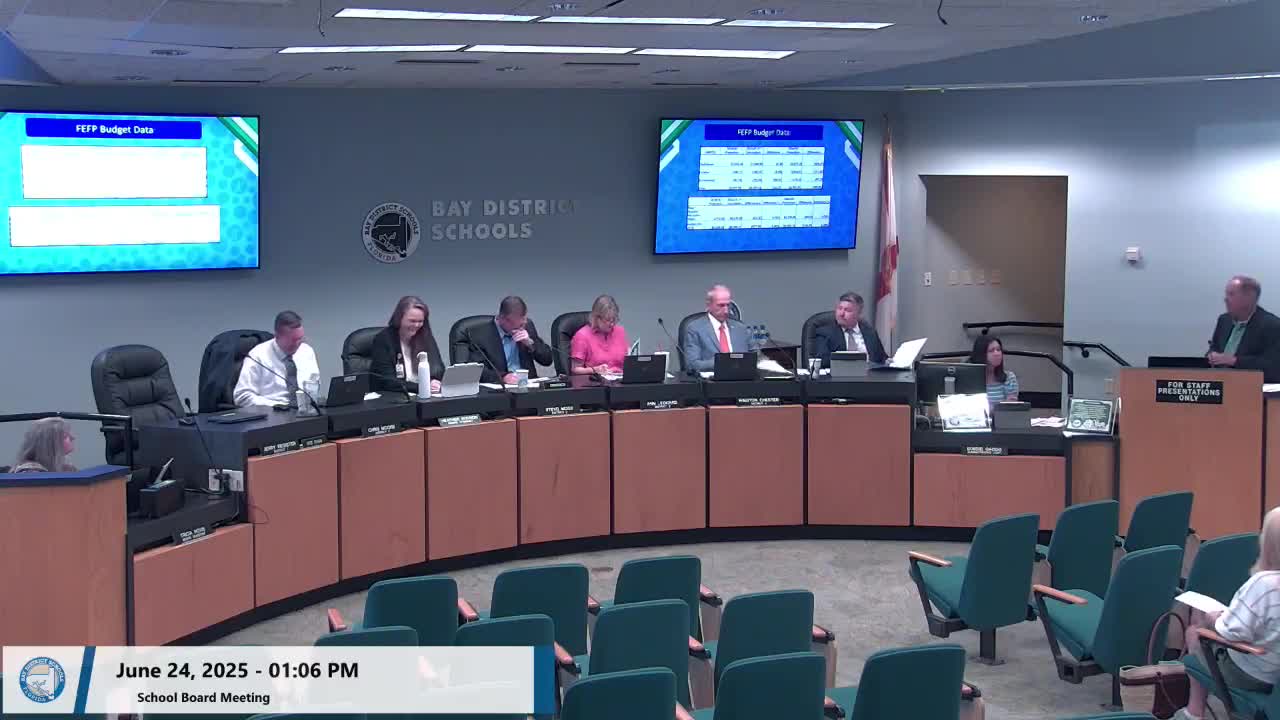
At a budget workshop, district staff presented a preliminary 2025–26 budget showing about $267 million in projected revenue and $286 million in proposed appropriations, prompting proposed program reductions and internal reassignments to balance the gap.
District staff presented a preliminary 2025–26 budget at a budget workshop, saying projected revenue of about $267 million falls short of proposed appropriations of about $286 million — a gap of roughly $19 million.
Jim (staff member, budget presenter) told board members the session was “probably unlike the other few we’ve had...there’s actually some numbers attached to it which helps when you’re trying to build a budget.” He and other staff emphasized that the figures assume the governor signs the state budget and that further clarifying detail will come from the Department of Education once that happens.
The presentation focused on enrollment-driven revenue and reallocated costs. Staff showed the district’s traditional FTE head count moving from an October-adjusted total of 21,988 to a projection of 22,034 for next year — a decline of about 536 students compared with last year’s projection. Scholarship-school enrollment has grown faster: staff reported a prior projection of about 1,215 scholarship students, actuals of about 1,392, and a projection of about 1,682 for next year. Staff said that growth in scholarship enrollments appears to be drawing students from traditional schools, not from charters.
To narrow the budget gap, the presentation outlined a combination of program eliminations, reclassifications of positions and expected increases in fixed costs: - District staff said $6.5 million in speech-language pathologist (SLP) costs have been moved from school-level budgets into the Teaching and Learning division for centralized management. - The district plans to remove roughly $1.4 million in data-clerk costs from individual school budgets and fund those positions centrally. - Staff identified a $3.2 million reduction in the CS and I (school-improvement) project line, elimination of social-skills/behavior classroom funding (about $700,000) that had been funded with CARES-era dollars, and ending the Aspire Academies program (about $900,000). - The superintendent’s office budget includes a proposed internal-auditor position, estimated at about $160,000 in additional appropriation.
Staff also called out several cost drivers that reduce discretionary capacity despite a modest rise in base allocations: the district’s share of a Florida Retirement System (FRS) rate increase, estimated about $680,000; prior-year teacher-salary allocations and a smaller teacher-pay increase than last year; and categorical funding shifts from base to designated categorical lines. Staff noted that some dollars that previously appeared in the base allocation have been reclassified into categoricals, which affects how much truly discretionary funding the district controls.
Workshop presenters reviewed the district’s reserve position and timing. They said the district currently holds roughly $9 million in fund balance and typically relies on available fund balance to cover the recurring appropriation/revenue mismatch during the budget cycle. Staff described that having a multi-million-dollar appropriation gap in preliminary numbers is “par for the course,” and outlined the schedule ahead: a summarized tentative budget will be presented for approval to advertise on July 24, a full presentation and tentative-adoption actions around July 31, and a final public hearing and adoption scheduled for Sept. 11.
Board members asked for further detail on program timelines and effectiveness, particularly for the CS and I investments. One board member urged staff to provide empirical evidence of program results and to show implementation timelines before reducing supports for schools that remain fragile despite prior interventions.
Staff told the board the district is tracking state-level policy changes that could affect budgeting, including conversations about changing how scholarship funding is paid to districts (monthly or quarterly payments were discussed at the legislature but related legislation did not pass). The presenters said last year’s statewide scholarship funding reconciliation created a roughly $280 million shortfall statewide and that districts were asked to repay funds; that issue remains a point of uncertainty going into the next fiscal year.
The workshop did not include any formal votes. Staff invited board members to schedule follow-up meetings to review line-item detail before the July tentative-adoption actions.