Get Full Government Meeting Transcripts, Videos, & Alerts Forever!
Get email alerts on the Stormwater topic
No spam. Unsubscribe anytime.
County splits off stormwater department, approves 'not to exceed' stormwater rate to preserve options for waterway dredging program
Summary
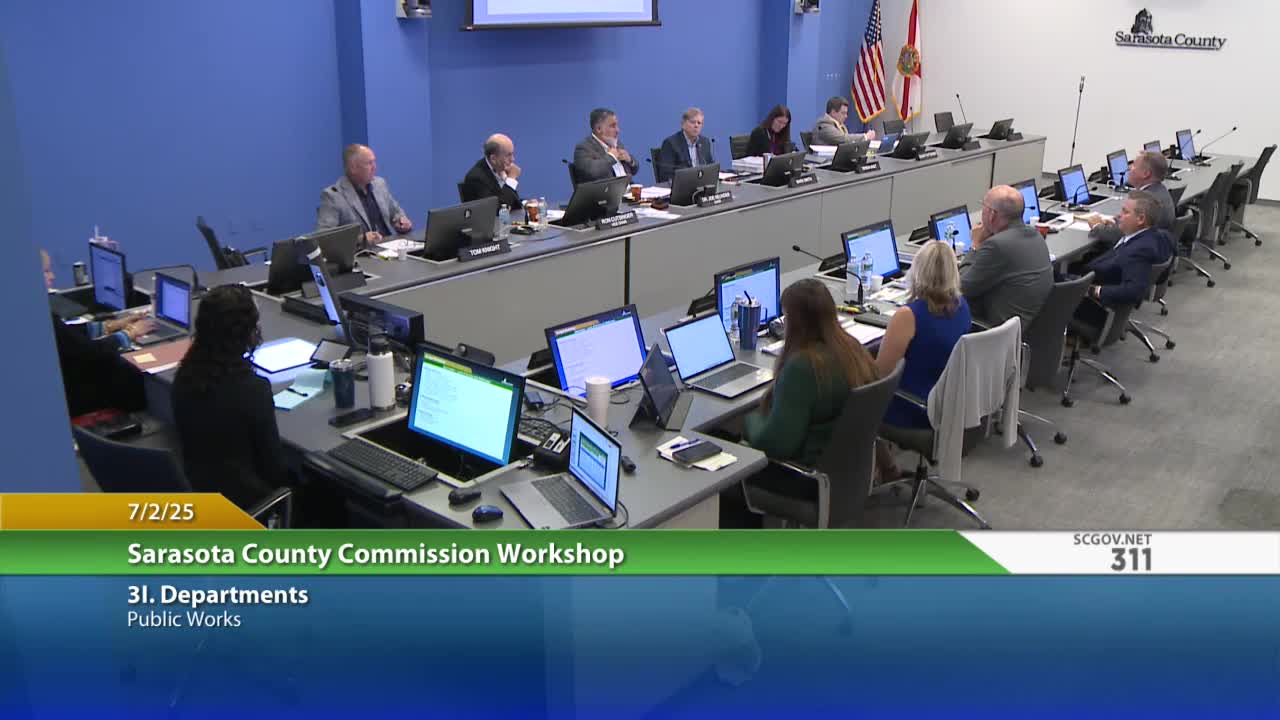
The Sarasota County Board of County Commissioners voted to make stormwater a separate department and approved publishing a not‑to‑exceed stormwater assessment rate so the board can later reduce the amount if it chooses, while continuing debate over adding a countywide waterways dredging program.
The Sarasota County Board of County Commissioners directed staff to separate stormwater from Public Works into a new, standalone stormwater department and approved public notice of a ‘not to exceed’ stormwater assessment rate that preserves the board’s flexibility to set the final rate later in the budget process.
The move came after public comment and extensive staff presentations on service levels, possible staffing and equipment increases, and an option that would add a countywide annual waterways maintenance line of about $10 million. Public Works Director Spencer Anderson told the board the county has identified about $90 million already for dredging and coastal maintenance—starting with a multi‑part effort on Phillippi Creek—and that staff is proposing a programmatic dredging budget to cover other coastal streams and creeks going forward.
Why it matters: The board’s direction sets a new organizational structure (a dedicated stormwater department) and signals willingness to consider a larger, countywide waterways maintenance program. Commissioners said they wanted the highest possible notice set for TRIM/trim mailings so the board would have room to reduce the proposed assessment if it chooses, rather than having to restart the TRIM process to raise it.
Key details - Department separation: Commissioners voted to establish stormwater as a separate county department; County Administrator Jonathan confirmed the job posting for a stormwater director and said staff expected candidate outreach and a status update within days. Commissioner John Smith reported he had contacted a potential interim, Steven Swat, who “is willing to come in and help, on a temporary basis.” - Not-to-exceed trim option: Public Works presented three assessment scenarios for FY‑26: current level of service; level of service increases excluding waterways; and level of service plus a $10 million/year waterways dredging program. The board voted unanimously to publish the highest (not-to-exceed) figure so the board can lower the final FY‑26 rate before adoption if it chooses. Commissioner Knight moved the motion; Commissioner Mast seconded; the motion passed unanimously. - Program funding and sources: Anderson said $5 million was approved earlier this year for Phillippi Creek, another proposed $10 million was on the agenda for board action next week to advance Phillippi Creek work out of the stormwater utility fund balance, and an additional $75 million was identified through the Resilient SRQ (Resilient SRQ) federal funds program for coastal work tied to SRQ Resilient initiatives. Anderson characterized the $10 million figure as an early placeholder for a countywide programmatic dredging effort. - Policy and ordinance updates: Commissioners directed County Administrator and County Attorney staff to review and draft necessary ordinance changes (including definitions of waterways and maintenance, permitting thresholds and other code updates) and return to the board for discussion; staff said an August work session was targeted to present a comprehensive list of needed code changes and recommended policy directions.
Dissent and next steps Several commissioners urged a careful, basin‑by‑basin policy approach rather than a flat assessment across all customers. Commissioner Kutzinger and others asked staff to explore whether some dredging work could be funded temporarily from Resilient SRQ appropriations while the long‑term assessment and ordinance structure are debated. Staff said next steps include continuing recruitment for a permanent stormwater director, preparing the TRIM notice materials, and returning ordinance language and policy options for the board’s August meeting.
Ending note: The board’s vote preserves flexibility: the published TRIM “not‑to‑exceed” numbers put the public on notice of the maximum proposed assessments, but the board kept authority to set lower final rates during the summer budget process.