Get Full Government Meeting Transcripts, Videos, & Alerts Forever!
Get email alerts on the Stormwater Infrastructure topic
No spam. Unsubscribe anytime.
City adopts $375M stormwater master plan and sets $22 monthly ERU fee amid phased projects
Summary
The City Commission adopted a stormwater master plan and approved a package of near-term and long-term projects; commissioners approved a new stormwater rate set at $22 per Equivalent Residential Unit (ERU) to fund design and construction of prioritized drainage work.
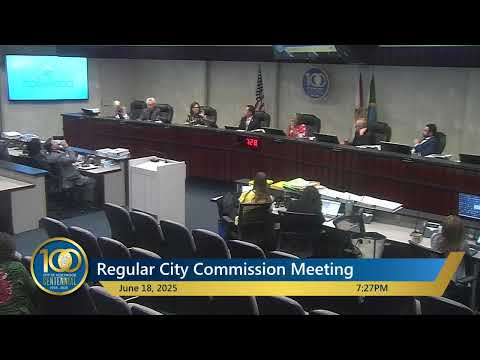
The Hollywood City Commission adopted a multi-stage stormwater master plan on June 18, 2025 and approved both near-term interim projects and a longer-term capital program intended to address chronic flooding across the city. The Commission also set a stormwater fee of $22 per Equivalent Residential Unit (ERU) to fund the plan’s initial design and construction phases.
What the plan covers
Utilities Director Vin Morello presented three linked items: adoption of the master plan, a list of priority projects to implement in the next 10 years (a $75 million set of interim/accelerated projects), and a larger $300 million CIP package for longer-term solutions. Morello described project groupings that include Fourteenth Avenue corridor work, designs for basins in the Liberia area, and solutions around Sunset Golf Course; the presentation emphasized both short-duration relief measures and larger, design-heavy pump station and conveyance projects.
Funding and rates
Commissioners voted to proceed with a $22-per-ERU (monthly) fee citywide; the current ERU had been $10.62. The $22 rate is intended to fund roughly $75 million in near-term work (including funds to integrate essential, concurrent City projects), and to fund design of the larger $300 million CIP projects so they qualify for financing and grants (for example, WIFIA) once design reaches a sufficient level of completion.
Why commissioners approved it
Commissioners said the city must move beyond stopgap fixes and prepare the designs required to access low-cost federal/state loans and competitive grant funds. The near-term “hotspot” work will address documented problem locations while the design work proceeds on larger conveyance and basin projects that require more complex engineering.
Voting and implementation
- Adoption of the master plan (Item 46) and approval of the implementation list (Item 47) passed unanimously. The rate resolution (Item 48) establishing $22/ERU also passed unanimously. - Staff will begin design work on the near-term projects immediately, advance the larger CIP projects to 30–90% design as funding allows, and seek grants or WIFIA financing once projects are shovel-ready.
Practical takeaways
- Expected homeowner bill impact: moving the ERU from $10.62 to $22 increases the average residential stormwater charge roughly to the mid‑hundreds per year (estimates provided during the meeting put the typical household at about $128/year at the new rate). Exact residential bills will vary by measured ERU. - Project sequencing: Some projects that overlap scheduled city capital work (for example, the Hollywood Beach Golf Course renovation) will receive interim, targeted stormwater construction funds so newly renovated areas are not re-excavated when larger conveyance projects are later constructed.
Ending
Commissioners described the vote as a major financial and engineering commitment to reduce flooding and increase system resilience over the next decade. Staff will return with scheduling, grant applications, and project-level budgets as design advances.