Get Full Government Meeting Transcripts, Videos, & Alerts Forever!
Get email alerts on the Transportation And Infrastructure topic
No spam. Unsubscribe anytime.
City selects 4-lane design for Northwest Bayshore Boulevard despite district objections
Summary
After a feasibility study, council approved a 4-lane design (Option 1) for Northwest Bayshore Boulevard to meet future traffic needs; the vote was 3-1 with Councilwoman Morgan opposed; staff estimate construction costs and potential property impacts.
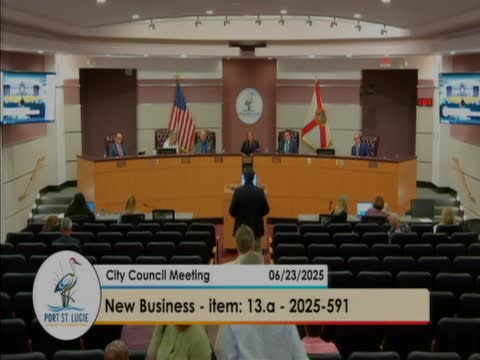
The Port St. Lucie City Council voted 3-1 on June 23 to advance the conceptual design for the Northwest Bayshore Boulevard corridor as a four-lane divided roadway ("Option 1") between Prima Vista Boulevard and Northwest Selvitz Road, citing future traffic capacity and safety. Vice Mayor Carvalho, Councilwoman Pickett and Councilwoman Bono voted in favor; Councilwoman Morgan voted against the measure. Mayor Martin was absent.
Why it matters: City traffic modeling shows the corridor will be near or over capacity in future years without expansion; the four-lane alternative is projected to meet demand through 2050. The decision sets design direction for a 1.2-mile corridor used by residents, delivery vehicles and school buses and could require property acquisitions at key intersections.
Staff and consultants summarized the work. Scalar Consulting and Mackenzie Engineering presented a feasibility study that examined current operations, five years of crash history and future traffic scenarios. The study found high proportions of rear-end collisions consistent with congestion and concluded a four-lane divided corridor would operate acceptably into 2050; a three-lane center-turn/median alternative would begin showing capacity issues by 2040.
Public Works and consultants recommended Option 1, which includes a raised median, 5-foot bike lanes on both sides, 8-foot sidewalks and turning provisions at intersections. The estimated conceptual cost for the four-lane alternatives is approximately $22 million; the three-lane concept was estimated at roughly $18 million. Staff said most corridor improvements can be built within the existing 100-foot right-of-way, but intersection improvements and a proposed roundabout at Floresta could require property takings.
Council comments and district concerns: Councilwoman Morgan, whose district includes the corridor, said many residents who attended an earlier public workshop preferred a 2-lane option to avoid creating a "race track" in front of homes and asked that residents receive the study findings. "I don't recall talking with as many residents that I did, none of them liked the 4 lane," she said, and said delivery trucks, garbage trucks and school buses currently contribute heavily to backup. Morgan said she favored the three-lane option (Option 3).
Councilman Pickett advocated for the four-lane design. "For me, the way I look at it, the 4 lane is the only way to go," he said, arguing the four-lane design better addresses projected traffic growth. Councilman Bonner and other members emphasized the need to plan for long-term capacity and safety.
Right-of-way and property impacts: Staff said property impacts will be concentrated at major intersections and at the planned roundabout at Bayshore and Floresta; they estimated acquisition of three to seven properties could be needed depending on final design and whether a roundabout or signal is selected. Public Works said the earliest construction could begin in 2026 but that property acquisition or design complexity could push work to 2027.
Next steps: The council authorized staff to proceed with preliminary and final design on Option 1, to hold a 60% design public involvement meeting and to continue coordination on right-of-way and traffic-calming features. Staff also said they will work with Councilwoman Morgan on potential additional traffic-calming and beautification measures to preserve a residential character where feasible.