Get Full Government Meeting Transcripts, Videos, & Alerts Forever!
Get email alerts on the Water Quality And Environment topic
No spam. Unsubscribe anytime.
Port St. Lucie opens probe after residents report mass fish deaths following canal spraying
Summary
Residents reported thousands of dead fish and chemical odors after recent herbicide spraying; city staff say early tests show low dissolved oxygen and say they are investigating and coordinating with contractor ABC.
Port St. Lucie officials opened an investigation after residents reported large numbers of dead fish in multiple canals following a herbicide application the week of June 16, 2025. Residents told city council members they found thousands of dead fish, an oily film and strong odors near homes on canals including one residents identified as the "Elk Chem" waterway.
Why it matters: Residents said the waterways are a daily recreational and economic asset for Port St. Lucie and raised concerns about human and pet exposure, municipal fish-restocking investments and the need for city transparency on chemical use and testing.
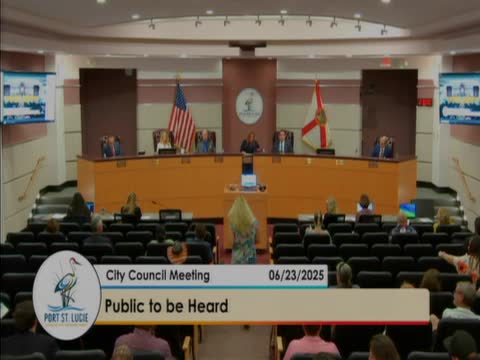
Multiple residents spoke during the council's public comment period. Stephanie White told the council she saw dead fish in a canal behind her house after she said the canal was sprayed with an herbicide on Monday, June 16. "Not sure what it is," she said. "By Thursday, we had thousands of fish dead in the canal behind my home. I came home to a horrendous smell." Marcia Gillings, who said she lives on Whitmore Drive, said she obtained test kits and was sending samples for analysis; she urged the city to inform residents of any findings and to consider aeration and other remediation steps.
City officials said they are investigating. The city manager told the council the matter "will be investigated" and that the city takes the incident seriously. Public Works Director Colt Schwartz said staff were notified on Friday, responded with the contractor and began testing. "Initial test results are dissolved oxygen issues," he said, adding that spraying can worsen low dissolved oxygen conditions during hot, low-flow summer periods and that the city will review the contractor's protocols and notification procedures.
Council members pressed for answers and documentation. Councilman Bonner called the event "unacceptable" and asked for every question submitted by residents to be answered and for the contractor to explain steps it will take going forward. Councilman Pickett asked how long the contractor ABC has been under contract; Public Works said the contractor relationship dates "upwards of two to three decades." The council asked staff to provide the contractor's response and any protocols that were or were not followed.
What the city and staff are doing: Public Works said it is coordinating testing with the contractor, reviewing notification procedures to the public, and evaluating containment or corrective measures for surface films. Staff said they will follow up with the council and residents with findings and that some initial dissolved-oxygen readings point to oxygen depletion as a major factor. The city manager said staff would investigate and take corrective measures where possible.
What residents said they observed and are doing: Residents reported fish deaths beginning two to four days after spraying, visible film on the water surface, bird scavenging and strong odors. One resident said the city had previously paid to restock fish in the canals in March and April. Another resident said she purchased test kits that cost about $2.50 each and planned to send samples for laboratory analysis if the city did not perform testing.
What the city has asked: Council asked staff to supply written answers to questions residents submitted, to report test results, to disclose the chemical(s) used if available, and to coordinate with public health and the contractor to minimize further impacts.
Next steps: Public Works said it will continue testing, work with ABC and report back to council. If additional remediation (for example aeration, temporary containment or restocking) is recommended, staff said they will present options and cost estimates.
Residents and council members emphasized the need for clear, timely communication and accountability during the probe.