Get Full Government Meeting Transcripts, Videos, & Alerts Forever!
Get email alerts on the Tree Regulations topic
No spam. Unsubscribe anytime.
Planning commission begins yearlong update to tree regulations after new state housing law
Summary
City staff outlined a yearlong project to revise Lake Oswego's tree regulations, citing House Bill 2138 requirements for clear-and-objective standards for housing, urban-forest sustainability concerns and a mix of regulatory and nonregulatory tools.
Lake Oswego staff on July 28 launched a multi-step project to update the city's tree regulations, saying changes are needed to align code with state law, industry best practices, and long-term urban-forest sustainability.
Jessica Numanalou, community development director, told the planning commission the project will amend provisions in both the tree code (Lake Oswego Municipal Code Chapter 55) and parts of the Community Development Code (Chapter 50) that relate to tree protection in design districts and sensitive lands.
"One of the reasons why we have to amend it is because we have to assure that we have clear and objective standards for housing," Numanalou said, referencing House Bill 2138, which the city must follow. She said the project aims to preserve mature canopy while improving clarity and consistency across permit types.
What the project will do: Staff summarized recommendations drawn from the city's 2024 Urban and Community Forestry Plan, the 2022 State of the Urban Forest report, and best-practice reviews. Key points discussed include:
- Permit threshold: The current tree code requires a permit to remove any tree 6 inches in diameter or greater. - Mitigation: Replanting is typically required at a 1:1 ratio; under some circumstances staff may require 2:1 replacement. Staff emphasized a policy goal of planting large-stature mitigation trees where feasible, rather than small ornamentals that do not sustain canopy over time. - Canopy and ownership: Staff noted that roughly 53% of the city's landscape is tree canopy and that about 20% of canopy is on city-owned properties while 80% is on private property, making private-property regulation central to canopy management. - Causes of removal: In the last five years, 32% of tree removals were for dead or hazardous trees and 16% were related to development permits; staff said this counters a common perception that development is the primary cause of canopy loss. - Climate resilience: Staff recommended expanding the list of allowed species to include climate-adaptive, drought-tolerant trees alongside native species to improve long-term survivability.
Project structure and outreach: The city has formed a 12-member ad hoc Tree Code Task Force representing arborists, developers, community members and board/commission members. The task force is expected to meet up to six times. The consultant, Cascadia Partners, has completed a code and policy audit and is working on best-practice alternatives; staff said draft code concepts will return to the planning commission in early fall, followed by public outreach, additional board reviews and public hearings in spring.
Staff emphasized a combination of regulatory and nonregulatory actions — education, voluntary programs and increased city stewardship — to complement code changes. The city budget includes funding to recruit an urban forester to help implement the plan and conduct a recommended inventory of trees on city-owned property.
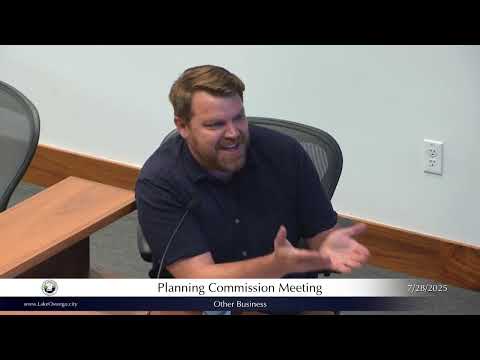
Public concerns: During discussion, at least one resident said private trees can present a hazard and asked whether the city could require or enforce care for dangerous trees on private property. Staff acknowledged the problem and said staff will study how other cities handle hazardous trees when the owner does not act, but said there is not an immediate enforcement policy change.
Next steps: Staff will return in early fall with draft code concepts and a public-outreach plan. The project timeline is approximately one year, with additional stakeholder interviews and a broader community outreach event scheduled before code amendments are drafted for public hearing.