Get Full Government Meeting Transcripts, Videos, & Alerts Forever!
Get email alerts on the Property Taxes topic
No spam. Unsubscribe anytime.
Milton schedules special meeting to decide whether to join Santa Rosa County law‑enforcement MSTU
Summary
Milton city leaders voted unanimously to schedule a Saturday special meeting to consider joining Santa Rosa County’s law‑enforcement municipal service taxing unit (MSTU), a change that would reallocate 2.07 mills of county property tax and affect the city’s community redevelopment area (CRA) revenue and overall city finances.
City Manager Ed Spears told the Milton City Council that Santa Rosa County has assigned 2.07 mills to a law‑enforcement municipal service taxing unit (MSTU) and asked the council whether the city should opt in or remain out.
Spears said the county’s current millage is 5.955 mills; under the change the county would divide that into 3.885 mills to its general fund and 2.07 mills dedicated to the law‑enforcement MSTU. He said municipalities may choose to opt into the MSTU; if Milton remains out city property owners would immediately see a 2.07‑mill reduction on their county tax bill for fiscal year 2026. "The Santa Rosa County law enforcement MSTU was established in 2018," Spears said, and "a millage has now been assigned to it, 2.07 mills." He told council the change would not alter the county’s overall millage this year but would reduce the county portion counted for the city’s three CRAs unless the city opts in.
Spears outlined the tradeoffs and options. If Milton does nothing (remains out), property owners within the city would receive a tax reduction this year equal to the 2.07 mills. If the city opts in, Spears said, the change could not take effect until fiscal year 2027 because the county had already certified taxable values and TRIM (Truth in Millage) notices for fiscal year 2026. He also provided figures for local impacts: he said the projected reduction to the three CRAs would be $52,820 across all CRAs and estimated that for a home assessed at $283,000 the 2.07‑mill change would amount to about $585 in annual savings. Spears also said, "1 mill in revenue ... generates approximately $672,730 in recurring general fund revenue" and gave examples of hypothetical city millage settings that could offset CRA losses while still producing a net tax reduction for city property owners.
Milton Police Chief Frank reviewed the calls‑for‑service data cited by staff and said his review showed the majority of calls inside city limits were for court‑related activity, school‑resource‑officer duties and traffic stops — categories that, he said, are separately funded or mandated. "We do not see it being a negative impact," Chief Frank said when asked whether joining or not joining the MSTU would harm Milton Police Department operations.
Council members debated options at length. Some members said remaining out of the MSTU would produce an immediate tax cut for city property owners and preserve a public message that Milton taxes could be lower than in unincorporated county areas, which they suggested could help attract annexations and business. Others urged caution about making a final decision before the council’s budget workshop and asked for the budget detail to be available at a follow‑up meeting.
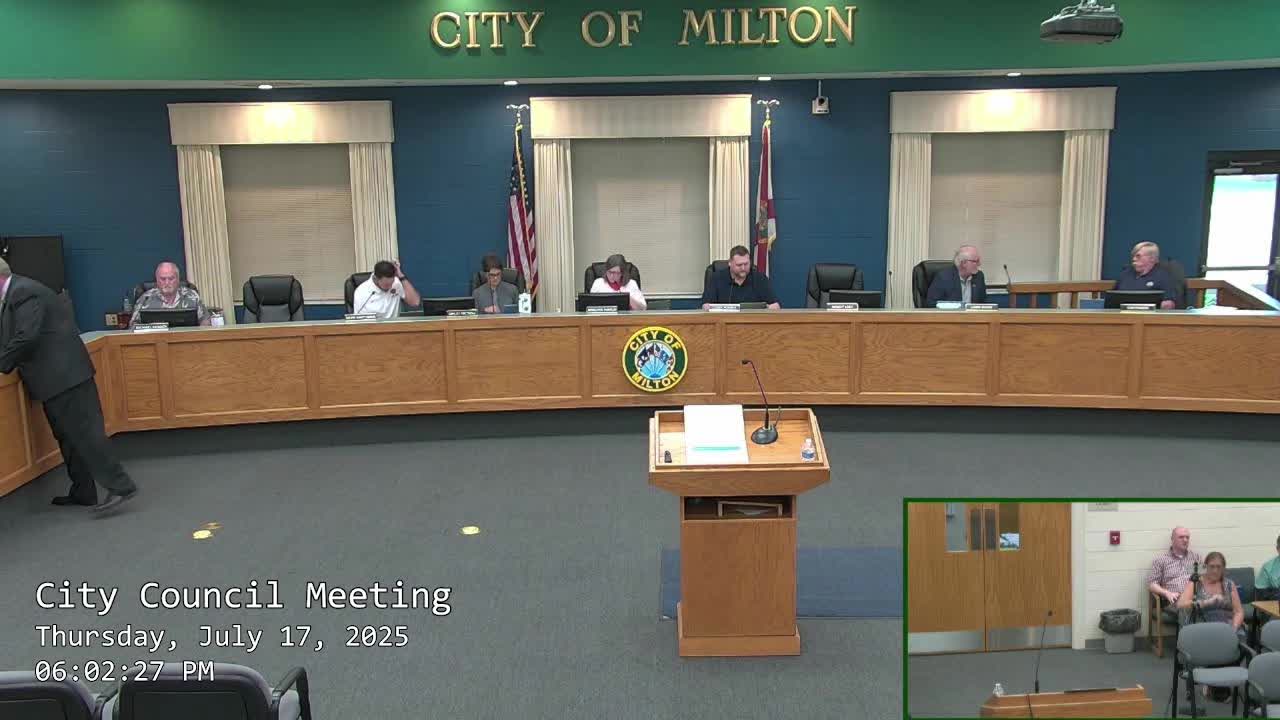
Councilman McKee moved to schedule a special meeting on Saturday following the council’s budget workshop to decide whether to opt into the MSTU; Councilman Powers seconded. The motion was "unanimously approved by all members present," and the council set the Saturday special meeting for further consideration.
Public comment included two speakers who identified themselves as property owners but living outside the city: Pam Mitchell said she favored the city using the moment to advertise lower taxes and potential annexation but urged careful public messaging if the city opted in and then later increased county millage; a second speaker (identified by address) offered a technical clarification distinguishing mills from percent changes.
What the council can and cannot do immediately: Spears noted the TRIM process limits changes to notices already sent and said an opt‑in could not be implemented for FY 2026 because the county had already certified values and millage. He also explained that service categories such as court service and school resource officers are governed by state statute or by separate contracts and that those services would continue regardless of the MSTU decision.
Next steps: the council directed staff to present budget workshop materials and scenario calculations at the budget meeting and reconvene Saturday for the special meeting to consider an opt‑in/opt‑out decision before the statutory July 24 deadline the county set for notifying participation (as described by staff).