Get Full Government Meeting Transcripts, Videos, & Alerts Forever!
Get email alerts on the Governance Boards Commissions topic
No spam. Unsubscribe anytime.
Milton council debates term lengths, term limits and enforcement mechanisms for volunteer boards' code of conduct
Summary
Councilmembers discussed standardizing board structures, whether to set term limits, term lengths (2–4 years debated), residency rules and how to enforce a proposed code of conduct for Milton's volunteer boards; no ordinance was adopted at the work session.
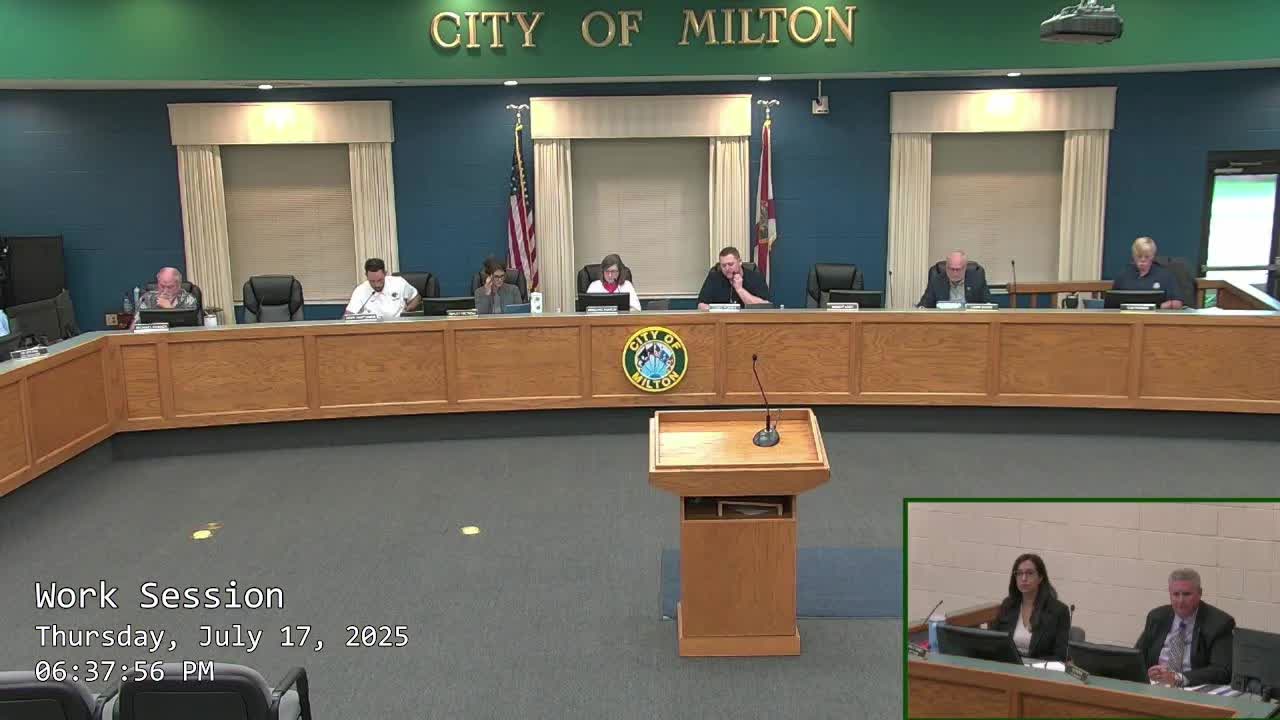
Milton City Council spent a work-session segment on July 15 discussing proposed standardization of board appointment rules and a code of conduct for volunteer board members, including term lengths, term limits, residency, and enforcement.
Councilman Powers introduced the item as his and circulated a draft that would standardize board composition, set term limits and establish a written code of conduct. Council members expressed differing views on term limits and term lengths: several members favored two-year staggered terms to encourage volunteer participation, while others argued for four years to allow members to gain experience. “Two years is good, but I think four years is really good,” a public commenter said, while several councilmembers suggested a possible three-year compromise.
On term limits, opinions diverged. Some councilmembers supported limits (one draft suggested 12 consecutive years maximum), while others said Milton’s small volunteer pool argues against strict term limits. Councilman Powell urged care around enforcement: “How are we going to ensure that that code of conduct is enforced uniformly to all members of every board?” he asked, urging safeguards so the policy is not used politically.
Council members discussed other specifics: whether board members must be city residents or Santa Rosa County residents, whether a board member may serve on more than one board at a time, and whether spouses of council members should be excluded from serving on boards. One council member proposed that board members be required to bring any delinquent city financial obligations current within 30 days of notification.
On enforcement, staff and council proposed a stepped approach: initial action by a board chair or liaison, referral to the council liaison and — if necessary — council action. City staff recommended not placing routine enforcement responsibility on lower-level staff to avoid conflicts of interest.
No ordinance was adopted at the meeting; the council directed staff to continue refining the draft and to bring revised language back for future workshops and formal readings. Council members also asked that the city website show both term start and end dates for board members.
Public commenters who serve or have served on boards urged standardization but cautioned the council to consider volunteer burdens and recruitment challenges. A preservation-board member asked for periodic (every four years) inventory updates of historic properties.
Council members said they would continue edits offline and plan further review at the council’s next workshops; staff indicated any final changes would follow the city’s ordinance-reading process.