Get Full Government Meeting Transcripts, Videos, & Alerts Forever!
Get email alerts on the Housing Policy topic
No spam. Unsubscribe anytime.
Commission weighs fee-in-lieu, transfers outside DDA to meet downtown 'diverse housing' requirement
Summary
East Lansing Planning Commission continued July 22 discussion of potential changes to the downtown "diverse housing" requirement (section 50'94), including a fee-in-lieu option, allowing credits to transfer from outside the DDA, and other incentives. Staff was asked to draft ordinance language and research examples and fee amounts for the next
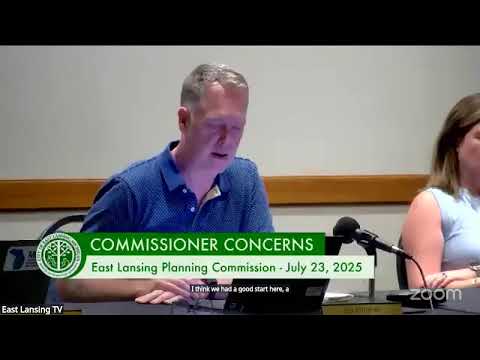
The East Lansing Planning Commission continued discussion July 22 of potential changes to the city's downtown "diverse housing" requirement (Section 50'94 of the zoning ordinance), considering a fee-in-lieu option, allowing transfer of per-unit credits from locations outside the downtown DDA, and other incentives aimed at increasing the feasibility of multifamily development.
Principal Planner Landon Bartley summarized the existing requirement: multifamily projects in the downtown DDA must provide at least 25% of units as "diverse housing" (owner-occupied, senior 55+ or affordable for low- to moderate-income households, or other case-by-case types). A transfer mechanism currently allows projects that exceed the 25% threshold to transfer excess unit credits, one-for-one, to other projects. Bartley said city staff and council have received multiple developer inquiries and that City Manager Bowman's letter asked the commission for guidance on whether to permit fee-in-lieu payments, permit transfers from outside the core DDA, explicitly allow Housing Choice Voucher units to meet the requirement, or require ratios between unit types.
Commissioners and staff reviewed research prepared by a planning intern comparing other cities' approaches (including density bonuses, floor-area-ratio bonuses, and fee-in-lieu programs). Commissioners asked staff to define each incentive type, to gather examples and implementation lessons from other cities (Boulder, Chapel Hill, Columbus, Ann Arbor, Pittsburgh, Toledo and others were cited in discussion), and to recommend fee-in-lieu per-unit amounts. Commissioners noted a wide range of per-unit fees in other jurisdictions discussed in the packet (one item pulled from Columbus proposed $5,000 per unit; other examples cited in the meeting ranged from roughly $35,000 to $150,000 per unit).
Developer representatives urged expedited action. Carrie Freeman, representing a developer interested in the Student Bookstore (SBS) site, said the project timeline requires clarity by early September (Labor Day timeframe) to remain viable. Freeman recommended starting with a simple, short-term ordinance change (she provided a redline modeled on Columbus's ordinance) and expanding options over time. Greg Ball, owner of the Student Bookstore, addressed the commission and said his bookstore has faced long-term decline and that redevelopment is time-sensitive; he described financing constraints and said that, even when state or federal funding exists, funding windows and local project costs can make it impossible to meet current on-site requirements.
Commissioners voiced two broad concerns: (1) ensuring any fee-in-lieu fund is managed and earmarked for creating or supporting affordable/diverse housing (not absorbed into general city revenue), and (2) avoiding displacement of the residents the ordinance seeks to help by placing new affordable units too far from downtown jobs and transportation. Commissioners supported staff drafting ordinance language that would: permit compliance using diverse housing outside the downtown DDA, examine fee-in-lieu mechanics and recommended per-unit amounts, define transfer mechanics, explore inclusion of Housing Choice Voucher units as eligible affordable units, and include evaluation/sunset or periodic review provisions.
Staff summarized requests at the end of the discussion and said planning staff will: prepare draft ordinance language and options, contact planners in comparable jurisdictions for implementation lessons, define the incentive terms in the staff memo, and present findings and draft language to the commission for further review (target: August 13 meeting). No ordinance amendments were introduced or adopted during the July 22 meeting.
Commissioners said they want ordinance drafts shared with related commissions (Housing Commission, Age-Friendly Committee and others) for input before any final recommendation to City Council.