Get Full Government Meeting Transcripts, Videos, & Alerts Forever!
Get email alerts on the Transit Safety Ab394 topic
No spam. Unsubscribe anytime.
Committee hears bill to clarify workplace-violence restraining orders for transit workers
Summary
The Senate Judiciary Committee heard AB 394, which would clarify that enhanced penalties and temporary workplace violence restraining orders (TROs) apply across transit workforces and allow employers and unions to petition, while affirming judicial discretion to tailor orders.
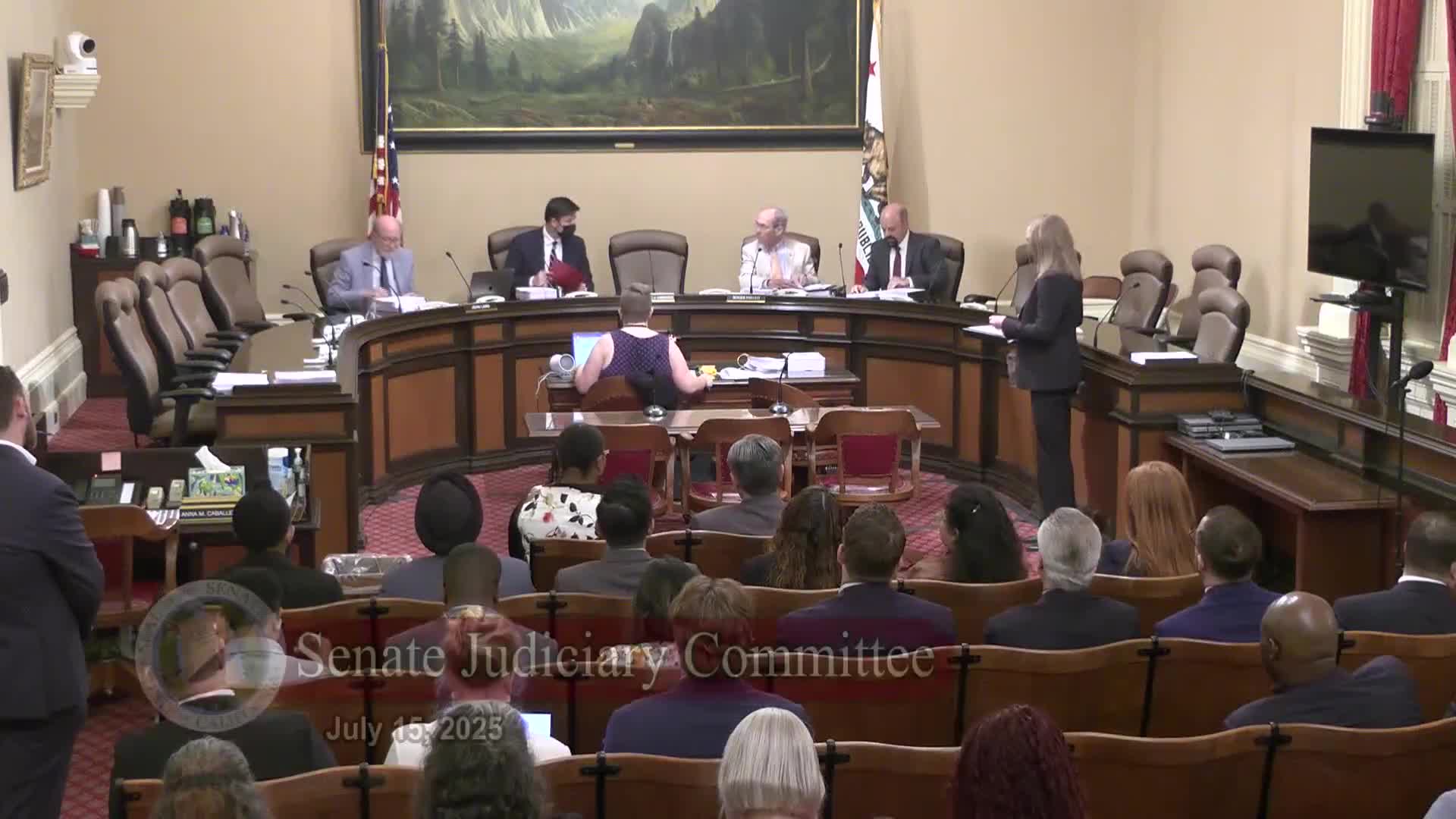
The California State Senate Judiciary Committee heard AB 394, authored by Assemblymember Wilson, a proposal to clarify how temporary workplace violence restraining orders apply to public transit employees and to confirm that enhanced penalties for assault apply to the broader transit workforce.
Supporters told the committee the bill is intended to remove uncertainty about whether current law extends to non-operator transit staff and to preserve a judge's ability to tailor systemwide orders. "What would be unacceptable in any other workplace will also be unacceptable in the transit context," said Matt Bridal, speaking on behalf of the California Conference of the Amalgamated Transit Union and the California Teamsters, which cosponsored the bill.
The bill clarifies that enhanced penalties for battery in the transit setting apply not only to operators but also to "transit ambassadors, ticket agents, mechanics, and more," and it affirms that public transit employers and unions may petition for workplace violence TROs under Penal Code §527.8. "A transit agency's ability to seek a TRO against individuals engaging in violent behavior is an absolutely imperative tool for protecting our employees, the riding public, and the foundational reliability of transit systems across our state," said Bill Churchill, general manager of County Connection, a mid-sized operator in Central Contra Costa County.
Churchill told the committee County Connection had sought and received temporary restraining orders against seven individuals over the past five years for repeated violent behavior on its system. He said that represents "less than 1/100th of a percent of our riding public," yet accounted for more than 80% of significant service disruptions and nearly all violent incidents the agency recorded, and that obtaining TROs had a "profound impact" protecting employees and passengers.
Multiple transit agencies, labor organizations and public-safety groups registered support during the hearing, including the California Transit Association, various county and regional transit districts, county boards of supervisors, the California District Attorneys Association, and several ATU locals.
Committee members asked technical questions about the scope and the committee amendments. The author and sponsors said the committee amendments narrow concerns about overly broad systemwide orders and preserve judicial discretion. The transcript records no formal committee vote on AB 394 during the hearing; the author asked for an "aye" vote and the chair said the bill would be moved if a quorum was present later in the session.
AB 394 remains before the committee; supporters said they will continue technical work with the committee staff and stakeholders.