Get Full Government Meeting Transcripts, Videos, & Alerts Forever!
Get email alerts on the Towing Regulation topic
No spam. Unsubscribe anytime.
Licenses committee shortens nonconsensual towing licenses to one year to speed enforcement
Summary
Milwaukee's Licenses Committee voted to shorten licensure for nonconsensual ("private" or "boot/tow-for-violation") towing businesses from two years to one year, and asked Department of Public Works to flag firms that owe the city so the committee can consider withholding renewal until outstanding pass-through fees are remitted.
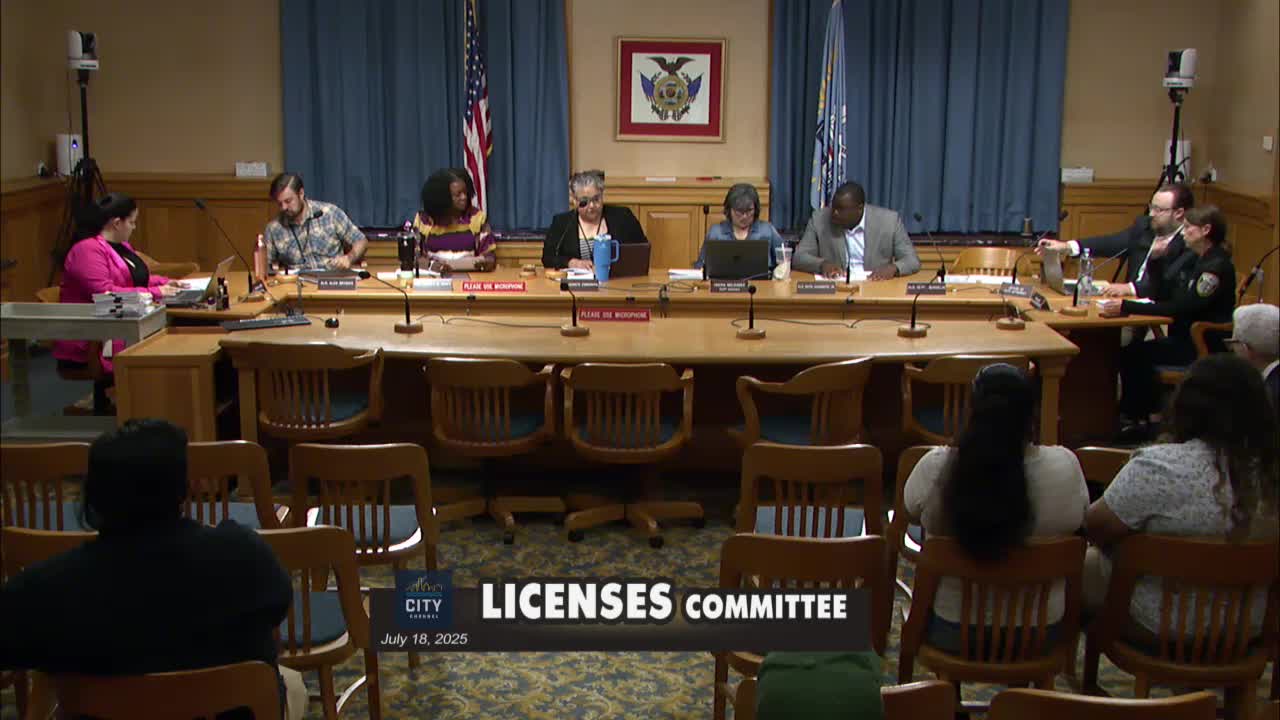
The Licenses Committee of the Milwaukee Common Council on June 27 approved an ordinance (File No. 250536) reducing the license period for businesses that perform nonconsensual tows from two years to one year.
The change aims to give city staff and aldermen a faster opportunity to review tow companies after complaints or unpaid fees accumulate. Jim Bole, director in the Office of Innovation, told the committee that the city has adopted state statutory requirements governing nonconsensual tows and collects a pass-through check fee when companies verify vehicles before towing. "That fee is set right now at the statutory ... maximum, which is $35 per vehicle," Bole said.
The shorter license period is intended to reduce the time between renewal reviews so the Department of Public Works (DPW) and the Licensing Division can act sooner on complaints and unpaid pass-through fees. Bole said the city's year-end report showed several towing firms owing substantial amounts to the city, including single firms in the "about $100,000" range and others around "$60,500," and that the aggregate receivable totaled "upwards to about $400,000" as of that report.
Why it matters: By shortening the renewal window, aldermen said they expect to hold firms more accountable for unpaid fees collected on the city's behalf and to give residents a faster venue for complaints about alleged overcharging or other practices. Jim Cooney, licensing division manager, told the committee that objections to recycling/salvage/towing umbrella licenses come disproportionately from firms that perform nonconsensual tows.
Legal question left open: Committee discussion noted a remaining legal question about whether the city may condition licensure on full payment of outstanding receivables. Alderman Mark Chambers asked whether the committee could refuse renewal until a company has paid the amounts it owes; city attorney counsel Travis Gresham said the question is legally nuanced and may require further legal review. "Conditioning licensure is a little bit fraught," Gresham said, recommending further analysis.
The committee adopted the ordinance by voice vote after Alderman Mark Chambers moved for adoption and there were no objections. The ordinance directs DPW to flag licensees who owe the city and moves the towing license term to one year; it does not itself change the statutory pass-through fee amount.
Votes at a glance: The motion for adoption was moved by Alderman Mark Chambers; the committee approved the ordinance by unanimous voice vote with no roll-call recorded.
What's next: The ordinance will follow the normal municipal process for enactment. Council members and staff said they expect DPW and Licensing to provide lists of firms with outstanding receivables at future renewals and to work with the City Attorney's Office on whether conditional renewal (e.g., requiring payment before issuing a new license) is legally enforceable.
Speaker excerpts (selected): "That fee is set right now at the statutory ... maximum, which is $35 per vehicle," Jim Bole said. "There are firms that owe the city ... upwards to about $400,000," he added.
Ending: Committee members said they support the change as a practical tool to speed accountability, while leaving the legal question about conditioning renewal to further counsel.