Get Full Government Meeting Transcripts, Videos, & Alerts Forever!
Get email alerts on the Workers Bill Of Rights topic
No spam. Unsubscribe anytime.
Olympia council briefs on 'Fair Wages, Fair Schedules' petition; action set for July 22
Summary
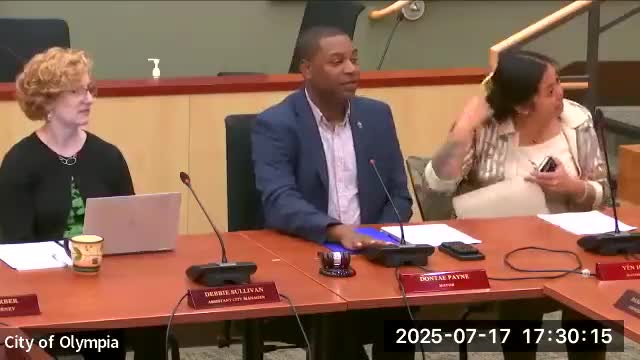
Stacy Ray, assistant city manager, briefed the Olympia City Council on July 17 about a certified citizen initiative titled “Fair Wages, Fair Schedules, a Workers’ Bill of Rights,” explaining petition language and the city’s process; the auditor certified the petition as sufficient on July 14 and the council must act within 20 days, with action scheduled for July 22.
Stacy Ray, assistant city manager, briefed the Olympia City Council on July 17 about a citizen initiative filed under the title “Fair Wages, Fair Schedules, a Workers’ Bill of Rights,” explaining the petition language and the city’s procedural timeline.
The initiative was certified sufficient by the Thurston County auditor on July 14; under state law the council must take action within 20 days. Mayor Payne and councilmembers used the study session to ask staff clarifying questions about coverage, timelines, enforcement and implementation, but the meeting produced no formal action. Councilmembers were reminded that public comment on the measure would be allowed at the July 22 regular meeting and that, if the council forwards the measure to the ballot, public comment on it at future council meetings would be restricted.
Why it matters: The initiative would set local minimum-wage floors and predictive-scheduling requirements for employers of different sizes, specify workplace safety requirements for large employers, create an enforcement structure that includes both city enforcement and private civil actions, and phase in different wage levels for small and medium employers. It could change wage and scheduling rules that affect thousands of workers in Olympia and trigger city rulemaking if enacted.
Certification, timeline and next steps
Ray told the council the Thurston County elections office reported 38,591 registered voters in the City of Olympia at the 2024 general election and that the petition sponsors submitted 13,764 signatures. The county examined 12,118 signatures and verified 5,796 — eight more than the minimum the county calculated would be needed to certify the petition as sufficient. Ray said the county stopped verification once it exceeded the minimum. The council was told the county rejected 6,322 examined signatures for various reasons.
Ray reviewed the city timeline: the auditor certified sufficiency on July 14, the council must act within 20 days, and council action is scheduled for the July 22 regular meeting. She said the council will have two resolutions to consider on July 22: to (1) pass the proposed ordinance without alteration, or (2) send the proposed ordinance without alteration to a vote of the people. If the council chooses the second option, the slides Ray presented showed subsequent dates the county had provided for voters’ pamphlet and ballot deadlines, including an August 4 council action on committee members for the for/against statements, an August 5 submittal deadline for the resolution and committee names, and an August 12 county deadline to submit materials for the voters’ pamphlet.
What the initiative would do (as presented)
Ray read and summarized sections of the certified petition language. Major provisions shown to the council included:
- Definitions and employer tiers: large employers are defined in the petition as employers with more than 500 employees, medium employers as those with more than 15 but not more than 500 employees, and small employers as 15 or fewer employees. The petition text counts employees “regardless of where those employees are employed” and includes franchisees; it also instructs how to treat separate entities for classification when they form an integrated enterprise or are under joint control.
- Predictive scheduling and scheduling penalties: large employers would be required to provide written work schedules at least 14 calendar days before the start of a work period. Employees may decline shifts with less than 14 days’ notice; if an employee consents to such a shift the initiative provides for an “unfair scheduling payment” equal to one hour of pay at the employee’s regular rate for each shift with less than 14 days’ notice. The initiative also creates a pay premium when a shift starts less than 10 hours after the end of a prior shift (an example in the petition shows a half-rate payment of hourly pay for overlapping hours).
- Minimum wage and phase-ins: the petition language presents an initial hourly minimum for “large employers” of $20 per hour on the ordinance effective date, with automatic annual increases tied to a defined regional consumer price index. Medium and small employers would have multi-year phase-in reductions from that rate (medium: initial minus $2, decreasing by $1 each January until parity; small: initial minus $3, decreasing by $0.50 each January until parity), as presented in the petition slides.
- Safety and workplace protections: the petition requires large employers to prepare workplace safety plans, consult with workers on those plans, provide panic buttons for workers in isolated or dangerous areas, conduct at least annual evacuation drills, and maintain safe staffing levels for retail workplaces exceeding 15,000 square feet, as presented in the petition text.
- Enforcement and remedies: the petition text presents both municipal enforcement options and a private right of action. Ray read language stating the city is “authorized to implement and enforce this chapter” and that the city may promulgate regulations. The petition also allows “any person or class of persons” who suffers financial injury or retaliation to bring a civil action and seek remedies including unpaid wages with interest, liquidated damages up to twice unpaid wages, compensatory damages, attorney fees, and a penalty payable to an aggrieved party of $1,000 to $5,000 in retaliation cases. The petition sets a three-year statute of limitations for enforcement actions. Ray said detailed petition language would guide how these enforcement options could operate.
Questions and clarifications councilmembers asked
Councilmembers asked staff to clarify coverage questions the petition language left unspecified, including whether the definition of “hours worked within the city” would apply to employees of employers based outside Olympia who perform work inside city limits, whether the Urban Growth Area (UGA) is included, how franchises and multiple-business ownership would be treated for the employer-size thresholds, how salaried employees are treated, and whether state or tribal governments would be covered. Ray repeatedly said she was limited in her ability to interpret legal questions at the study session but that staff would note the questions and seek follow-up information. Assistant city manager Debbie Sullivan also told councilmembers staff would record and seek answers to the questions raised.
Councilmembers asked about available local data and analysis. Ray said the city has an existing request for qualifications (RFQ) to obtain consultants for economic and implementation analysis and that the RFQ period was still open; she said staff could refine the scope to address council questions but that detailed workforce numbers were unlikely to be available by the July 22 meeting. Councilmember Vanderpool and others asked for a breakdown of how many employers would fall into small, medium and large buckets and demographic and earnings data for low-wage workers; Ray said those are the kinds of questions a consultant scope could cover.
Costs and budget questions
Ray said Thurston County provided a county estimate of approximately $66,800 for the election cost if the council sends the measure to the ballot. Ray also said the county gave a ballpark estimate of about $1,500 to complete verification of the remaining signatures that had not been examined. The city has approximately $150,000 identified from a prior project set-aside that Ray said could be used for consulting and analysis associated with studying the petition’s economic and implementation implications.
No council decision; July 22 meeting will require one
No formal council vote or resolution occurred at the July 17 study session. Ray reminded the council that state law requires action within 20 days of certification; the council is scheduled to act during its July 22 regular meeting. Councilmembers were urged to bring public comment on the petition to the July 22 meeting because, if the council treats the petition as an initiative to be placed on the ballot, opportunities to comment at future council meetings will be limited by the legal status of the initiative.
Ending
Ray closed by reiterating the two formal options that will be in front of council on July 22 — to adopt the proposed ordinance without alteration or to send it to a public vote — and that staff would collect council questions and work to provide additional information before or after the action, consistent with legal constraints. The council recessed into an executive session on potential litigation after the study session concluded.