Get Full Government Meeting Transcripts, Videos, & Alerts Forever!
Get email alerts on the Clean Power Sf Gas Decommissioning topic
No spam. Unsubscribe anytime.
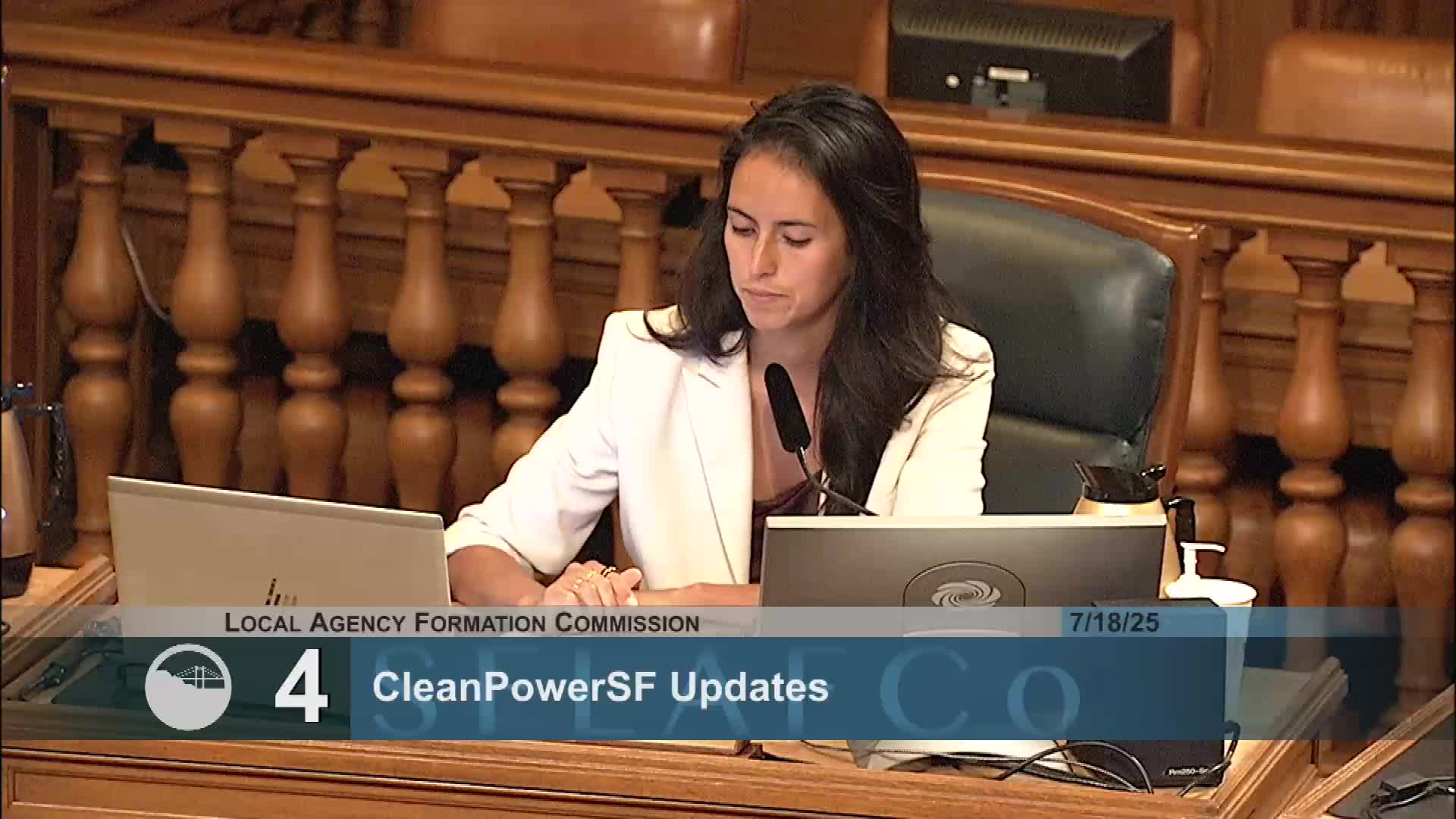
SFPUC updates LAFCO on Clean Power SF planning and gas‑system decommissioning pilots
Summary
San Francisco Public Utilities Commission staff told the Local Agency Formation Commission on July 10 that Clean Power SF is preparing its 2025 Integrated Resources Plan with a new emphasis on affordability and that the city is engaging with CPUC pilots to plan equitable decommissioning of the natural gas system.
San Francisco Public Utilities Commission staff provided the Local Agency Formation Commission an update July 10 on Clean Power SF’s Integrated Resources Plan and on planning to decommission portions of the city’s natural gas system.
Faraz Abousnay Ne, acting resource planning and compliance manager in SFPUC’s Power Enterprise, told commissioners that Clean Power SF adopted a portfolio in 2022 that aims to deliver 100% renewable or greenhouse‑gas‑free energy for at least 90% of hours annually and avoid reliance on system power from 5 p.m. to 9 p.m. He said Clean Power SF has provided 100% clean power or GHG‑free electricity since 2023. “We will focus on balancing these different goals, but we will have a special focus on affordability,” Faraz said, noting that generation and interconnection costs have risen because of inflation, supply‑chain disruption and tariffs.
Kieran Yater, SFPUC staff working on regulatory matters, described the department’s role in planning for gas decommissioning. He said the city’s Climate Action Plan calls for transitioning end uses off fossil fuels and that Senate Bill 12 21 (as referenced in the presentation) will establish up to 30 state pilots to test gas decommissioning approaches. The CPUC released public maps on July 1 identifying foreseeable pipeline replacements over the next 10 years; those maps will help locate priority neighborhood decarbonization zones that the CPUC must establish by Jan. 1, 2026. Kieran said SFPUC has contacted PG&E to express interest in hosting a pilot and that all pilots must be initiated by the end of 2029.
On tenant impacts and equity, commissioners raised concerns about displacement and how multifamily rental housing will be addressed. Commissioner Richard Singh asked how the city is factoring in multifamily rental housing and tenant vulnerability; Kieran said the CPUC’s pilot selection is statutorily required to consider disadvantaged communities using CalEnviroScreen and that SFPUC plans to advocate for pilots in San Francisco. Commissioner Williams asked about outreach to tenant‑advocacy groups; SFPUC said it is coordinating with the Department of the Environment and the city’s Climate Equity Hub and plans stakeholder outreach tied to the IRP schedule.
Faraz described the tentative IRP schedule: the CPUC guidance that drives LSE (load‑serving entity) IRPs was delayed and is expected in August; Clean Power SF is prepared to submit by Dec. 1 if required. He said the plan will refresh assumptions about costs, interconnection and federal policy changes that may alter resource availability.
Kieran listed SFPUC programs intended to support electrification in potential decommissioning zones, including bill credits for heat‑pump water heaters, an electric multifamily program that provides electrification roadmaps for affordable housing, a municipal fuel‑switching pilot and energy‑efficiency upgrades that may add electrification measures. Based on pilot learnings, SFPUC said it will prepare a memo with recommended next steps for 2030 and seek agreements with PG&E for citywide gas decommissioning by 2040.
The presentation closed with commissioners asking about federal policy and tariffs; SFPUC staff said they are tracking federal permitting and tax‑credit changes and are incorporating tariff and supply‑chain impacts into their cost assumptions for the IRP.
Less critical details: SFPUC described national illustrative cost trends and cautioned that California‑specific costs can be higher. The commission did not take formal action on the presentation.