Get Full Government Meeting Transcripts, Videos, & Alerts Forever!
Get email alerts on the Housing Development topic
No spam. Unsubscribe anytime.
Commission approves multiple Bluenest proposals after lengthy public comment; neighbors raise flooding and farmland concerns
Summary
The Miami‑Dade County Commission approved or transmitted several Blue Nest comprehensive-plan and zoning applications for Homestead and nearby Redland areas after extended public comment, but added conditions to address neighbors’ concerns about flooding, traffic and agricultural loss.
The Miami-Dade Board of County Commissioners took action on multiple comprehensive-development and zoning applications involving Blue Nest developments in Homestead and the Redland area after extensive public testimony from residents and workers. The applications addressed a mix of CDMP (Comprehensive Development Master Plan) amendments and companion zoning requests for sites in South Dade and Homestead.
What the commission did: For several Blue Nest items the board voted to adopt or transmit the CDMP and companion zoning requests per staff recommendations, with conditions. Conditions discussed and recorded during the hearing included a requirement for legally sufficient covenants and a conceptual master plan to be filed within a short period (county staff used a 10‑day window as a condition for some items). Commissioners also negotiated design commitments for several projects, including perimeter buffers of single‑family homes around higher-density townhome interiors and required landscaping/sidewalk buffers along project edges.
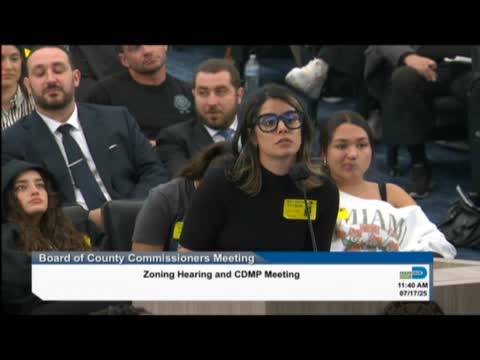
Public comment and concerns: The hearing featured dozens of public speakers. Opponents — many of them longtime Redland residents, growers and nurserymen — urged the commission to protect agricultural land, raised concerns about road capacity, stormwater management and impacts to wetlands and wildlife, and said the area already faces drainage and evacuation challenges. Speakers noted flooding after heavy rains, limited roadway capacity on narrow, two‑lane roads, proximity to Turkey Point and evacuation concerns, and potential loss of agricultural jobs and locally produced food.
Supporters’ remarks: Dozens of speakers, including teachers, police officers, younger workers and advocates for workforce housing, urged approval. They said workforce housing is in short supply, argued that homeownership helps retain local workers and first responders, and called the projects an opportunity for young families and essential workers to live near jobs.
Applicant presentations and staff findings: Applicant teams described project designs, community‑benefit packages and stormwater approaches and said they would work with county staff on required design, environmental and mitigation steps. Staff recommended approval for several of the CDMP/zoning items with the proffered covenants and conceptual plans as conditions. For multiple items, commissioners accepted staff-recommended changes to ensure compatibility and preserve buffers along property edges.
Why it matters: The votes move multiple housing projects forward in areas outside or on the edge of denser corridors; commissioners repeatedly balanced the need for workforce housing against infrastructure and environmental concerns. Several commissioners asked applicants to provide clearer, documented stormwater and traffic-mitigation commitments and to file covenants documenting workforce affordability and design commitments.
Next steps: Applicants were directed to provide legally sufficient covenants, conceptual plans and any required joiners and title opinions within the period set by staff. County departments will review required infrastructure, drainage and environmental mitigation measures through normal permitting and platting steps before site development occurs.
Ending: The hearing highlighted a recurring countywide tension: demand for workforce housing and infrastructure to serve new residents, versus residents’ requests to preserve agricultural land and limit increased traffic and flooding risks. Several projects moved forward with additional conditions intended to address neighbors’ concerns.