Get Full Government Meeting Transcripts, Videos, & Alerts Forever!
Get email alerts on the Zoning Open Space topic
No spam. Unsubscribe anytime.
Commissioners send amended open-space rule for cluster developments to planning commission after heated debate
Summary
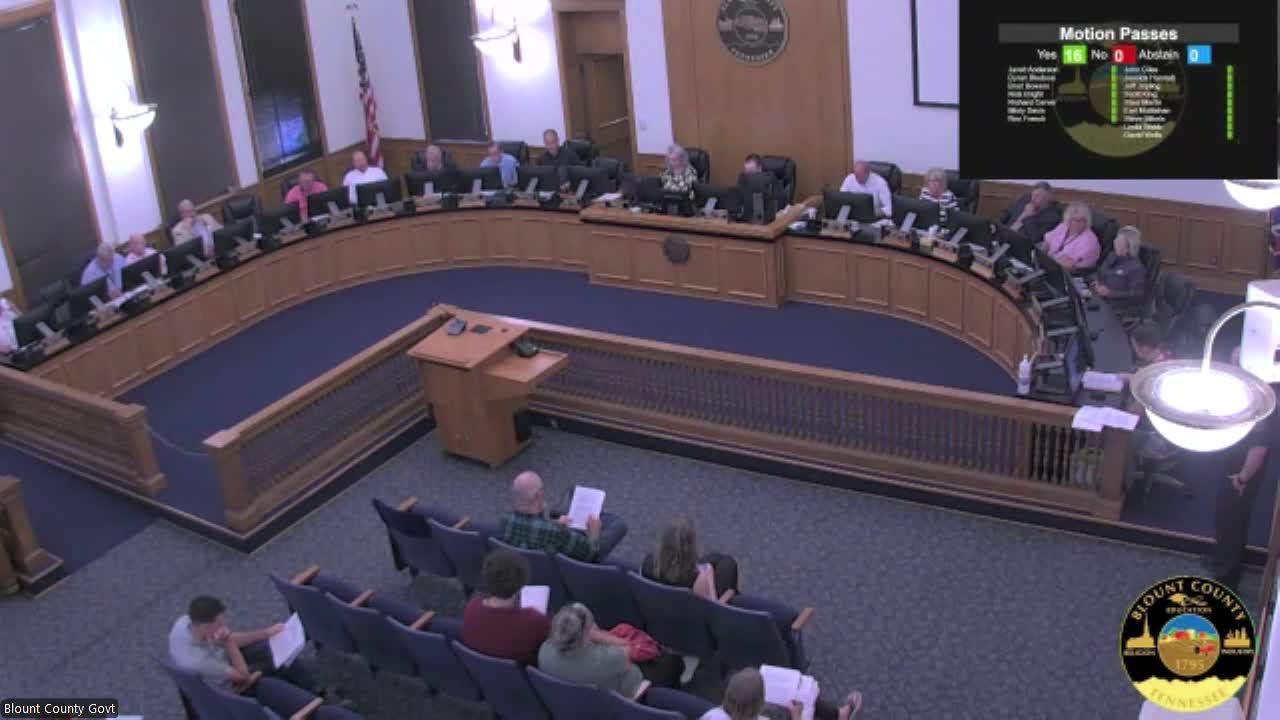
Blount County commissioners on July 17 voted 15–1 to forward a zoning amendment, Resolution 25‑7‑012, as amended, to the county planning commission for review. The amended language would require 35% open space for cluster developments in suburbanizing areas and retain a 40% open‑space requirement in R‑1 and R‑2 zones.
Blount County commissioners on July 17 voted 15–1 to forward a zoning amendment, Resolution 25‑7‑012, as amended, to the county planning commission for review. The amended language would require 35% open space for cluster developments in suburbanizing areas and retain a 40% open‑space requirement in R‑1 and R‑2 zones.
The vote followed more than an hour of public comment and extended debate among commissioners about housing affordability, rural character, and how open‑space rules affect whether cluster developments are built. Supporters of reducing the requirement said a lower percentage would allow more compact, affordable units; opponents said lowering the floor risks more sprawl and environmental harm.
Resolution 25‑7‑012 was introduced by Commissioner Wells and originally proposed changing the county's cluster development open‑space requirement. Wells said he had proposed a one‑third (33.33%) standard earlier in the review process and acknowledged some confusion over the exact figure during debate. Commissioner Giles proposed 35% as a compromise; that proposal was discussed and modified on the floor and ultimately the commission approved the version that applies 35% in suburbanizing areas and retains 40% in R‑1 and R‑2.
Public comment was sharply divided. David Hagan, identifying himself as a District 5 resident, urged commissioners not to reduce open space, warning that "less open space means more runoff, more flooding, and also weakening our open space standards accelerates the suburban sprawl." Joy Nahagian, a Maryville resident, told commissioners she and others participated in the county's comprehensive‑plan workshop and asked them to "uphold the 40% open space requirement to stay true to the comprehensive plan." Several other speakers, including Phil McGill and Austin Penton, urged a reduction (to 30% or similar) as a way to expand housing supply and reduce per‑unit land costs.
Commission debate covered several proposals. Giles moved to amend the resolution to 35% (that motion initially failed to reach the 11‑vote threshold). Commissioner Wells then offered an amendment to set the standard at one‑third (33.33%). Commissioner Bowers proposed and secured an amendment to that amendment to set 35% in suburbanizing areas while maintaining 40% in R‑1 and R‑2; that amendment to the amendment passed 15–1 and was applied to the main motion. The final motion — to forward Resolution 25‑7‑012 as amended to the planning commission for review and approval — passed 15–1.
Commissioners and several public speakers repeatedly noted that any change approved by the commission would return to the planning commission and other review bodies before taking effect. Commissioner Giles cited University of Tennessee research saying design and quality of open space matter as much as quantity; Commissioner Michaels warned that lowering the requirement could stimulate immediate large‑scale development and urged clearer urban growth boundaries and infrastructure planning before change.
The commission did not record individual roll‑call votes for the final 15–1 tallies in the meeting minutes; the transcript records the tallies but does not identify the lone no vote by name. The forwarded amendment must complete the planning commission review and related procedural steps before it could be enacted.
The discussion made clear the county is balancing competing objectives: preserving rural character and habitat, responding to affordability concerns raised by residents and builders, and resolving how regulatory changes would interact with infrastructure and municipal boundaries. The planning commission next will receive the amended resolution for its review and recommendation.