Get Full Government Meeting Transcripts, Videos, & Alerts Forever!
Get email alerts on the Nelson Mandela Prize topic
No spam. Unsubscribe anytime.
U.N. awards Nelson Mandela Prize to Brenda Reynolds and Kennedy Odede; leaders urge renewed action on poverty and inequality
Summary
At an informal plenary marking Nelson Mandela International Day, the U.N. presented the 2025 United Nations Nelson Mandela Prize to Brenda Reynolds and Kennedy Odede. Speakers including Secretary‑General Antonio Guterres and regional delegations emphasized Mandela's legacy and called for renewed global action on poverty and inequity.
The United Nations on Friday marked Nelson Mandela International Day with an informal plenary meeting that included the presentation of the 2025 United Nations Nelson Mandela Prize to Brenda Reynolds of Canada and Kennedy Odede of Kenya and a series of statements by member states urging action on poverty and inequality.
United Nations Secretary‑General Antonio Guterres praised Mandela's example, saying, "Madiba's extraordinary life was a triumph of the human spirit. He endured the brutal weight of oppression and emerged not with a vision of vengeance and division, but of reconciliation, peace, and unity." The prize, conferred every five years, honors two individuals whose work advances U.N. purposes and Mandela's legacy, organizers said.
The ceremony recognized Brenda Reynolds, identified in the meeting as an Indigenous social worker from Fishing Lake First Nation in Canada, and Kennedy Odede, founder and chief executive officer of Shining Hope for Communities (SHOFCO) in Kenya. In accepting the prize, Reynolds described decades of work supporting survivors of Canada's residential school system and the programs she developed to train cultural support workers and provide emotional assistance to survivors and families. "To receive a prize that holds the name of an iconic man who embodied peaceful resistance and reconciliation is a tremendous honor and a solemn responsibility," Reynolds said.
Reynolds told delegates she began working at Gordon's Indian Residential School in Saskatchewan in 1988 and later helped design a pilot resolution health support program to train Indigenous cultural support workers to assist survivors. She said the training emphasized trauma management and cultural healing, that survivors had described severe abuse in residential schools, and that the resulting disclosures fed into the Indian Residential School Settlement Agreement. She also said public and private truth‑telling hearings reached tens of thousands of survivors and that in some cases records from private hearings are no longer available.
Kennedy Odede described growing up in the Kibera informal settlement and the community work that became SHOFCO. "We didn't seek permission from those in power. We exercised the power within us," he said, describing SHOFCO's growth from neighborhood initiatives into a nationwide network providing schools, health centers and water services. Odede told the assembly that SHOFCO has reached millions of people and offered program figures: he said the organization has directly impacted over 4,000,000 people, trained about 1,300,000 youth leaders, treated more than 150,000 children for malnutrition, provided clean water to roughly 40,000 households and extended more than $10,000,000 in microloans.
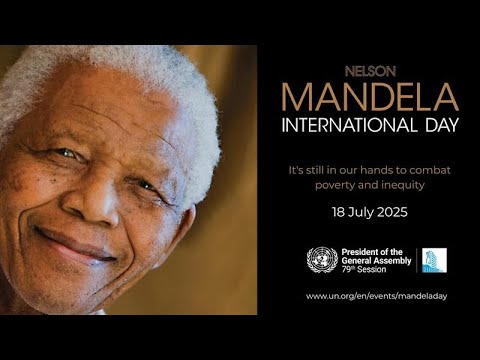
The chair of the Nelson Mandela Foundation, who addressed the meeting, urged delegates to "make good trouble," calling on individuals to use their positions and skills to advance justice and equality. The secretary‑general and other speakers repeatedly linked Mandela's life to the meeting's theme, which the assembly framed as "It is still in our hands to combat poverty and inequality."
Representatives speaking for regional groups echoed the call for solidarity and concrete action. The distinguished representative of The Gambia, speaking for the African group, quoted Mandela: "Overcoming poverty is not a gesture of charity. It is an act of justice," and urged reforms to international finance, debt, and trade policies. Speakers for the Asia‑Pacific, Latin America and the Caribbean, Western Europe and other states, South Africa, Cuba and Burundi reiterated the need for multilateral cooperation, stronger social protection and steps to reduce inequality.
The assembly also noted the 10th anniversary of the Nelson Mandela Rules, the U.N. standard minimum rules for the treatment of prisoners, and participants tied those standards to broader themes of dignity and justice.
The informal meeting concluded with an invitation to a traditional Nelson Mandela International Day public service activity scheduled for later the same day at Governors Island in New York Harbor, and the plenary adjourned.