Get Full Government Meeting Transcripts, Videos, & Alerts Forever!
Get email alerts on the Transportation Utility Fee topic
No spam. Unsubscribe anytime.
Farr West holds public hearing on proposed transportation utility fee to fund roads
Summary
City staff and a consulting engineer presented a study showing multiple fee scenarios; the council took public comment but made no decision. Under one scenario, $3 per equivalent residential unit (ERU) per month would roughly double current road funding; $10 per ERU would generate roughly $1.3 million annually.
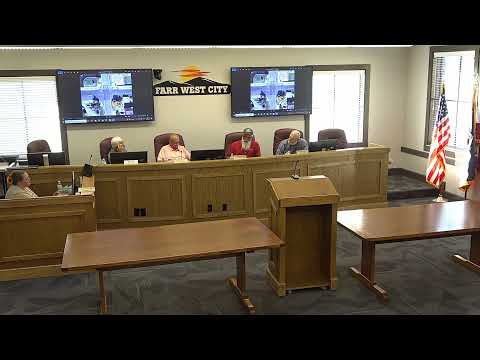
Farr West — Farr West City Council held a public hearing July 17 on a proposed transportation utility fee (TUF) intended to raise new, dedicated revenue for street maintenance and preservation.
The council heard a detailed presentation from Zach Burke of Jones and Associates, the city's consulting engineer, who laid out pavement-condition data, funding gaps and modeled revenue scenarios. Burke told the council that the city’s current street funding — roughly $382,000 a year from Class C and other sources — would not keep pace with wear and increasing road miles and that, “this is not new to the state of Utah.”
The presentation used an equivalent-residential-unit, or ERU, approach to assign fees based on estimated daily trip generation for every parcel in the city. Burke said Farr West totals about 7,796 ERUs under his analysis and that, with no new funding, the citywide remaining service life (RSL) for pavement could fall from its current average (about eight) to roughly 3.9 over 10 years.
Why it matters: city staff and consultants said preservation spending is more cost-effective than delayed reconstruction. Burke presented multiple scenarios showing the long-term effects of monthly fees per ERU: about $3 per month would roughly double the city’s current annual pavement funding; $10 per month would generate roughly $1.3 million a year and produce much higher projected pavement-condition averages over a 10-year horizon.
During the public-comment portion, business representatives and residents asked for more detail about the ERU calculations and how commercial buildings were classified. Tony Merrill and Alan Whitman, representing Associated Foods, asked for the detailed ERU breakdown and for a refreshed shareable copy of the consultant report. Burke said he would provide the file to the city for distribution.
Several residents raised distribution and fairness questions, including whether temporary construction traffic or nonresidents who use Farr West roads would pay. Burke and staff said the TUF is a city-administered, user-based fee; it would be assessed by ERU to properties inside city limits and is distinct from state roads, which were excluded from his inventory. Councilmembers noted that impact fees and permitting can address developer costs for new construction but said the typical TUF structure would not collect fees from temporary construction traffic before occupancy.
The hearing closed without a council vote. Councilmembers asked staff to return with more granular ERU detail, options for graduated or reduced rates for large commercial users and language clarifying permissible uses of TUF revenue. No ordinance or fee schedule was adopted on July 17.
The council indicated it will use public input to refine scenarios and return to the matter for future consideration; no implementation date was scheduled.
Ending — The hearing was explicitly informational: the city solicited comments and questions rather than making a policy decision. Staff pledged to post the consultant’s ERU tables and follow up on technical questions about construction and large-user charges.