Get Full Government Meeting Transcripts, Videos, & Alerts Forever!
Get email alerts on the Transportation Trails topic
No spam. Unsubscribe anytime.
Norwalk council, staff weigh permits and policy to shorten trail closures
Summary
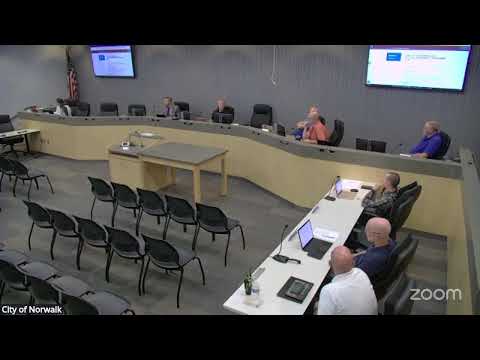
Mayor Phillips opened a dedicated work session July 17 for council and staff to discuss recurring closures of the city’s pedestrian and bicycle trails and possible ways to shorten the time segments are unavailable.
Mayor Phillips opened a dedicated work session July 17 for council and staff to discuss recurring closures of the city’s pedestrian and bicycle trails and possible ways to shorten the time segments are unavailable.
The discussion focused on why trail connections and approaches are often removed for months while subdivision work proceeds, what the city can require of developers, and whether tools should include a permit system, an ordinance with enforceable deadlines, or stronger requirements in site-plan and construction drawings.
Tony, city engineer, told the council that trail connections often require substantial handwork and grading after paving machines complete main street surfacing. That sequence, together with needed utility work and weather delays, can mean the trail cannot simply be poured alongside the street. He said the city could do more at the design and construction-drawing stage to anticipate closures and require temporary replacement surfaces. “When I say temporary, not gravel. No. That I'm a 100% against that. It's too dangerous for trails with cyclists. It needs to be a hard surface pavement, temporary asphalt or concrete,” Tony said.
Wayne, a public-works staff member, said the Iowa Department of Natural Resources (DNR)–approved engineering report for other projects showed the city could build temporary or permanent fixes, and that expanding the construction specifications and testing requirements had already improved replacement quality. He said the city had started interim administrative requirements—notification, subgrade testing, and a 6-inch replacement thickness regardless of prior trail depth—and that developers had complied, though the council and residents had rightly pushed staff for faster timelines.
Several council members cited local examples where trail segments were closed for two to eight months. Council member Brown said some closures had lasted “almost 8 months,” and Council member Poole described observing a runner trip at a gravel-detour site. Council members and staff discussed the trade-offs contractors face: keeping equipment mobilized to remove trail sections incurs added cost, while temporary closures can be safer but last longer.
Mayor Phillips and others urged a combination of tools. The mayor said he had successfully used final-plat holdbacks in the past as leverage to encourage developers to replace trails, but council members wanted staff to draft a more formal option. Staff agreed to draft an approach that could include: - an optional trail-closure permit with required advance coordination and notification; - timeline guidance for short-term closures and a requirement for temporary hard-surface replacement when closures extend; and - stronger site-plan or construction-drawing conditions requiring contractors to prioritize trail restoration or provide safe, engineered detours when necessary.
Council asked staff to draft a permitting/policy option and coordinate with the city attorney, then bring a draft to the Policy & Administration committee for review before returning to full council. Staff noted flexibility would be required in any ordinance to accommodate weather, utility delays or unforeseen on-site changes, but said having clearer, advance requirements and enforcement options would give staff more leverage to shorten closures and protect cyclists and pedestrians.
The work session ended with council generally supportive of staff returning with a draft permit or ordinance and interim administrative improvements; staff emphasized they will continue to use project-specific conditions during construction review and to hold developers accountable in final-plat actions.
Ending
Council did not adopt an ordinance at the July 17 meeting; staff will prepare a draft permitting/policy package and take it to the Policy & Administration committee before presenting it to the full council.