Get Full Government Meeting Transcripts, Videos, & Alerts Forever!
Get email alerts on the Workforce Coordination Sb638 topic
No spam. Unsubscribe anytime.
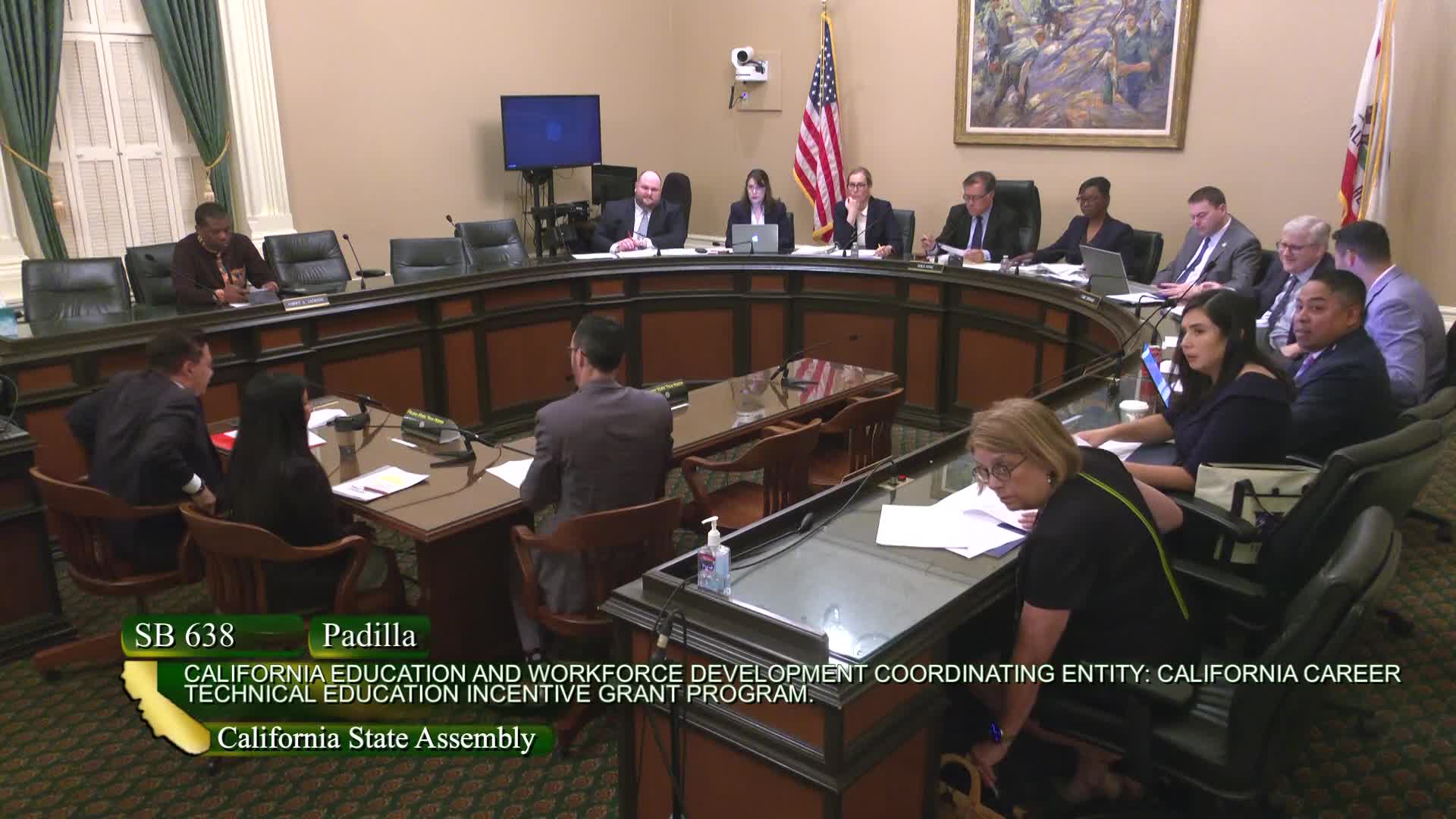
Assembly Higher Education Committee advances SB 638 to Appropriations after debate over new workforce coordinating entity
Summary
The Assembly Higher Education Committee voted to refer SB 638 to the Appropriations Committee after supporters said the bill would create a statewide workforce coordinating entity and opponents warned it duplicates existing agencies and lacks sufficient funding.
The Assembly Higher Education Committee voted to send SB 638, a measure authored by Senator Padilla that would create a statewide workforce-coordination entity, to the Assembly Appropriations Committee following a special hearing and roll call vote. The committee recorded multiple members in favor and several opposed; the chair announced the measure passed and left the roll open for additional 'aye' votes.
SB 638 would establish an entity the bill refers to as the "Bridal Class Pipeline Project" to coordinate education and workforce programs, make regulatory recommendations and administer or align career technical education (CTE) efforts across K–14 and higher education. The bill also proposes modifications to the CareerTechEd incentive grant intended to direct resources to high-unemployment, low-income regions.
Supporters told the committee the bill aims to reduce fragmentation across California's numerous workforce and education programs. Alex Graves, a representative of the Association of Independent California Colleges and Universities, said the state lacks a coordinating body and urged backing for SB 638, noting independent nonprofit colleges contribute substantial numbers of credentials in teaching, nursing and mental health professions. "We recognize the value that a statewide education workforce coordinating entity can provide to the state, to policy makers, to students, families, and employers," Graves said.
Zima Creason, executive director of the California EDGE Coalition, said the proposal would bring together business, labor, education and workforce partners and align investments with measurable outcomes. "This bill's alignment with the cradle to career data system is also critical," she said.
Senator Padilla told the committee SB 638 is part of the Senate Democratic Caucus's affordability package and should be considered as a possible operational—rather than purely advisory—body. Padilla said the governor's January budget proposal included $5,000,000 for a coordinating entity but the May revision reduced that allocation to $1,500,000, and he described further details as subject to tri-party negotiations among legislative leadership and the governor's office. "My personal opinion ... the reason we have it in the bill in this form ... is we think it should be operationalized," Padilla said.
Committee members raised questions about scope, staffing and potential duplication with existing entities, including the California Workforce Development Board, the California Community Colleges Chancellor's Office and local workforce boards. Assemblymember Fong, serving as chair, asked how the entity would staff up with the reduced funding and which functions would be prioritized; Padilla replied that those decisions would be made as part of the broader negotiations and that the bill is intended to put the operational option on the table.
Assemblymember Jeff Gonzales asked when language merging this bill with other related measures would be available; Padilla said leadership expected additional language or agreements in the late summer. Assemblymember Marcucci expressed support for continuing the discussions; he said he had been working on related coordination efforts and would support keeping the measure moving to allow further negotiation.
Assemblymember De Maio strongly opposed advancing the measure at this time, arguing it duplicates existing efforts and lacks sufficient resources. "If this has already been decided by the leaders, then why do we have a hearing? Let's just bring it directly to the floor," De Maio said. He suggested delaying the bill for further deliberation, referring it to an audit or making it a two-year discussion to allow more committee input.
Supporters from outside the Legislature also spoke in favor in the hearing room. Mark McDonald testified on behalf of National University; Orquidea de Breuer Reyes spoke for Long Beach City College; and Danielle Bautista testified on behalf of United Ways of California and allied organizations.
The committee's formal action was to refer SB 638 to the Appropriations Committee. A roll-call sequence recorded the following: Assemblymember Fong — aye; Assemblymember De Maio — no; Assemblymember Berner — aye; Assemblymember Jeff Gonzales — no; Assemblymember Jackson — aye; Assemblymember Marcucci — aye; Assemblymember Aguiar-Curry — aye; Assemblymember Tongipa — no; Celeste Rodriguez — not voting. The chair later recorded Assemblymember Haney adding an "aye" on the item. The chair announced the measure passed to Appropriations and kept the roll open for additional members to add on.
Committee members said they expect additional negotiations and amendments as leadership works toward a tri-party agreement on the entity's form, scope and budget. Padilla and several committee members said the bill's operational details, prioritization of duties and staffing levels remain to be worked out in those negotiations.
The committee adjourned after the roll call; no final enactment or gubernatorial action was taken at the hearing. The bill will next be considered by the Assembly Appropriations Committee.