Get Full Government Meeting Transcripts, Videos, & Alerts Forever!
Get email alerts on the Energy Policy topic
No spam. Unsubscribe anytime.
Assembly Natural Resources Committee advances bill to create power fund, change climate credit timing and streamline permitting; sends measure to appropriations
Summary
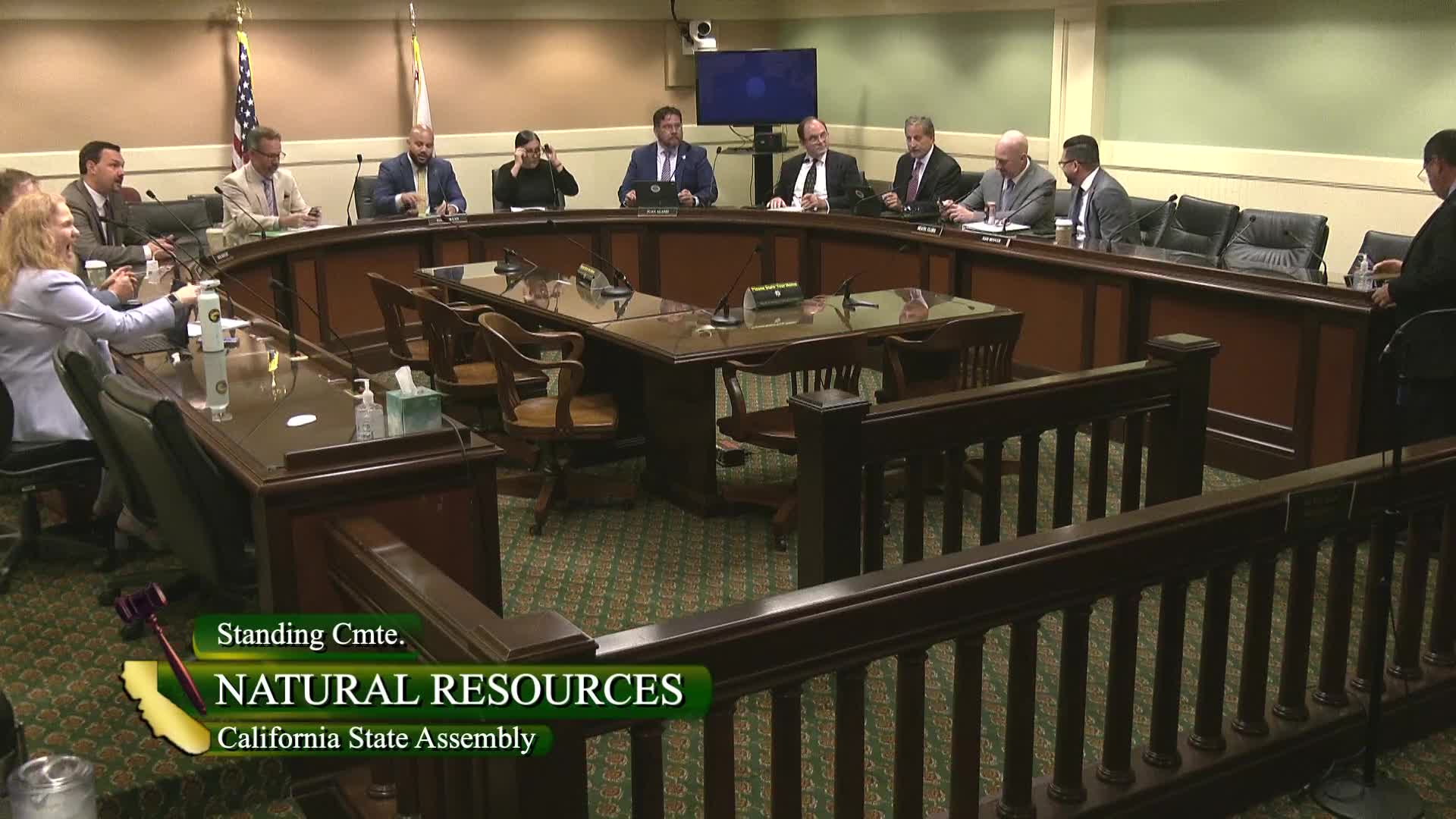
The California State Assembly Committee on Natural Resources voted to give a due‑pass recommendation to a bill by Senator Becker that would establish a power fund, change the climate‑credit distribution and timing from the cap‑and‑trade program, and streamline programmatic environmental review for utility projects.
The California State Assembly Committee on Natural Resources voted to give a due‑pass recommendation to a bill by Senator Becker that would establish a “power fund” to shift certain state policy costs out of utility rates, change how and when climate‑credit payments from the cap‑and‑trade program reach customers, and streamline environmental review for groups of similar utility projects. The committee sent the measure to the Assembly Appropriations Committee with a due‑pass recommendation.
Senator Becker, the bill’s author and presenter, told the committee the bill contains multiple pieces that are intended to balance clean‑energy goals and cost impacts for customers, including changes to rate setting, climate credit timing and wildfire spending oversight. Becker said the measure aims to ensure “we're getting the bang for the buck on our wildfire spending.”
The bill would create a power fund intended to remove some state‑mandated program costs from utility rates and hold money outside of rate base until the Legislature appropriates it. Becker and proponents described the fund as a mechanism to stabilize customer bills by using appropriations to cover certain mandated expenditures rather than leaving all costs in utility rates. Becker said the bill would direct 100 percent of the cap‑and‑trade proceeds received by electric utilities to the customer climate credit (up from 85 percent previously) and change when credits are distributed. He also said the bill would allocate larger credits to low‑income customers.
Supporters who registered at the hearing expressed conditional backing and asked to work with the author on amendments. Trent Smith, representing the California Municipal Utilities Association, said the association was “in support and look[ed] forward to working with the author on future amendments.” Jason Eichard of the California Community Choice Association and Michelle Canales of the Union of Concerned Scientists also registered support. Raquel Mason of the California Environmental Justice Alliance registered in support and requested to be noted for the Leadership Council for Justice and Accountability.
Opponents at the hearing raised affordability and reliability concerns. A witness who identified a commissioned study by the Blue Sky Consulting Group told the committee that “state mandated policy costs are the single largest component of the average residential IOU customers bill. They are 36 and a half percent. It's about $69 of the average $188 bill.” The witness warned that moving costs between rates and the state budget would create instability and “rate whiplash” when appropriations fluctuate.
John Kendrick, testifying for the California Chamber of Commerce, argued the state needs a financially sound utility sector and warned against sustained mandated expenditures that utilities cannot earn a return on. Kendrick told the committee, “a financially sound utility sector is not a luxury. It's essential to a reliable modern grid, and it's essential to California achieving its climate goals.” Other opponents included representatives for Pacific Gas and Electric Company, San Diego Gas & Electric and Southern California Gas Company, the Utility Workers Union of America, the California Business Roundtable, LS Power (via Axiom Advisors) and other industry groups; several said they were “opposed unless amended.”
Committee members focused questions during the hearing on how the power fund would interact with existing wildfire spending, the Greenhouse Gas Reduction Fund (GGRF) and the cap‑and‑trade program; how less frequent wildfire‑mitigation reporting would affect oversight; and whether programmatic environmental impact reports (programmatic EIRs) could provide adequate site‑ and project‑level review. Becker said the bill directs the California Public Utilities Commission to develop programmatic EIRs for sets of similar projects so that project‑level reviews can focus on location‑specific issues rather than redoing broad regional analyses.
Witnesses and members cited several numeric and fiscal details during questioning and testimony: the Blue Sky Consulting Group finding that state policy costs account for about 36.5 percent of the average residential IOU bill (about $69 of an $188 average bill); an opponent’s statement that there are roughly $15,000,000,000 in mandated utility expenditures that utilities cannot earn a return on; reference by the author to roughly $10,000,000,000 per year being spent on wildfire work across investor‑owned utilities; and the bill’s length (about 161 pages as referenced in testimony). Committee dialogue also noted current and prior GGRF appropriations to Cal Fire.
The committee concluded the hearing and took a roll‑call vote to give the bill a due‑pass recommendation to the Assembly Appropriations Committee. The roll call, as recorded in the hearing, showed nine members voting in favor and four members voting against; two members were recorded as not voting. The committee clerk announced the motion was “due passed to appropriations.”
The bill will now go to the Assembly Appropriations Committee for fiscal review and potential amendments. Committee members and stakeholders said they expect ongoing negotiations and technical amendments on wildfire funding, permitting streamlining and the climate‑credit allocation before the measure proceeds further.