Get Full Government Meeting Transcripts, Videos, & Alerts Forever!
Get email alerts on the Charter School Oversight topic
No spam. Unsubscribe anytime.
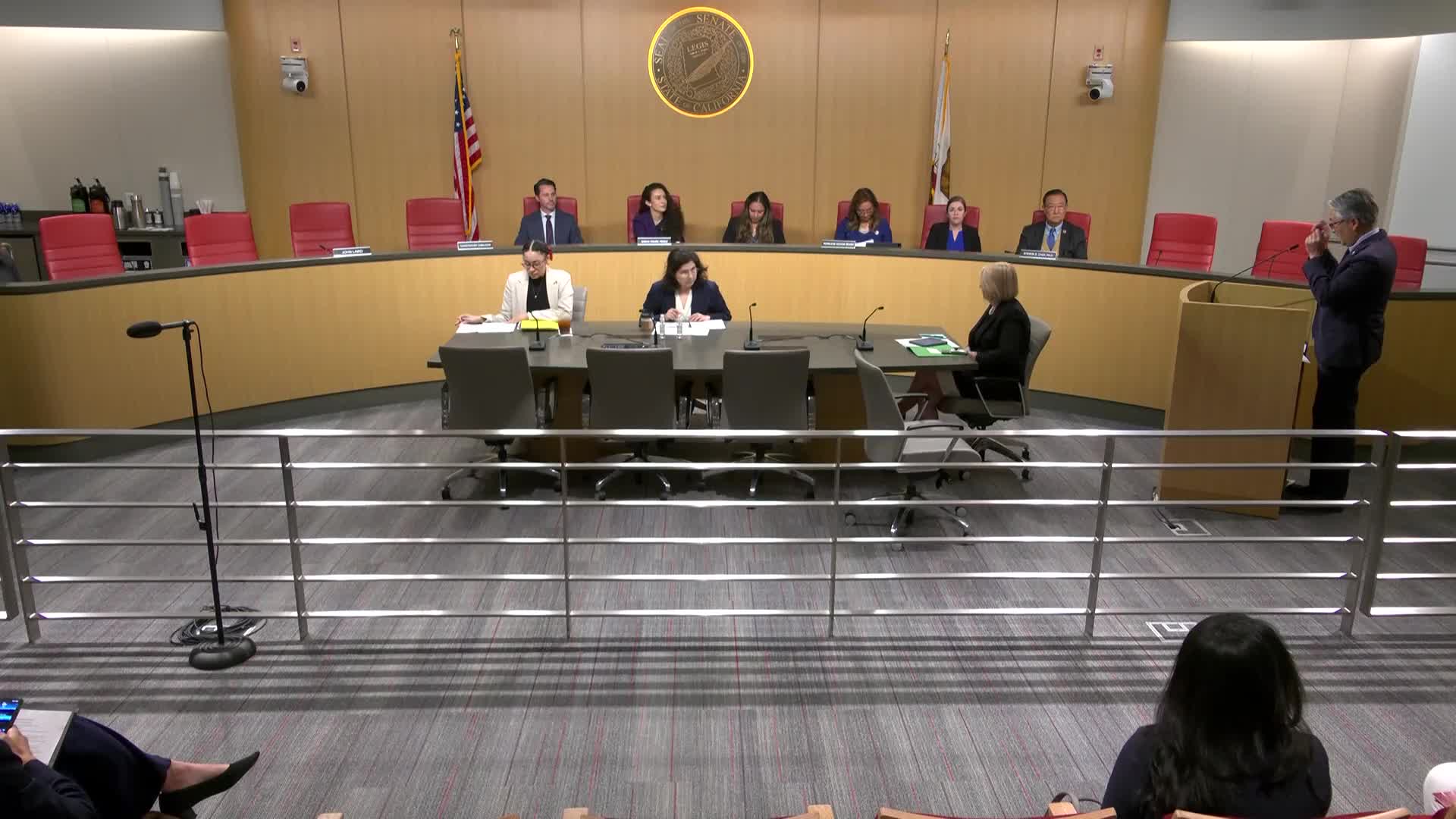
Senate Education Committee advances AB 84 to tighten charter-school audits and oversight
Summary
AB 84, introduced by an Assemblymember, would standardize audits, strengthen authorizer responsibilities and add new safeguards aimed at preventing fraud at non–classroom-based charter schools after recent multi‑million‑dollar scandals.
Assemblymember Marisucci introduced Assembly Bill 84 to the Senate Education Committee, saying the bill "strengthens charter school oversight and accountability" and aims to "crack down on the documented cases of charter schools, especially the non‑classroom based charter schools engaging in fraud and abuse of taxpayer dollars to enrich bad actor charter school operators."
The bill responds to a string of high‑profile cases that the author said revealed systemic weaknesses in oversight. The presentation cited the A3 charter case, in which operators were criminally convicted after prosecutors found schemes that the author described as diverting “over $400,000,000” in public K‑12 funds, and a recent state auditor report finding that Highlands Community Charter Schools wrongfully received “over $180,000,000” in Proposition 98 funds. The author told the committee the bill codifies recommendations from the Legislative Analyst’s Office (LAO), the Fiscal Crisis and Management Assistance Team (FCMAT), and a state controller task force.
Mike Fine, chief executive of FCMAT, told the committee FCMAT and the LAO had jointly researched non‑classroom‑based charters and included themes and recommendations from that work in AB 84. Fine emphasized that audit statutes and procedures were crafted originally for school districts and do not consistently address charter schools; AB 84 would explicitly apply standardized audit requirements to charter schools and strengthen auditor training and oversight.
Supporters including Cassie Mancini of the California School Employees Association said the bill is intended to close enforcement gaps and to hold authorizers accountable for oversight. Mancini and other supporters pointed to the recent audits and the state’s moratorium on some non‑classroom‑based charters as backdrops to the proposal.
Opponents — including leaders and parents from many non‑classroom‑based charter schools — argued AB 84 would create unfunded mandates and regulatory burdens that could harm student services at flexible, home‑school‑based charters. Mary Cox, superintendent of a TK–12 non‑classroom‑based charter in Butte County, said AB 84 would “impose costly unfunded mandates including 10 new audit reports every year” and could force programs such as clinician‑led wellness services to be cut. Several charter school coalition witnesses said the bill, as drafted, effectively limits which small districts can authorize large non‑classroom‑based charters and risks a de‑facto moratorium in most districts.
Negotiations were ongoing: author and committee staff repeatedly described AB 84 as part of a broader negotiation with Senate Bill 414, and several committee members urged further amendments to preserve legitimate flexibility for high‑quality charters while closing fraud loopholes. Senator Laird, among others, said she supported cracking down on fraud but urged that the final package preserve the charter act’s intent to permit innovation and local choice.
The committee voted to pass AB 84 to the Senate Appropriations Committee as amended. The committee action advances the measure while leaving unsettled specific language on vendor‑funded enrichment, the scope of authorizer responsibilities, and SACS accounting submission timing.