Get Full Government Meeting Transcripts, Videos, & Alerts Forever!
Get email alerts on the Municipal Budget topic
No spam. Unsubscribe anytime.
Board of Supervisors adopts two‑year budget package on first reading after sharp debate over reserves and Prop C flexibility
Summary
The San Francisco Board of Supervisors on July 15 voted to adopt the city's two‑year budget and a package of trailing ordinances on first reading, approving reserves and targeted homelessness and housing investments while narrowly authorizing a limited reallocation of Proposition C funds.
The San Francisco Board of Supervisors on July 15 voted to adopt the city's two‑year budget and a set of related ordinances on first reading, approving the administration's revenue and spending plan and several fee and technical ordinances while debating how much flexibility to give the mayor's office to reallocate future homelessness revenues.
The budget package passed on a series of roll calls that left most measures adopted unanimously (11-0) on first reading. Several items were severed for separate votes during the meeting; one contested provision that would have relaxed a voter‑protected spending rule tied to Proposition C was pared back and adopted after a divided vote on a narrower reallocation authority.
Why it matters: Supervisors said the budget responds to an immediate fiscal shortfall — described in the debate as a deficit approaching three quarters to eight hundred million dollars — and attempts to shield core services from projected federal cuts. The package includes reserves and targeted additions for homelessness and housing programs while requiring follow‑up scrutiny for certain reallocations of Proposition C ("Our City, Our Home") funds.
Budget highlights and what the board approved
- Reserve: The budget package puts roughly $400,000,000 in reserve to help the city absorb expected federal funding reductions and to preserve Medicaid, housing subsidies and food programs.
- Homelessness and housing add‑backs negotiated by the budget committee include: an additional $17,300,000 for family rapid rehousing (bringing total family rapid rehousing to nearly $30,000,000 as described at the hearing); $9,500,000 more for transitional‑age youth rapid rehousing (total cited at $19,000,000); $3,000,000 for RV intervention and homelessness prevention; $9,000,000 for medium‑term housing (total cited at $21,000,000); and $3,400,000 for hotel vouchers for transitional‑age youth and adults. These were described repeatedly at the dais as additions negotiated beyond the mayor's original proposal.
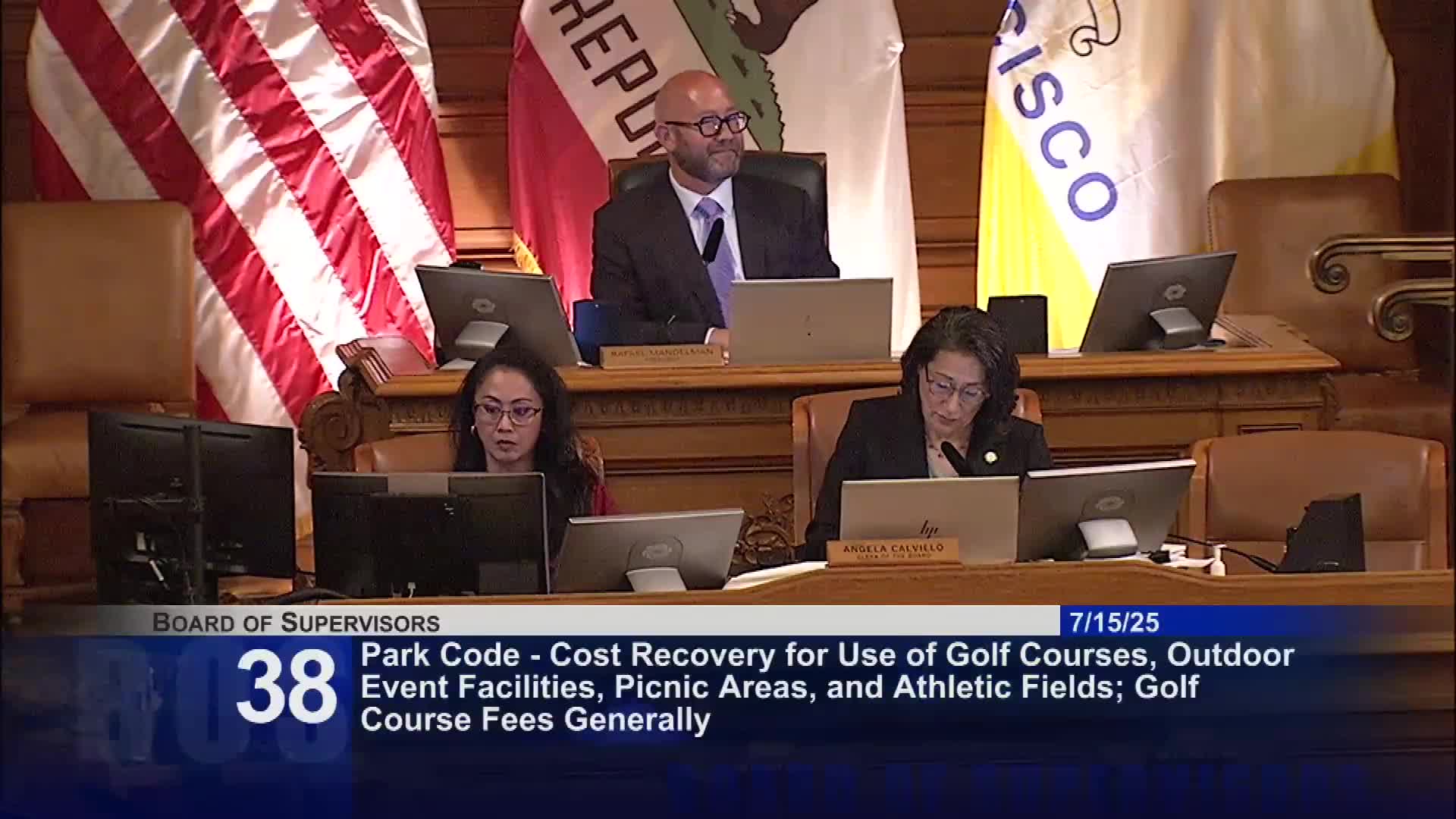
- Grants and fees: The package also carries a set of technical and fee ordinances (park fees, building inspection fees, patient rates, etc.) that the budget chair said are revenue assumptions underpinning the overall plan.
Board debate and key positions
Budget chair Supervisor Chan, chair of the Budget and Appropriations Committee, framed the vote as a hard compromise intended to protect "our most vulnerable communities." Chan said the board's approach aims to "guard against draconian cuts from the [federal] administration" and stressed that the package preserves funding for core services.
"This year's budget required not just solving for our current $800,000,000 deficit," Supervisor Chan said during her remarks, adding that the package "puts $400,000,000 on reserve so that we will be able to continue to provide Medicaid, housing subsidies, and food security."
Supervisor Matt Dorsey, vice chair of the budget committee, emphasized the scale of the fiscal challenge and defended the process that led to the negotiated add‑backs. "We entered this budget season facing a nearly $800,000,000 deficit," Dorsey said, and he described the result as "a responsible foundation" that avoids mass layoffs.
By contrast Supervisor Fielder announced a no vote on the overall package and spoke at length about program cuts he said were "indefensible," spotlighting Muni and immigration legal defense. "The mayor has talked a lot about hard decisions," Fielder said, but criticized what he called preferential treatment for law enforcement funding. "In a deficit year, SFPD and the sheriff's department got a $50,000,000 increase," he said, and added he could not "in good conscience vote in support of this budget."
Supervisor Walton and others said they would support the package because it preserved many essential safety‑net programs even if it did not restore everything advocates sought. "I will be supporting this budget because, at the end of the day, a lot of the services, a lot of the things that I believe in were preserved through this budget process," Walton said.
Proposition C reallocation: divided question and cap
One of the most contested items was an ordinance (item 36) that would allow limited reallocation of Our City, Our Home (Proposition C) revenues and earned interest. The mayor originally sought broader authority to reassign surplus funds in future years by a simple majority vote of the board; opponents argued the ballot measure requires a supermajority for such changes and that voter safeguards should remain in place.
During debate the board adopted an amendment that capped the amount eligible for a simple‑majority reallocation at $19,000,000 (the ordinance text later referred to $19,100,000 in sections) and limited that authority through fiscal year 2026‑27; any larger reallocation would still need the supermajority required by the charter/ballot measure. The divided roll call on the ordinance's section 4 (the reallocation clause) passed 8‑3, with Supervisors Chan, Mandelmann, Melgar, Dorsey, Angardio (Engardio), Mahmoud, Sautter and Sheryl voting yes, and Supervisors Chen, Fielder and Walton voting no. The remainder of the ordinance passed on an 11‑0 vote.
Votes and formal actions (selected items)
- Motion: Adopt budget and trailing legislation (items 8–14, 17–19, 22–30, 32–35, 37–38, as called) — outcome: passed on first reading; roll calls recorded 11 ayes, 0 no. - Motion: Adopt items 7, 16, 20, 21 and 31 (as amended) — outcome: passed on first reading 10 ayes, 1 no (Supervisor Fielder voted no). - Motion: Ordinance amending annual salary /technical adjustments (item 8, as amended) — outcome: adopted on first reading, 11 ayes, 0 no. - Motion: Accept and expend retroactive grant for immigration defense (item 15, $3,400,000 from private foundation to the public defender's immigration unit) — outcome: passed on first reading, 11 ayes, 0 no. Several supervisors noted the grant is philanthropic and not the same as sustained city general‑fund support for immigration legal services. - Motion (divided): Item 36 (Our City, Our Home reallocations) section 4 (reallocation authority up to the cap) — outcome: passed on first reading 8 ayes, 3 no (Supervisors Chen, Fielder, Walton voted no). - Motion (divided): Item 36 remainder (all other provisions) — outcome: passed on first reading 11 ayes, 0 no.
What supervisors asked of departments
Multiple supervisors requested follow‑up reporting and oversight. Chair Chan and others asked the mayor's budget director and departments to provide technical adjustments and a clear accounting of how trailing ordinances feed the budget assumptions. Supervisor Chan asked for continued monitoring of how Proposition C funds would be spent if reallocated under the newly adopted cap. Several supervisors said they would expect regular reports from HSH, the controller and the budget office on implementation of the homelessness and housing commitments.
Context and implementation risks
- Fiscal scale: Speakers on the dais repeatedly cited a near‑term structural challenge described as roughly a $750–$800 million shortfall across the two fiscal years covered by the plan. - Dependencies: Several budget items depend on future revenues, fee changes, or bond issuances documented elsewhere in the packet; the chair emphasized that trailing legislation (fee and revenue ordinances) are part of the budget assumptions. - Political risk and timing: Several supervisors warned that the use and reallocation of voter‑approved funds is politically sensitive. The limited cap adopted for Prop C reallocations is intended to preserve voter protections while giving limited flexibility if unexpected new revenue arrives.
Ending
Supervisors framed the vote as a difficult compromise: supporters said it preserved critical services and created reserves to guard against federal cuts; opponents warned it fell short on certain services and cautioned against granting too much discretion over voter‑mandated funds. Most measures passed on first reading; individual items will return for second‑reading votes and implementation details will be tracked by the budget office, departments and the board in the months ahead.
Votes at a glance (selected budget‑related items and final recorded tallies at the July 15 session)
- Budget and trailing ordinances (major packet items excluding severed items): adopted on first reading (roll calls recorded as unanimous where noted: 11 ayes). - Items 7, 16, 20, 21, 31 (called separately): adopted on first reading 10 ayes, 1 no (Supervisor Fielder). - Item 8 (annual salary ordinance; technical adjustments accepted): adopted on first reading 11 ayes. - Item 15 (retroactive $3.4M grant for immigration defense unit): adopted on first reading 11 ayes. - Item 36 (Prop C reallocations): divided vote on section 4 passed 8‑3; remainder passed 11‑0.
(Second‑reading votes and final implementation schedules will appear on subsequent agenda notices.)