Get Full Government Meeting Transcripts, Videos, & Alerts Forever!
Get email alerts on the Zoning 111 Taylor topic
No spam. Unsubscribe anytime.
Board of Appeals upholds zoning administrator’s Jan. 28 determination for 111 Taylor Street; enforcement review to continue
Summary
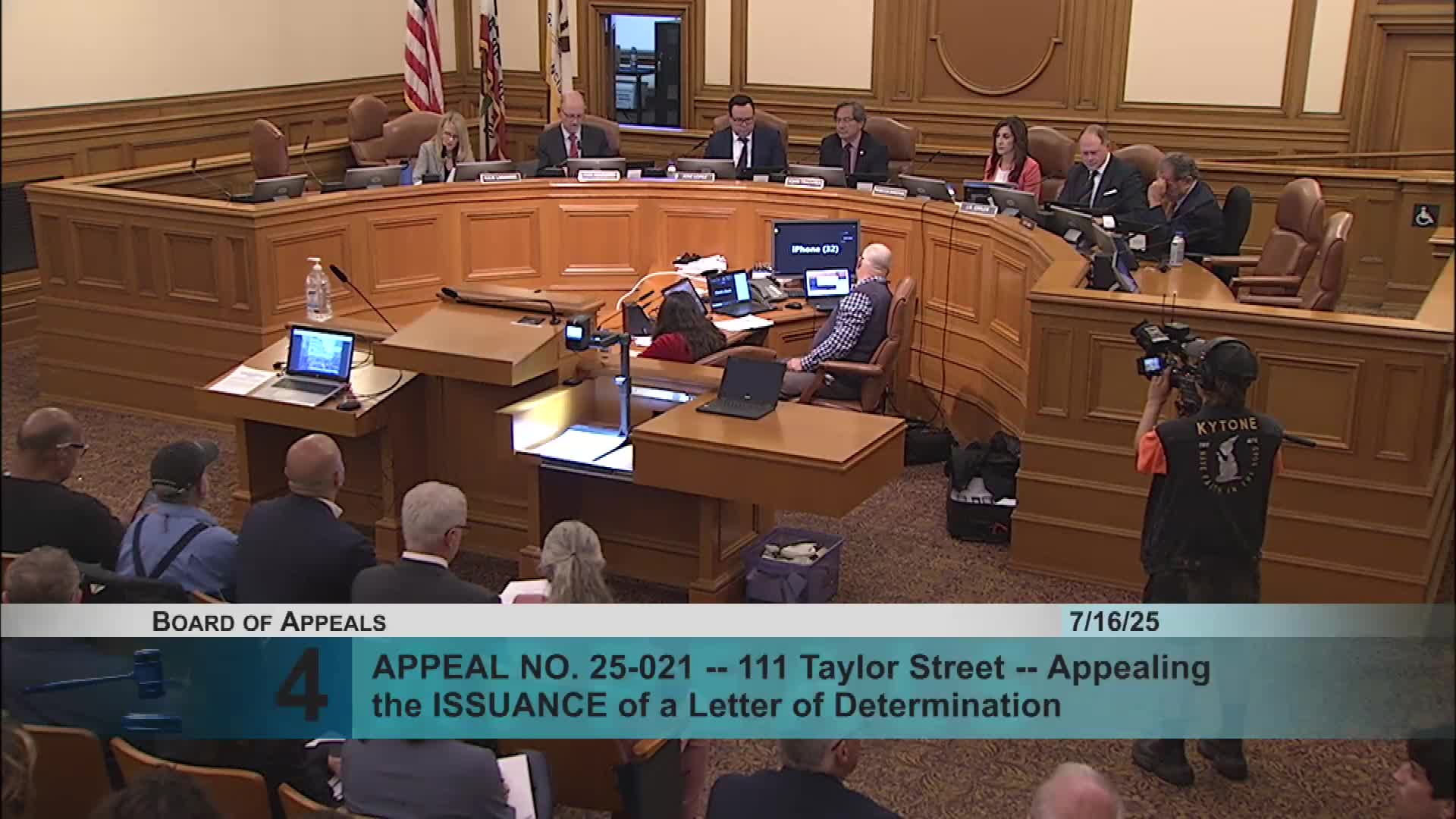
The San Francisco Board of Appeals on July 16 denied an appeal of the Planning Department’s January 28, 2025 letter of determination for 111 Taylor Street, upholding a finding that the property is a legal nonconforming group‑housing use; the vote was 4–1.
The San Francisco Board of Appeals on July 16 denied an appeal of the planning department’s January 28, 2025 letter of determination (LOD) for 111 Taylor Street, the property operated by GEO Reentry Services. The board voted 4–1 to uphold the zoning administrator’s classification of the site as a legal nonconforming group-housing use; Vice President JR Epler cast the lone no vote.
The decision leaves in place the LOD but does not end other city review: the Planning Department has an open enforcement investigation and the Department of Building Inspection (DBI) has received and processed complaints this spring. Commissioners encouraged planning and enforcement staff to continue their inquiries and the public was urged to pursue enforcement avenues in addition to this appeal.
Why it matters: 111 Taylor is in the Tenderloin and part of San Francisco’s Transgender Cultural District and has historic significance tied to the Compton’s Cafeteria Riot. The site is used for federal and state reentry and work-furlough contracts; opponents told the board they view GEO’s operations as carceral and argued the facility has been misclassified for decades. Supporters, including facility staff and some criminal-justice professionals, argued the site provides transitional housing and reentry services that reduce recidivism.
Legal standard and what the board decided
Deputy City Attorney Jesse Minardi told commissioners the board may “uphold, modify or set aside the letter of determination,” but to set aside or modify the LOD it must find “error or abuse of discretion by the zoning administrator.” Minardi summarized the standard applied to the board’s review and explained that letters issued under Planning Code section 307 respond to a narrow request about land‑use classification rather than serving as an enforcement action.
Appellant’s case
Appellant Chandra Laborde, a San Francisco resident, told the board the January 28 LOD mischaracterizes the site’s operation and omits advisory language that earlier LODs had included. Laborde said the facility’s services and security practices — including interior monitoring, urinalysis testing and searches described in job postings and contracts — are “carceral practices, not typical in group housing” and asked the board to “revoke the January 28 letter of the determination” and direct a full planning investigation and a conditional‑use review if operations are changed.
Owner and operator response
Counsel for the property owner, David Blackwell, said the appellant had not shown the required legal error or abuse of discretion. Blackwell noted a continuous administrative record of prior LODs dating to 1989 and said the January 28 determination was consistent with earlier determinations. Facility director Maria Richard told the board Taylor Street Center provides voluntary reentry programming, does not provide on‑site clinical or licensed medical services, and argued that overturning the LOD would disrupt current residents and contracts.
Planning and enforcement
Zoning Administrator Corey Teague told the board the January 28 LOD addressed the narrow legal question of the property’s land‑use classification and that the Planning Department treats operational compliance as an enforcement matter separate from an LOD. Teague reiterated that “group housing” covers a wide range of residential uses and said the LOD could be amended to reference that a change to a residential‑care facility would require conditional‑use authorization — but that such a change itself is a separate regulatory path.
DBI and complaints
Senior building inspector Joseph Ospital reported DBI had received multiple complaints earlier in May 2025; two complaints were consolidated and referred to Planning, an elevator complaint filed on May 2 was closed May 5, and a prior complaint dated October 4, 2022, was closed in October 2022. The Planning Department told the board it has an open enforcement investigation and has performed site visits and requested documents from the operator.
Public comment and community positions
More than a hundred people attended in person and dozens testified via Zoom. Speakers split sharply: many residents, community organizers and Transgender Cultural District leaders urged revocation of the LOD and said GEO Group’s presence is incompatible with the site’s history; other speakers, including criminal‑justice professionals and former residents, described the center’s reentry services and urged that removing the LOD or the operator would harm people who rely on the programs.
Votes at a glance
- Adoption of minutes (July 9, 2025): motion to adopt carried 5–0. (Recorded votes: Commissioner Jose Lopez — Yes; Commissioner Rebecca Saroyan — Yes; Vice President JR Epler — Yes; Commissioner Rick Swig — Yes; President John Trevino — Yes.) - Appeal 25‑021, Chandra Laborde v. Zoning Administrator (111 Taylor Street): motion to deny the appeal and uphold the zoning administrator’s January 28, 2025 LOD carried 4–1. (Recorded votes: Jose Lopez — Yes; President John Trevino — Yes; Rebecca Saroyan — Yes; Rick Swig — Yes; Vice President JR Epler — No.)
What comes next
The board’s ruling upholds the LOD but does not halt the enforcement investigation the Planning Department described. If the enforcement process finds unauthorized changes of use or other violations, the city can issue notices of violation and require abatement or, if appropriate, seek conversion through the conditional‑use process. Community members were advised to continue submitting complaints to DBI, Planning and other oversight agencies and to pursue legislative or policy changes through the Board of Supervisors for broader reforms.
The board provided a written record of the hearing and directed staff to continue coordinating with enforcement units. The appeal is concluded.