Get Full Government Meeting Transcripts, Videos, & Alerts Forever!
Get email alerts on the Commercial Zoning topic
No spam. Unsubscribe anytime.
Planning Commission approves lifting hard storefront-size caps in several neighborhood commercial districts, keeps conditional‑use review
Summary
The Planning Commission voted 5–2 to recommend approval of an ordinance removing historic hard caps on nonresidential use sizes in several neighborhood commercial districts and making it easier to subdivide very large retail storefronts; the ordinance preserves conditional‑use review for new large-format spaces and drew both merchant association*
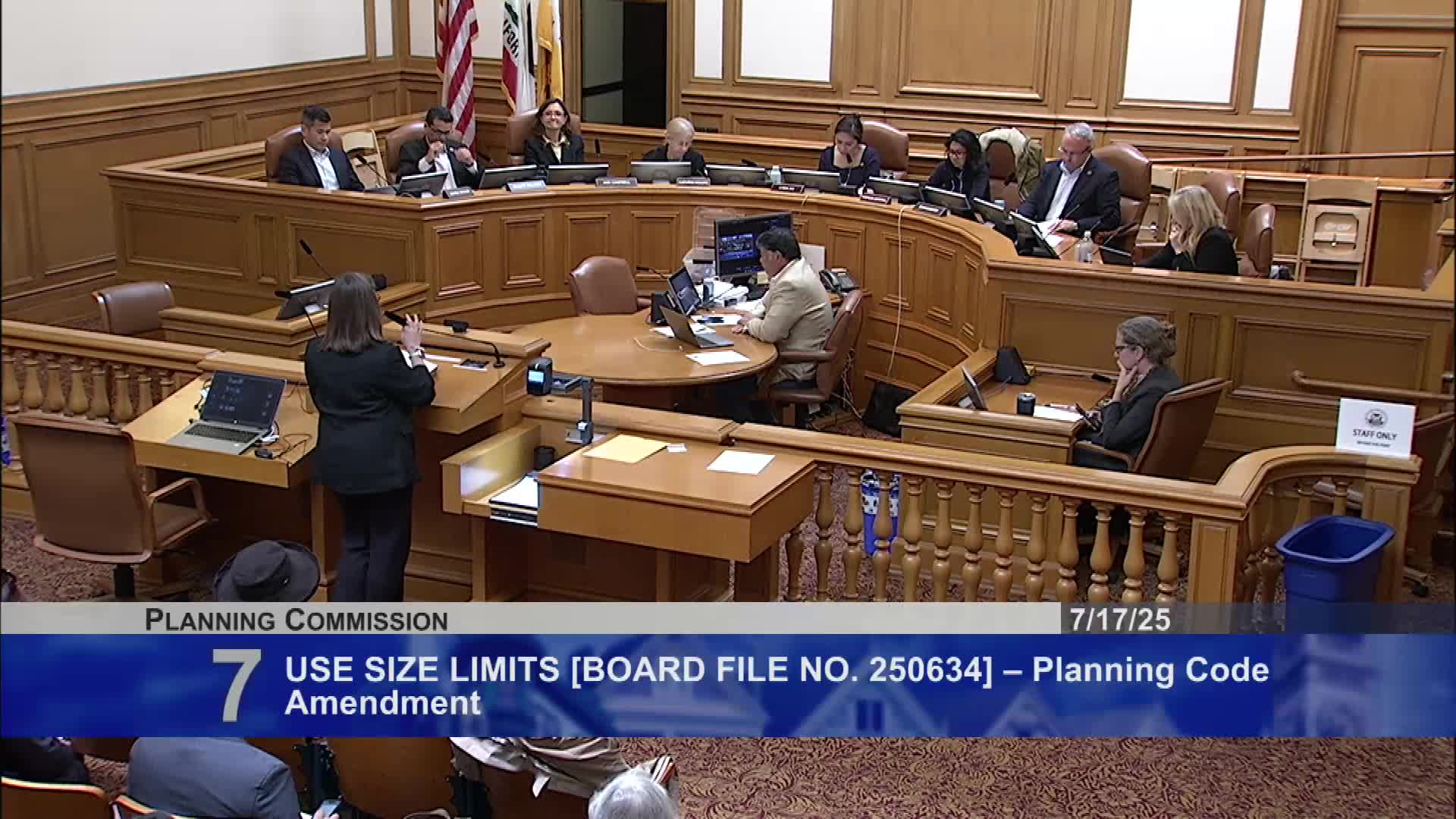
The Planning Commission on July 17 voted 5–2 to recommend approval of an ordinance that would remove hard caps on nonresidential storefront sizes in several neighborhood commercial districts (NCDs) and regional commercial districts and make it easier to subdivide preexisting super‑large storefronts into smaller leasable spaces.
Supervisor Mearna Malgar (transcript spelling) introduced the ordinance and said the measure responds to small businesses that find the city’s historic “hard cap” restrictions prevent reasonable reuse or expansion, forcing one‑off legislative carve‑outs. Planning staff said the amendment grew from prior carve‑out requests (West Portal, Bob’s Donuts on Polk) and argued that removing caps while retaining the conditional‑use (CU) process for proposals that would create or merge large-format spaces gives the commission a case‑by‑case safeguard.
Key provisions summarized by staff (Audrey Marloney and Jen Lowe): - Remove absolute maximum nonresidential use-size caps in named NCDs (Castro, Pacific, Polk, West Portal, North Beach and several RC districts). - Allow owners of legally nonconforming very large spaces (for example, legacy pharmacies) to subdivide into smaller spaces without triggering new CU requirements solely because a subdivided portion would still exceed the prior cap. - Retain CU review for new storefront mergers or newly proposed large-format spaces (generally over ~2,000 sq ft depending on district), preserving community input and discretionary findings.
Public comment and concerns - Merchants’ associations from multiple corridors submitted a same-day letter opposing the change in its current form; speakers representing merchant associations and neighborhood business groups said they had not been adequately consulted and warned that removal of caps could accelerate consolidation and displacement of small independent merchants. - Livable City and others urged changes to use consistent floor-area definitions (occupied floor area vs. gross floor area) and suggested the ordinance include provisions to preserve a mix of small storefronts. - Staff and supporters said the CU process remains a key safeguard and that the ordinance aims to avoid repeated parcel-specific legislation that previously delayed small businesses.
Commission discussion and vote Commissioners debated whether additional outreach to merchant associations was needed. Commissioner Williams moved to continue the matter to allow more outreach; that continuance motion failed 2–5. The commission then adopted the ordinance recommendation with an added finding encouraging Supervisor Melgar’s office to consult merchant associations in the named corridors; the final recommendation passed 5–2 (Williams and Moore opposed).
Why it matters: Planning staff said the measure is intended to provide certainty and speed for small businesses and to reduce the need for parcel‑specific legislation. Opponents said removing hard caps could, without stronger protections, favor larger corporate tenants and reduce the supply of small, affordable retail spaces.
Next steps: The Planning Commission’s recommendation will go to the Board of Supervisors for consideration; staff said they will continue outreach with merchant associations.