Get Full Government Meeting Transcripts, Videos, & Alerts Forever!
Get email alerts on the Land Use Rezoning topic
No spam. Unsubscribe anytime.
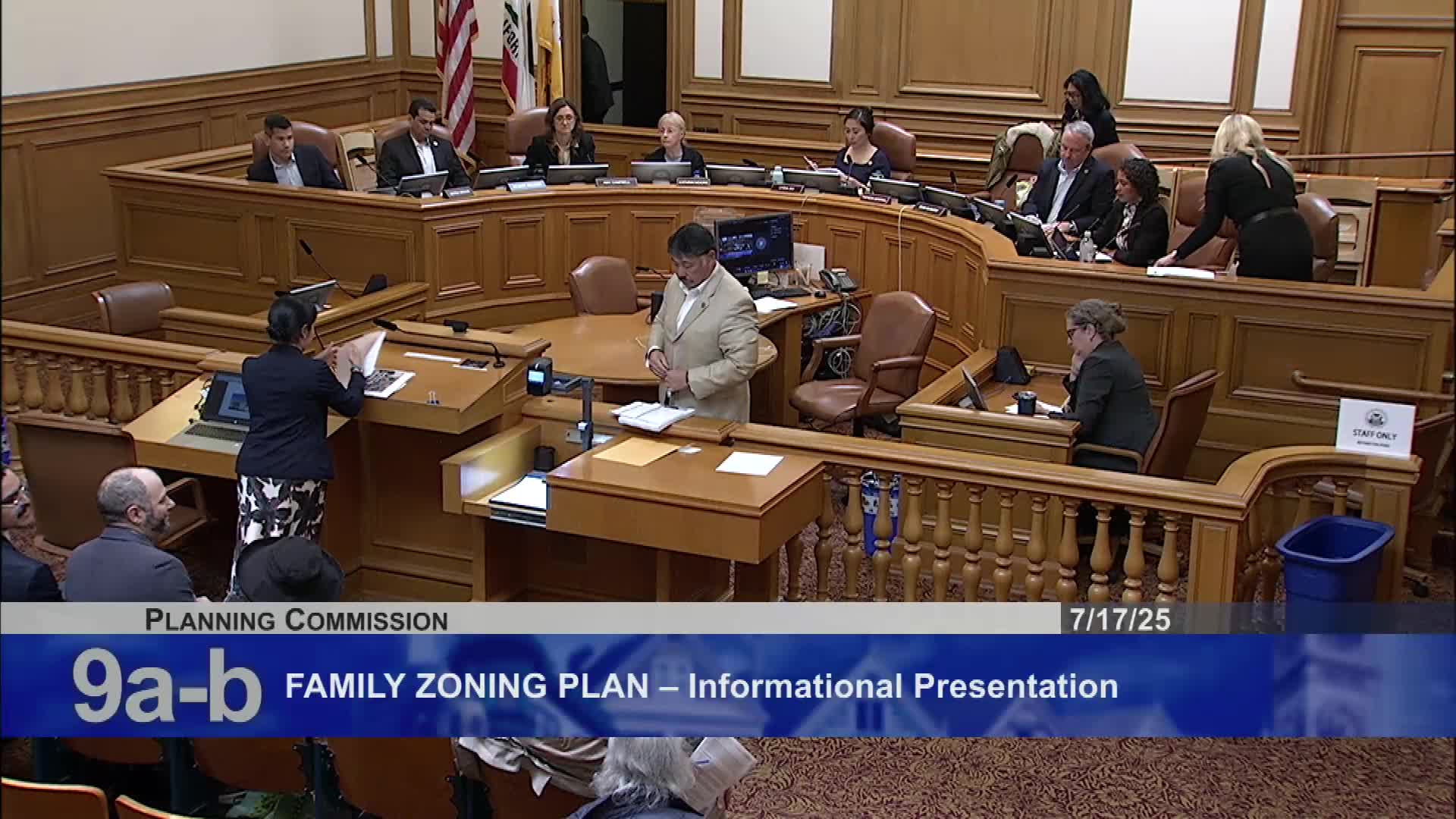
Planning Commission initiates general-plan amendments for Mayor’s family zoning plan amid mixed public reaction
Summary
The San Francisco Planning Commission on July 17 voted 5–2 to initiate general-plan amendments tied to the mayor’s family zoning plan, advancing the package toward a planned Sept. 11 adoption hearing after staff presented site, funding and infrastructure analyses.
The San Francisco Planning Commission on July 17 voted 5–2 to initiate general-plan amendments tied to the mayor’s family zoning plan, advancing the rezoning package toward a September adoption hearing while staff complete technical work and outreach.
The commission’s initiation vote directs staff to bring the proposed general-plan amendments forward for adoption on or after Sept. 11, 2025. Planning staff and the mayor’s Office of Housing and Community Development presented an informational briefing on an affordable-housing sites analysis and related funding and infrastructure work that staff say underpins the rezoning.
Planning Department principal staff described the family zoning plan as a citywide framework to add housing capacity—particularly in areas state law identifies as housing opportunity areas—and to identify “low-income sites” that could be approved ministerially if projects provide at least 20% affordable units on-site. James Pappas of the planning department told commissioners the rezoning’s goals include meeting the city’s Regional Housing Needs Allocation shortfall and aligning zoning with the 2022 Housing Element’s requirements. MOHCD’s Sheila Nicholas said the office is “supportive and eager to get to work” but reiterated that available funding will determine how much affordable housing can be built.
Why it matters: The family zoning plan is the city’s primary strategy to meet state-mandated housing targets and to expand multifamily housing capacity in better-resourced neighborhoods. Planning staff said adopting a locally designed rezoning by the state deadline helps the city avoid a state-imposed “builder’s remedy” zoning default and improves priority for certain state funding streams.
Key details and timeline - The mayor introduced the zoning and implementing ordinances June 24. The package includes a zoning map ordinance (base and local program heights and districts) and a code ordinance that establishes standards and a local incentive program called Housing Choice SF. - The Planning Commission set a hearing to consider adoption on Sept. 11, 2025; that schedule is driven by the 90‑day review window and the state’s Jan. 31 deadline for Housing Element compliance. - Staff said a notice mailer to affected addresses will be sent 30 days before the Sept. 11 adoption hearing; planning staff said proofs are in production and the mail program will start in August.
Affordable-housing sites analysis and pipeline Planning staff and MOHCD presented an “affordable housing sites analysis and strategies” (ASAS) that inventories existing affordable projects in the pipeline and assesses parcel suitability for 100% affordable development. Highlights: - More than 12,600 affordable units across 59 projects are in pre‑construction stages and about 2,300 units are under construction, staff said. An additional 2,500 inclusionary units are tied to market projects in the pipeline. - Staff modelled more than 1,200 standalone parcels larger than roughly 8,000 square feet with capacity for more than 148,000 units; combining smaller parcels could add additional theoretical capacity but site assembly is difficult in practice. - The analysis concluded that land availability is not the single limiting factor; rising construction costs, financing constraints and funding shortfalls are the primary bottlenecks to producing deeply affordable housing.
Emerging strategies staff described included more targeted site acquisition plans, tailored approaches by geography (public land, religious and nonprofit parcels), and options to reduce transaction friction and interim holding costs for acquisitions.
Infrastructure and public facilities Planning staff summarized agency input on water, sewer, power, fire protection and transportation. They said city and regional utilities have long-planned upgrades that are being coordinated with growth assumptions, and that the type of infill housing the plan encourages is incremental and distributed. Key points: - SFPUC projects adequate Hetch Hetchy water supply but emphasized climate risk and the need for continued investments. - Sewer capacity is managed through phased upgrades; major treatment-plant investments are already planned for the southeast and ocean-side plants. - Power distribution and grid upgrades are ongoing; the city and PG&E routinely evaluate localized upgrade needs tied to development. - Transportation agencies are focused on transit-priority corridors and longer-term capacity improvements, including work to increase Muni Metro throughput.
Public comment and concerns More than three dozen members of the public spoke. Supporters called the rezoning a critical step to reverse exclusionary zoning and to expand affordable housing opportunities in neighborhoods that historically lacked multifamily housing. Affordable-housing developers and nonprofit developers submitted letters and several spoke in favor of the plan.
Opponents and residents raised concerns that included possible displacement, demolition of rent‑stabilized housing, insufficient tenant protections and inadequate guarantees of funding for 100% affordable housing. Several merchant associations said they had not been adequately notified and urged stronger small‑business protections such as relocation assistance and right‑of‑return policies; planning staff said they are coordinating with supervisors’ offices and small‑business stakeholders on a package of measures and a proposed funding approach.
Commission action and next steps On a 5–2 vote (Commissioners Williams and Moore opposed), the commission initiated the general-plan amendments that are part of the family zoning package. Staff and the mayor’s office said they will continue stakeholder outreach, finalize an affordable‑housing sites report this fall, and finalize the tenant- and small‑business‑protection ordinance for introduction in September. After the Planning Commission’s Sept. 11 adoption hearing, the package will go to the Board of Supervisors and then to the mayor for signature.
Ending note: Commissioners and staff repeatedly stressed that rezoning alone does not build affordable housing: staff and the mayor’s office said substantial new, sustained funding will be needed to turn the rezoning’s capacity into permanently affordable homes.