Get Full Government Meeting Transcripts, Videos, & Alerts Forever!
Get email alerts on the I 94 East West topic
No spam. Unsubscribe anytime.
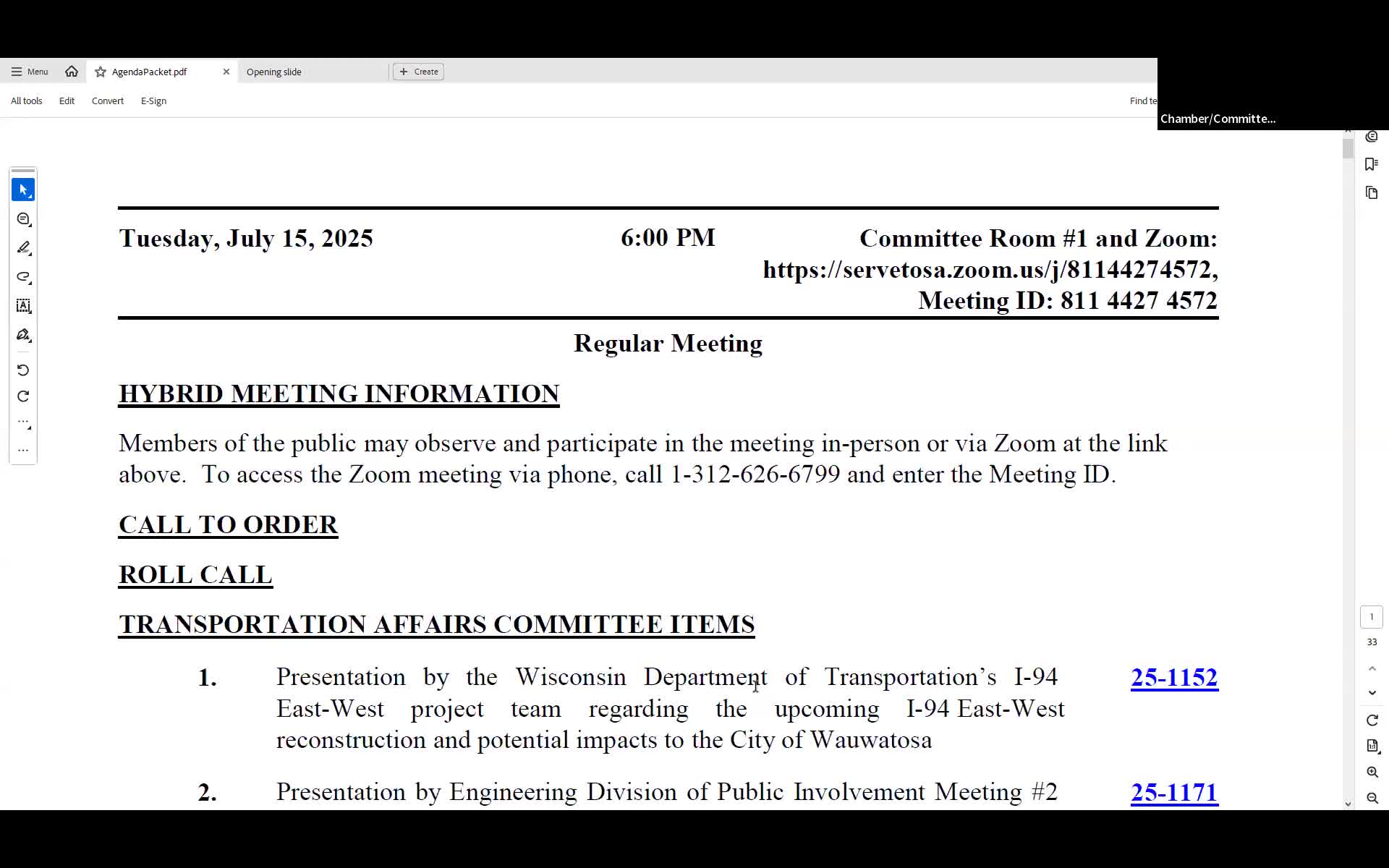
WisDOT project team outlines multi‑year I‑94 East–West reconstruction, warns of lane closures and ramp removals affecting Wauwatosa
Summary
Project presenters said the I‑94 East–West reconstruction will add a lane each way but require multi‑year lane reductions, long‑term closure of Holly Road ramps, extensive utility work through 2028 and targeted mitigation that includes up to $25–30 million for transit.
Jeff Bowen, Southeast Freeways design chief with Westat, and Tim Vick of HNTB told the Wauwatosa committee that reconstruction of the I‑94 East–West corridor will add one travel lane in each direction but will require multi‑year work zones that reduce freeway capacity and change some local access.
The project team described a work program that runs in phases across the corridor, with “early east leg” and “west leg” construction beginning as early as fall of this year and major work continuing into 2027–2028. Tim Vick said the work will reduce I‑94 to two lanes in each direction through the work zone and could add about “3 to 4 miles” of queueing and “an additional 10 to 15 minutes” of travel time for some peak trips.
Why it matters: the corridor reconstruction touches Wauwatosa traffic patterns, local intersections and bicycle/pedestrian connections. Presenters said the project will move exit and entrance ramps to the right where possible, add bicycle and pedestrian facilities including a connection to the Hank Aaron State Trail and Oak Leaf Trail near Wisconsin Avenue, and permanently alter access at some interchanges.
Project changes and local access Jeff Bowen said the project will increase the number of through lanes from three to a minimum of four in each direction, but that engineering constraints require changing some ramps and local connections. The Holly Road interchange will be significantly modified; project staff said it will provide access only to and from the west going forward after reconstruction, and the eastbound on‑ramp and the westbound off‑ramp will be removed because there is not enough room to fit four lanes plus the ramp geometry near the cemetery.
To offset some access loss, the project includes an extension of Washington Street (to be called West Allis Chalmers Way on the West Allis side) to provide alternate east‑west circulation south of the corridor.
Schedule, utilities and uncertainty Presenters said the published schedule is dependent on funding beyond the segments already in the state biennial budget. The team described a construction timeline with substantial work in 2025–2028 and extensive utility relocations by We Energies and ATC that will occur through 2028 and likely beyond. The project team noted the schedule becomes “fuzzier” for later packages and cautioned that dates could change.
Traffic impacts and mitigation Tim Vick said the project team expects longer and earlier traffic delays during peak periods and urged drivers to consider alternate routes and travel times. For Wauwatosa specifically, the team predicted additional diversion to Bluemound Road, Wisconsin Avenue and State Street/Watertown Plank Road, with some traffic possibly reaching North Avenue depending on destinations. The team also recommended encouraging regional detours such as I‑894 and Brown Deer Road/Highway 100 to move east‑west trips off the local street grid.
To manage impacts the Department of Transportation (DOT) and its consultants described a multi‑pronged mitigation program: a traffic management plan, a dedicated public information team, adjusted signal timing and corridor signal upgrades (notably at 70th & Wisconsin and 80th & Wisconsin), school coordination (rapid‑flashing beacons, crossing guards where possible) and a travel‑demand management program working with large employers to promote multimodal trips and carpooling.
Transit mitigation and safety resources Jeff Bowen said the project includes a transit mitigation commitment incorporated into the environmental documentation. "That commitment is part of our environmental document," he said, noting the DOT has set aside funds to maintain and, where needed, increase Milwaukee County Transit System service during construction.
Presenters said the DOT is also committing funds to law enforcement and work‑zone safety: dedicated officers (local, county, or state) and a freeway service team to help motorists who break down in the work zone.
Traffic control and pavement treatments The team said long‑term lane and ramp closures will accompany bridge work at Holly, 70th, 68th and 64th Streets and that some bridge and ramp work could require nighttime or full closures for short periods. During construction, the agency plans to use raised pavement markings between April and November where snow‑plow operations permit, and to widen permanent pavement markings to improve visibility in winter conditions.
Public outreach and next steps The presenters described a project website with signups for updates and committed to continuing coordination with Wauwatosa staff, Milwaukee County, utility owners and local law enforcement. They emphasized that early east‑ and west‑leg work has funding in the current state budget but that later packages are not yet funded.
Key quotes "We anticipate delays on the freeway to be an additional, 3 to 4 miles ... and an additional 10 to 15 minutes ... during rush hour," Tim Vick, HNTB, said during the presentation.
"That commitment is part of our environmental document ... we are still dedicated to up to $30,000,000 as part of the project to overarching transit mitigation," Jeff Bowen, Westat, said when describing transit funds.
What to watch next: project staging and final schedule as funding is secured, the timing and extent of utility relocations, and the signal upgrades on Wisconsin Avenue that the presenters said they would coordinate with city engineering.