Get Full Government Meeting Transcripts, Videos, & Alerts Forever!
Get email alerts on the Climate Action Plan topic
No spam. Unsubscribe anytime.
Milwaukee County outlines Climate Action 2050 plan and adopts sustainable design standards for county facilities
Summary
County sustainability staff presented the newly adopted Climate Action 2050 Plan, outlined implementation steps, and described sustainable design standards that will apply to county capital projects, including tiering, scorecards and an exemption process.
Milwaukee County staff presented the county's Climate Action 2050 Plan and an internal sustainable design standards tool, and described early steps for moving from planning into implementation.
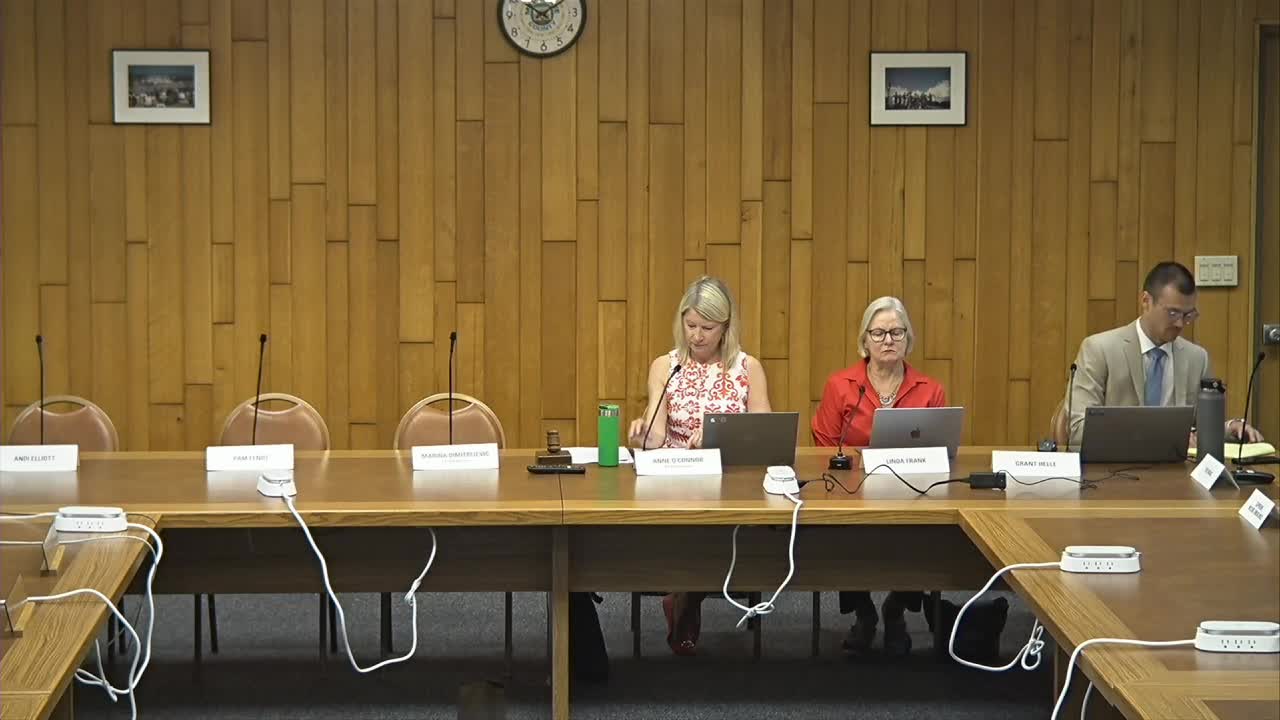
Grant Talley, Director of Sustainability for Milwaukee County, told the City-County Advisory Board on Climate and Economic Equity that the county's Climate Action 2050 Plan—adopted by the County Board in April and signed by County Executive David Crowley—focuses on reducing county operational emissions (Scope 1 and Scope 2) and sets implementation milestones to reach carbon neutrality in county operations by 2050. Talley said the county has achieved roughly a 47—648 percent reduction in operational emissions since the 2005 baseline and that roughly one-third of current emissions come from the vehicle fleet while the other two-thirds are from buildings and facilities.
"This focuses on operational emissions for the county," Talley said, noting the plan does not cover community (Scope 3) emissions. He described four high-level pathways: avoid new emissions, reduce existing emissions, substitute lower-carbon fuels and, for remaining hard-to-abate emissions, compensate with credible offsets. Talley said the county will reconstitute its sustainability task force to support implementation, hire a third-party consultant to build progress-tracking tools, and continue an energy dashboard that is updated quarterly on the Office of Sustainability webpage.
Talley also presented the county's Sustainable Design Standards, a county-only tool issued in March that sets mandatory requirements and best practices for capital projects. The standards use a two-tier project classification: larger new-construction or major-renovation projects above 10,000 square feet or $3 million are Tier 1 (higher requirements), while smaller projects fall into Tier 2. Three focus areas—energy efficiency, emissions and pollution control, and climate resilience and adaptation—carry mandatory requirements. Talley said each project will carry a scorecard to record decisions and any additional costs, and deviations will require an exemption reviewed by the director of sustainability and the director of architecture, engineering and environmental services.
Board members asked how the plan and standards will be reflected in capital budgeting; Talley said project charters for 2026 will indicate whether projects are Tier 1 or Tier 2 and that cost estimates will account for applicable standards. Talley identified the Investing in Justice/Courthouse Complex (IJCC) as a pilot project expected to align with the standards at the highest level.
Talley and the board discussed co-benefits such as local job creation and community well-being; Talley cited a recent American Rescue Plan Act pilot that combined LED facility retrofits with paid youth apprenticeships. He said the county plans annual implementation reviews with department leadership and regular public communication of progress.