Get Full Government Meeting Transcripts, Videos, & Alerts Forever!
Get email alerts on the Council Rules topic
No spam. Unsubscribe anytime.
Council task group proposes clearer remote‑attendance, timeline and public‑comment rules; vote set for July 28
Summary
A council task group reviewed revisions to the council’s internal rules, proposing clearer language on remote attendance, agenda deadlines and public comment time limits. Council members reached tentative agreement on raising the allowed number of remote attendances and asked staff to produce a formal draft for a July 28 vote.
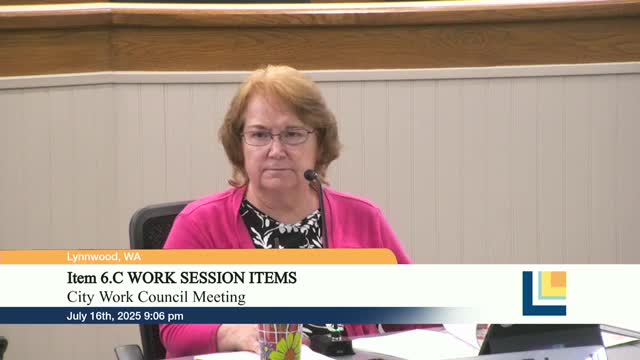
Lynnwood council members on a rules task group presented proposed revisions Wednesday to the council’s internal rules, focusing on remote attendance, meeting‑timing expectations, the presiding officer’s role and the public‑comment process. The council agreed to return with a written draft and a proposed council vote on July 28.
Task group lead Council Member Benda introduced the review and said the updates were intended to clarify existing practice and resolve recurring ambiguities. “These are the rules that we write and we agreed to live by,” Benda said, describing the effort as a housekeeping and policy clarification exercise.
Major proposals and outcomes
- Remote attendance and caps: Task‑group members proposed removing overly strict or ambiguous language about remote attendance and instead set a clear, higher cap on allowed remote meetings per year. After discussion the council signaled support for a limit higher than the current rule; the group agreed to present revised language that reflects a limit of nine remote meetings per councilmember per year (subject to final drafting). Members said individual waivers or council majority exceptions remain available for exceptional circumstances. - Timeline for requested agenda items: The task group recommended a requirement that if a council‑requested agenda item cannot be scheduled within 45 days, the council president will notify the council in writing explaining the circumstances and arrange that the item be scheduled at the next regular work session. Council members debated whether the requirement should specify the “next scheduled work session” or the “next available work session;” the draft will be reworded to reduce ambiguity. - Public comment and hearings: The task group proposed a new structure to discourage lengthy single‑speaker filibusters while preserving public access. Council members discussed an approach used informally during the meeting — an initial, shorter speaking round to give more people time, then an optional second turn for those who want to return. The group asked staff to draft a rule that limits each public‑hearing speaker to a short initial time (for example five minutes) per rotation, with the presiding officer empowered to open a second rotation as needed. - Presiding‑officer language and other clarifications: Council members asked staff to clarify grammar and technical phrasing where the rules use “presiding officer” so the document unambiguously ties points of order and related authorities to the mayor (or the mayor pro tem when presiding). The task group also standardized the reference to the council assistant/legislative aide job title. - Agenda deadlines: The task group proposed clarifying operational deadlines so council members submit packet materials to the legislative aide by noon on the Wednesday prior to a meeting; staff reported a 5 p.m. staff deadline for material the aide forwards to the city clerk for packet publication.
Discussion and next steps
Council members debated whether to eliminate or relax the remote‑attendance cap entirely. Some members argued for trust and flexibility; others said a formal guardrail and public transparency were still appropriate. The group settled on returning a formal, word‑for‑word proposal that will reflect the council’s direction (including the nine‑meeting limit) and asked the clerk to circulate a polished draft in advance of the July 28 meeting for a vote.
Ending
Council members set a conditional schedule for final action: the rules task group will circulate a revised draft with the edits discussed and a vote was targeted for the July 28 council meeting. The group said further topics (for example, the formal council appointment process) would be handled separately.