Get Full Government Meeting Transcripts, Videos, & Alerts Forever!
Get email alerts on the Concrete Batch Plant topic
No spam. Unsubscribe anytime.
Sunnyvale planning commission backs one-time temporary concrete batch plant for Homestead Phase 7 with conditions
Summary
The Sunnyvale Planning and Zoning Commission voted to recommend approval of a planned development (PD) amendment allowing a one-time temporary concrete batch plant on Lot 4 of Homestead Phase 7, with a 25-calendar-day limit and a one-time five-day weather extension; staff had recommended denial.
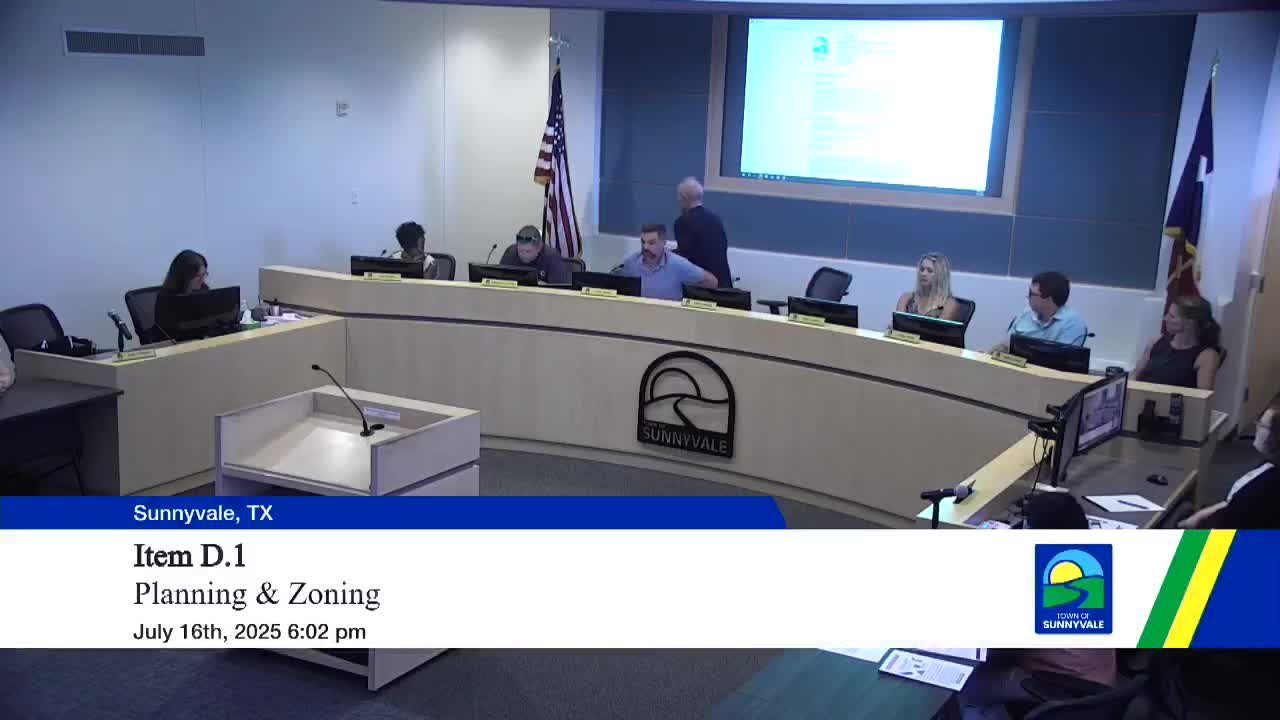
The Sunnyvale Planning and Zoning Commission recommended approval on July 16 of a planned development amendment to allow a one-time temporary concrete batch plant on Lot 4 of Homestead Phase 7 to support construction of internal streets.
Sarupa Pazen, Sunnyvale director of planning and development, told the commission the amendment seeks to permit a temporary, single-use batch plant on the southeast corner of Towne East Boulevard and New Hope Road to produce concrete for the subdivision’s roadways. She said staff’s formal recommendation in the staff report was denial but described conditions staff would require if the commission and then Town Council approved the use.
The recommended conditions include a maximum of 25 calendar days of operation, a one-time five-day extension for weather delays (30 calendar days total maximum), a building permit with a time-limited permit term, an updated stormwater pollution prevention plan (SWPPP) and compliance with Texas Commission on Environmental Quality (TCEQ) batch-plant regulations and the town’s construction operating hours in Code of Ordinances chapter 4.01003.
Jim Douglas of Douglas Properties, the applicant, told commissioners he had no objection to the conditions staff proposed. Brian Caudle of Chris Harp Construction (CHC paving) described operational controls: “The control is approximately 99.9% retention for particle sizes 2.5 microns and less,” he said, and said aggregates would be washed before arrival, stockpiles sprayed, haul routes watered and a lined washout pit used to contain concrete waste. Caudle said the developer would file a site-specific SWPPP and a separate notice of intent with TCEQ.
Commissioners and speakers discussed trade-offs between a short-term nearby batch plant and repeated ready-mix truck deliveries on public roads. Caudle said his estimate for the site-produced approach was about 256 truck trips to the site versus roughly 519 ready-mix deliveries if trucks made on-road deliveries. He told the commission the company expects to complete street pours in about 10 working days using the on-site plant and that the 25-calendar-day permit would include mobilization and dismantling time.
Several nearby residents and the Homestead HOA voiced support. Chris Thomas, vice president of the Homestead HOA board, said the board of roughly 446 homes voted unanimously to prefer the temporary plant over the increased heavy-truck traffic on Towne East Boulevard. Kimberly Hawkins, who lives on Towne East Boulevard adjacent to the subdivision, said dust was her main concern but that the applicant’s controls addressed many of her questions.
Sarupa Pazen said staff had mailed 11 notices within 200 feet of the subject property (the notice area covered the whole phase because final platting is not complete) and had received two written responses, both included in the staff packet.
After discussion, a commissioner moved to recommend approval “as presented tonight, including all the conditions that the city has put on this amendment”; a second was given by “Commissioner Josh” (last name not specified in the record). The commission recorded the vote as 6–0 with 1 abstention. The commission’s action is a recommendation to Town Council; the amendment still requires council action before the PD is changed.
Commissioners and staff noted enforcement steps if operations continued beyond the permitted period: the permit would be stopped, a stop-work order and code violation process would follow, and fines could be levied under the town code (staff cited potential citation amounts in discussion). Pazen said the town would treat any post-approval continuation as a new application process.
The commission’s recommendation and the staff report note that the temporary use must comply with TCEQ rules, the town’s construction-hours ordinance, the updated SWPPP, and requirements to restore the lot to preconstruction condition when operations cease. The staff report also emphasized compatibility concerns for allowing industrial uses inside a predominantly residential PD and noted that staff judged this the smallest phase of the larger Homestead subdivision and that mobile concrete delivery could have been used without a batch plant.
The matter will go to Town Council for final action; if approved by council, the permit conditions described by staff would govern the temporary plant’s operations.