Get Full Government Meeting Transcripts, Videos, & Alerts Forever!
Get email alerts on the Humanitarian Aid Gaza topic
No spam. Unsubscribe anytime.
UN spokeswoman: secretary-general condemns strike on Gaza church, urges cease-fire and more aid as displacement mounts
Summary
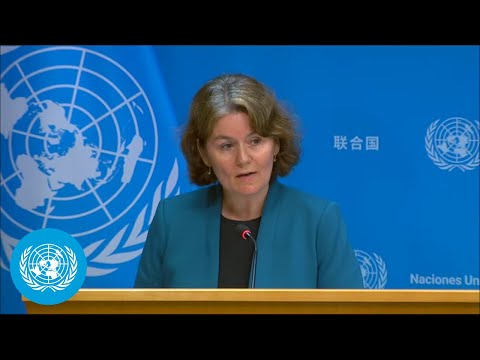
At a U.N. noon briefing, associate spokesperson Stephanie Tremblay said the secretary-general “strongly condemns” a strike on the Holy Family Church in Gaza and called for an immediate cease-fire, unfettered humanitarian access and more fuel as hundreds of thousands have been displaced.
Stephanie Tremblay, associate spokesperson for the United Nations Secretariat, told reporters at a noon briefing that the secretary-general “strongly condemns today’s strike on the Holy Family Church in Gaza, a place of worship and a sanctuary for civilians.” She said attacks on places of worship are unacceptable and renewed the U.N.’s call for an immediate cease-fire and the “immediate and unconditional release of all hostages.”
The U.N. Office for the Coordination of Humanitarian Affairs (OCHA) and U.N. partners reported large and continuing population movements inside Gaza, Tremblay said. Between July 8 and July 15 more than 11,500 people were newly displaced, bringing total displacement since the most recent escalation on March 18 to more than 737,000 people — roughly 35% of Gaza’s population, according to the briefing.
The World Health Organization has dispatched 35 trauma and emergency surgery kits — described at the briefing as sufficient for roughly 1,750 interventions — but Tremblay said many items remain undelivered because of access constraints. She warned that health facilities in affected areas are critically strained, that some hospitals are operating without power and that patients have been transferred to Damascus. The brief also said at least two doctors in Soweto (as reported by local partners to U.N. humanitarian colleagues) were killed in recent clashes and that health facilities have been used by armed groups in ways that endanger patients and staff.
Tremblay said fuel deliveries remain insufficient to sustain life-saving services. She reported that, for the first time in more than 135 days, the U.N. was able to bring in some “benzene,” which she said powers ambulances and other critical services, and that limited deliveries of diesel have continued. She gave specific quantities for the most recent deliveries, saying 75,000 liters of diesel and 35,000 liters of benzene were brought in on the day of the briefing, while stressing those amounts are not enough and more regular fuel access is required.
The U.N. briefing also highlighted secondary humanitarian consequences: many shelters are uninhabitable, people have repeatedly been displaced, and water infrastructure is largely nonfunctional. Tremblay said Israeli authorities had reinstated a ban on access to the sea along parts of Gaza’s coast, prohibiting swimming and fishing; OCHA reported that some displaced people had used the sea to wash because there is “barely any functioning water infrastructure” and almost no fuel to pump water.
Tremblay said U.N. staff and partners are “mobilizing to deliver humanitarian assistance and to assess needs as security allows,” and that U.N. officials continue to engage with interim authorities to facilitate access. She said a Security Council meeting on Syria was scheduled later in the day and that Khaled Khiari (assistant secretary-general for the Middle East, Asia and the Pacific) would brief the council on behalf of the U.N. secretariat.
The briefing included repeated calls for parties to respect international law, protect civilians and humanitarian personnel, and allow aid to flow at scale. Tremblay also flagged comments from U.N. humanitarian leadership that food is running out in Gaza and that people seeking food risk their lives.
The U.N. spokesperson did not offer a prediction of the Security Council’s actions and described the statement on the church strike and the calls for more aid as the U.N. position at the time of the briefing. The U.N. said it would keep the public informed as the situation and access evolve.