Get Full Government Meeting Transcripts, Videos, & Alerts Forever!
Get email alerts on the Vision Zero topic
No spam. Unsubscribe anytime.
Santa Clara presents draft Vision 0 safety plan; residents press for bike-trail, speed and enforcement fixes
Summary
City staff and consultants presented a draft Vision 0 action plan at a fourth community workshop, outlining an 8-year collision analysis, a priority “high injury” network and a toolbox of engineering and nonengineering countermeasures; residents urged more enforcement, trail access fixes and roadway redesigns.
City of Santa Clara staff and their consultants on Thursday presented a draft Vision 0 action plan and preliminary safety improvements at the fourth community workshop for the program, outlining proposed engineering, enforcement and education strategies to eliminate traffic fatalities and severe injuries on city streets.
"Vision 0 is a strategy to eliminate all traffic fatalities and severe injuries on the city's Santa Clara roadways," said Robert Padurna, project consultant with Kimley‑Horn, introducing the plan's purpose and the project timeline. He said the firm analyzed eight years of collision data covering 2016–2023 and has identified a priority high‑injury network and a countermeasure toolbox to guide implementation.
The workshop provided technical findings and solicited location‑specific feedback from residents. "We are taking those type of specific locations and issues," said project moderator Regina Merrill of CirclePoint, noting staff recorded public comments and would review them for the draft plan.
Why it matters: project staff said roughly 60 percent of all injury collisions occurred on 16 percent of the road network. The team identified about 40 fatal collisions across Santa Clara from 2016–2023, and collision‑profile data showed that among fatal or serious‑injury crashes, 13 percent involved pedestrians or bicyclists, 15 percent involved alcohol, 13 percent involved speeding, 44 percent occurred at night and 15 percent involved children or people 65 and older. The draft plan will list targeted improvements on the priority corridors and a program for funding and long‑term monitoring.
Planned approach and timeline The Vision 0 approach presented combines a safe‑systems framework—safer streets, safer speeds, safer people, safer vehicles and improved post‑crash care—with an implementation program and a public dashboard. The project team said the draft plan will be posted for public comment in late August–early September and that the city expects to take a final plan to City Council in early 2026.
Technical highlights and candidate treatments Consultants and staff described a range of engineering countermeasures in the toolbox for prioritized corridors and other locations: removal of high‑speed right‑turn slip lanes, protected intersection treatments for bikes and pedestrians, high‑visibility crosswalks, bulb‑outs to shorten crossing distances, green bike lane markings at conflict zones, rectangular rapid flashing beacons (RRFBs) for uncontrolled crossings, overhead signal heads on El Camino Real, speed‑feedback signs, roundabouts and neighborhood traffic calming measures.
"Enhanced lighting is a proven safety countermeasure," said Mike Colte, project consultant with Kimley‑Horn as he summarized roadway, intersection and speed‑management options included in the toolbox. The team said countermeasures are chosen to reduce vehicle speeds and the kinetic energy in collisions, with documented crash reduction factors where available.
Community feedback and recurring concerns Residents used the workshop to register location‑specific safety concerns and broader priorities. Multiple attendees urged a focus on engineering changes rather than signage alone. "If the road is designed in a different way, that's a little bit more of a continuous reminder," said Michael, a resident who cited experience in Sweden and other European cities.
Local trail access and crossing problems drew detailed comments. A resident who lives near the San Tomas Expressway trail entry described a narrow, awkward 40‑foot trail entrance that forces riders onto sidewalks or into conflict with oncoming cyclists, and asked the city to investigate moving the sidewalk to provide two turning lanes for bicycles. The comment was recorded for follow‑up by the project team.
Other frequent themes included: calls for more school‑based and public education about safe driving and bicycle rules; requests for more speed enforcement and mobile speed trailers in residential shortcuts; and interest in daylighting (red‑curbed) crosswalk approaches where parked vehicles block sightlines.
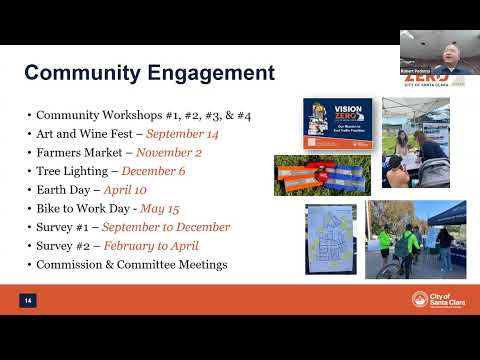
Data and public involvement Staff said the team collected 729 survey responses in a February–April round (621 unique contributors, more than 540 of whom were Santa Clara residents) and has launched a third survey period running through July 13. The collision analysis relied on police‑reported crash data (excluding property‑damage‑only incidents) accessed via statewide portals; staff said the draft plan will include a summary of crash types and an appendix with the analysis.
Coordination and next steps Staff emphasized that some priority corridors cross county and state roadways — including county‑maintained expressways and Caltrans‑managed El Camino Real — and that improvements on those facilities will require coordination with Santa Clara County and Caltrans. Nicole Hee, project manager for the Vision 0 project in the city's traffic engineering division, said the city is already coordinating with Caltrans on bikeway work and that collaborative projects generally score better for grant funding.
Implementation measures discussed included an ongoing Vision 0 working group that includes neighboring jurisdictions, a funding program to pursue state and federal grants, updates to the city's traffic‑calming and design review procedures, and commitments to monitoring countermeasure effectiveness over time using established crash‑reduction factors.
Residents who want to submit site‑specific concerns not captured in the workshops were directed to the project email (SantaClaravision0@kimley‑horn.com) and the Vision 0 project web page. The draft Vision 0 plan will be published for public review and comment in late August–early September, with final adoption discussions expected in early 2026.