Get Full Government Meeting Transcripts, Videos, & Alerts Forever!
Get email alerts on the Humanitarian Aid Gaza topic
No spam. Unsubscribe anytime.
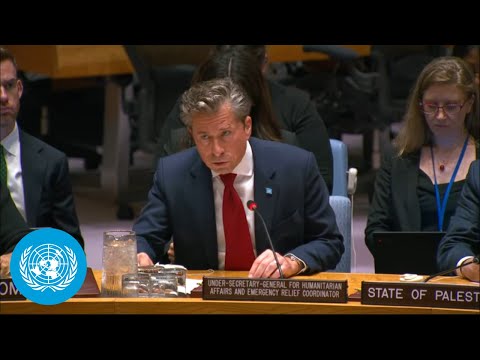
UN briefing: aid must enter Gaza ‘at scale,’ Tom Fletcher tells Security Council
Summary
Tom Fletcher briefed the U.N. Security Council on a deteriorating humanitarian situation in Gaza, citing collapsing health services, rising child malnutrition and large obstacles to getting food, fuel and medical supplies into the Strip.
Tom Fletcher, who briefed the United Nations Security Council, told members that the General Assembly gave the U.N. a humanitarian mandate in "resolution 46/182" and laid out principles of "humanity, impartiality, neutrality, and independence." He said those principles require that "aid must go where needs are greatest and without discrimination" and that humanitarian workers "answer to civilians in need, not the warring parties."
Fletcher said Gaza is facing sharply escalating humanitarian needs and provided a series of operational and health statistics to illustrate the scale. "Food is running out. Those seeking it risk being shot. People are dying trying to feed their families," he said. He reported that in June more than 5,800 children were diagnosed as acutely malnourished and that health facilities are severely impaired: "Only 17 of 36 hospitals and 63 of 170 primary health care centers are functioning. All only partially," Fletcher said, adding that "70% of essential medicines are out of stock" and that "half of all medical equipment has been damaged."
Fletcher described how fuel and aid move into Gaza and the obstacles involved. He said Israeli authorities have allowed two trucks of fuel per day, five days a week, through the Kerem Shalom crossing — "the first time any fuel has been allowed to enter the Strip in a hundred and 30 days" — but that two trucks are "a fraction of what's required to run essential life sustaining services." He also outlined the multi-step approvals and inspections required for deliveries, the repeated reloading of cargo onto different trucks, and security and access constraints inside Gaza that reduce the amount of aid reaching people in need.
Providing detailed operational figures for the period between May 19 and July 14, Fletcher said 1,633 trucks entered Gaza, representing 62% of roughly 2,600 submissions to Israeli authorities; 74% of those approved reached the Kerem Shalom and Zikim crossings. He said 1,600 Palestinian trucks were ultimately collected for distribution inside Gaza. He said humanitarian partners deployed 21 emergency medical teams, brought in 238 pallets of medical supplies including 10 cold-chain pallets that contained 1,396 blood units and 1,550 plasma doses, supported 800 weekly medical consultations for women and girls, enabled 84 kitchens to serve 260,000 meals daily, and delivered 17,000 cubic meters of drinking water through 1,300 collection points. Fletcher contrasted those totals with a ceasefire period average of about 630 truckloads per day.
Fletcher also described security dynamics beyond Gaza, saying the West Bank has seen "continued loss of life and livelihoods, movement restrictions, growing displacement," and citing an instance he said occurred over a weekend near Ramallah in which two Palestinian youths were killed in a settler attack and ambulances were blocked. "Each day this year, the UN has documented an average of 4 incidents of settler violence against Palestinians and their property," he said, and he noted that in June some 100 Palestinians were injured by settlers.
On legal and normative questions, Fletcher reminded the council that the International Court of Justice "has demanded that Israel take immediate and effective measures to enable the provision of urgently needed basic services and humanitarian assistance," and asked members to assess whether Israel is meeting its obligations under international humanitarian law. He listed measures he said should be part of rules of engagement to avoid civilian harm: verifying targets, giving effective advance warnings, choosing tactics and weapons carefully, and cancelling or suspending attacks that would cause disproportionate civilian harm. He cautioned that intentional starvation of civilians "would, of course, be a war crime."
Fletcher said humanitarian staff face restrictions tied to security clearances and visa renewals and that in 2025 "56% of the entries denied were for emergency medical teams." He also paid tribute to aid workers killed in the conflict, saying "hundreds of aid workers have been killed" and noting one colleague from the International Committee of the Red Cross was killed the morning of his briefing.
He urged the council to allow a predictable, scaled flow of aid into Gaza through multiple crossings and routes that avoid exposing civilians to fire, saying, "We have a plan that works" and that the ceasefire period demonstrated higher levels of access that should be restored. Fletcher welcomed a recent agreement between the European Union and Israel on humanitarian access and said he looked forward to details on implementation and assessment.
The presiding officer gave the floor next to Executive Director Catherine Russell, whose remarks were not included in the transcript excerpt.