Get Full Government Meeting Transcripts, Videos, & Alerts Forever!
Get email alerts on the Board Training topic
No spam. Unsubscribe anytime.
City attorney reviews variance standards, Open Meetings and ethics with Troy ZBA
Summary
City attorney and staff gave the board an annual refresher covering dimensional- and use-variance legal standards, motion-writing best practices, Open Meetings Act constraints, FOIA and conflicts-of-interest guidance.
City legal counsel and staff gave the Troy City Zoning Board of Appeals an annual training session covering the legal standards that govern dimensional and use variances, best practices for drafting motions and written findings, and rules that govern board conduct.
The presentation emphasized that a dimensional variance requires the applicant to prove every element of "practical difficulty," including an exceptional characteristic of the property, a nexus between the difficulty and the premises, an absence of self-created hardship, and that the variance will not harm the surrounding area. Attendees were reminded that the board must tie factual findings to each element in a written motion so that appellate courts reviewing the record can see the basis for the board's decision.
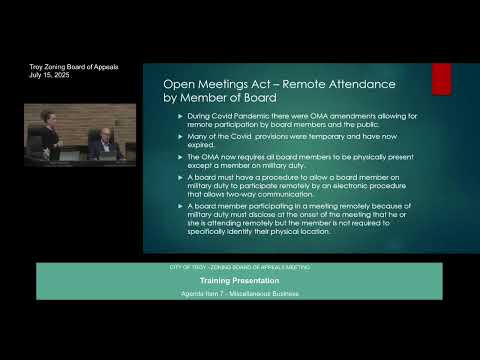
Counsel also reviewed obligations under Michigan's Open Meetings Act and the Freedom of Information Act (FOIA), including guidance that board members avoid serial deliberations outside publicly noticed meetings (no reply-all email discussion of pending matters), that site visits are permitted only individually unless an applicant invites multiple members, and that FOIA requests may cover board-related records including email. The board discussed conflict-of-interest disclosure and recusal procedures and were reminded that social-media posts should not present the poster's views as those of the board.
City staff and the attorney provided a template-style resolution and sample motions intended to help the ZBA link each required variance element to the record. Training presenters urged members to deliberate among themselves at the meeting, organize reasons that correspond to legal elements and include those reasons directly in motions to grant or deny so decisions are resistant to judicial reversal.
Board members asked procedural questions about site visits, when an applicant may request a postponement if fewer than seven members attend, and whether motions should list element findings before or after the approval text. Counsel recommended including the factual findings as part of the motion. The training concluded with an offer from staff and counsel to assist in drafting motions in advance of upcoming hearings.