Get Full Government Meeting Transcripts, Videos, & Alerts Forever!
Get email alerts on the Housing Tiny Homes topic
No spam. Unsubscribe anytime.
Mount Shasta planning panel clears tiny‑home ordinance, bars ownership language and limits moves to once a year
Summary
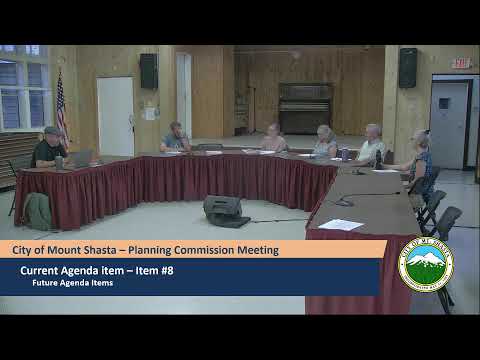
The Mount Shasta Planning Commission voted July 15 to forward a municipal code amendment on tiny homes on wheels to city council, leaving the draft ordinance “silent” on individual ownership and adding a provision that movement on or off a site be limited to no more than once every 12 months.
The Mount Shasta Planning Commission voted July 15 to forward a municipal code amendment on tiny homes on wheels to city council, leaving the draft ordinance “silent” on individual ownership and adding a provision that movement on or off a site be limited to no more than once every 12 months.
The change, adopted as part of Resolution PC 2025-02, also includes objective design standards and a staff-recommended provision listed as Mount Shasta Municipal Code section 18.180.040(e) that restricts movement “to no more than annually or as required for registration, certification or related compliance at the discretion of the planning director.” The commission also found the action categorically exempt from CEQA under the standard set out in CEQA Guidelines section 15061(b)(3).
Staff said the goal of the ordinance is to allow a new housing typology while retaining local design control. Jeff, city planning staff, told the commission he reached out to other California jurisdictions and the Tiny Home Industry Association while drafting the ordinance and recommended keeping ownership unspecified so market models—individual ownership, developer ownership, co‑ops or community land trusts—remain available.
"Homeownership equity is a large part of the reason" to allow tiny homes on wheels, Jeff said, adding his research showed most tiny homes move only two to three times over their lifetime and that over‑regulating village design has kept some other jurisdictions from achieving the intended scale.
Commissioners and members of the public debated two central concerns: whether tiny‑home villages would operate like RV parks if units can be moved, and whether allowing individual ownership in residential zones (R‑2 and R‑3) should be prohibited. Commissioner David (first name used in the transcript) repeatedly argued that movable units functionally resemble RV parks and said he opposed placing villages in R‑2 and R‑3 zones. Several other commissioners and public speakers emphasized the potential for tiny homes to provide lower‑cost, equity‑building housing.
Public commenters framed the discussion around local housing scarcity and construction quality. Evan Drake, a local builder with Siskiyou Housing Alliance, said he supports keeping ownership as an option because "ownership of tiny houses should remain an option for all individuals," and added that well‑built tiny homes can hold value and build equity. Resident Natalie Shively described long waitlists for subsidized housing and urged the commission to expand realistic housing options for workers and families.
Other speakers raised technical and regulatory points. Rachel Streeter asked which construction and tax standards would apply; Jeff and commissioners discussed Appendix Q (the model building code provisions for small dwellings), ANSI certification and State Housing and Community Development (HCD) rules for manufactured homes. Jeff said the ordinance distinguishes tiny homes on wheels from HCD‑certified manufactured homes and that local design and site standards would be applied at entitlement and building permit stages.
On ownership, after extended discussion the commission first considered—and then rejected by roll call—the idea of expressly prohibiting individual ownership in R‑2 and R‑3. Instead the body voted to keep the ordinance silent on ownership (effectively allowing ownership models to be decided by the market or later regulation). The motion to remain silent on ownership passed 4–1.
Later the commission voted to approve Resolution PC 2025‑02 (the ordinance text incorporating design standards and the movement restriction). The motion carried; a roll call recorded at least one dissenting vote. The commission then voted to adopt the staff finding that the amendment is exempt from CEQA. That CEQA motion passed unanimously.
Staff told commissioners the ordinance will go to city council for a public hearing (tentatively the August 2025 meeting) and that the staff report will include the background on the R‑2/R‑3 ownership discussion so council sees the record.
Planning staff and several commissioners emphasized the ordinance is new and intended to be adjusted as experience with local projects accumulates. Jeff noted that applicants will present site plans, CC&Rs and photos or elevations of units as part of entitlements; staff will review individual delivered units for ‘‘substantial conformance’’ with approved designs, and the commission retains discretion to grant variances or conditions.
The action adds a new local pathway for tiny home villages while creating a procedural review that staff and commissioners say is intended to preserve local design character, oversee common‑area maintenance, and reduce the risk that villages become similar in operation to RV parks.
Votes at a glance
- Motion: Keep ordinance silent on individual ownership of tiny homes on wheels (no explicit prohibition in any zone). Outcome: Passed, 4–1 (mover/second not specified in the record). Note: the commission debated explicitly prohibiting ownership in R‑2 and R‑3 before choosing to remain silent.
- Motion: Approve Resolution PC 2025‑02 adopting Mount Shasta Municipal Code amendments on tiny homes on wheels and add a movement restriction limiting moves on/off a site to no more than annually (section 18.180.040[e]). Outcome: Passed (roll call recorded; at least one nay). CEQA finding under Guidelines section 15061(b)(3) approved unanimously.
What’s next
The commission’s recommendation and staff report will be transmitted to the City Council for a public hearing, where council will consider adopting the ordinance into the Mount Shasta Municipal Code. Staff said the council hearing likely will be in late August 2025.
Speakers and precise votes are recorded in the planning commission transcript and in the staff report that will accompany the council package.