Lifetime Citizen Portal Access — AI Briefings, Alerts & Unlimited Follows
Senate elections committee advances bills on ballot language, billboard disclaimers, campaign security and voting access; votes recorded
Loading...
Summary
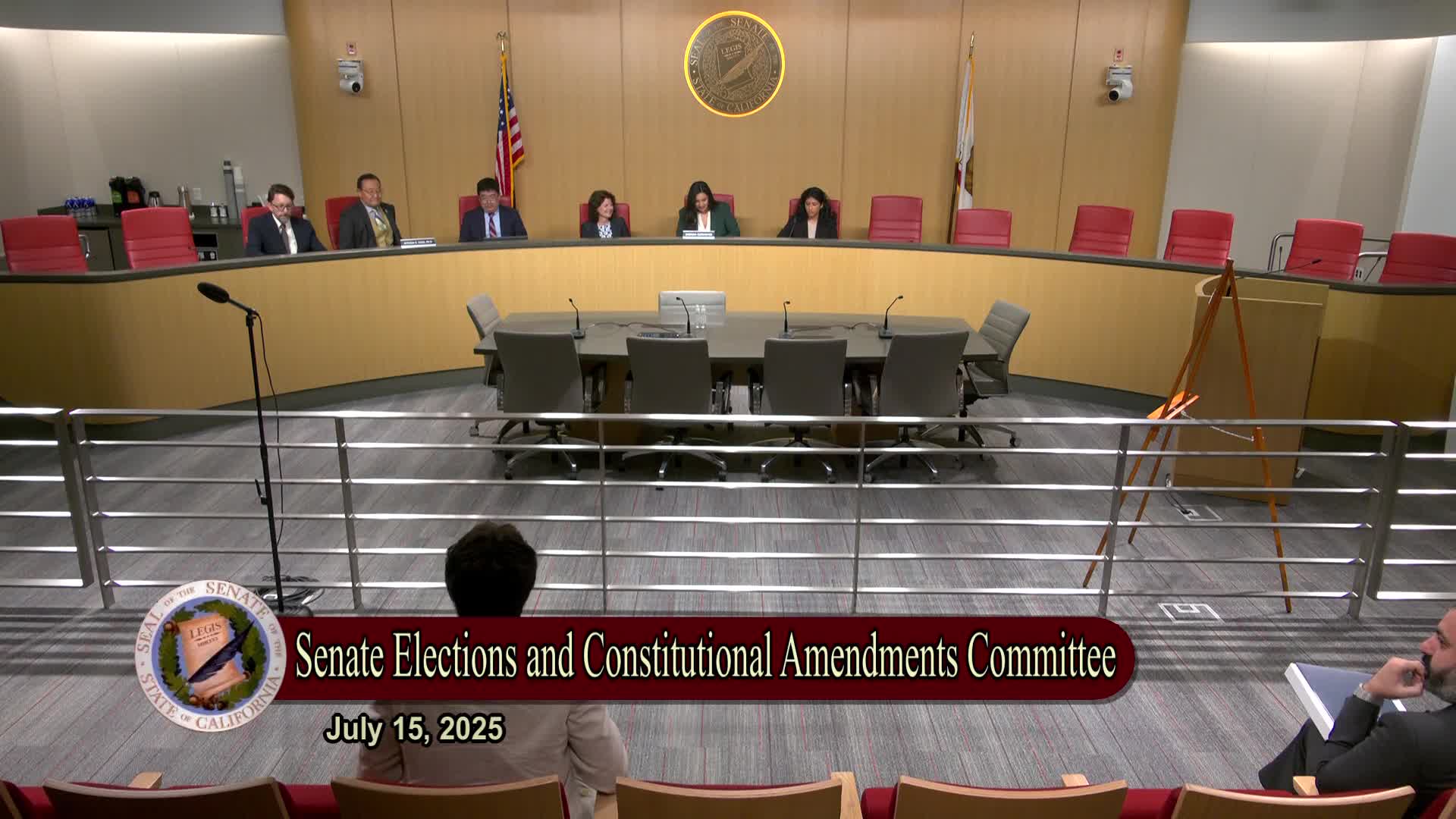
Senate Committee on Elections and Constitutional Amendments members heard testimony on multiple election-related bills and moved several to the next stage, addressing ballot-labeling for tiered taxes, billboard disclosure formatting, campaign security expense limits, modernization of campaign-finance filing systems, voting-rights enforcement and voter services.
Senate Committee on Elections and Constitutional Amendments members heard testimony on multiple election-related bills on the committee agenda and moved several to the next stage, while taking public and organizational testimony on proposals affecting ballot language, disclosure formats for political billboards, use of campaign funds for security, campaign finance technology, voting-rights enforcement and voter services.
The hearing opened with Assemblymember Stephanie presenting AB 699, focused on how the 75-word ballot-label limit affects measures with tiered tax structures or phased bond financing. "Current law requires jurisdictions to fit complex financial disclosures into a 75 word ballot label," Assemblymember Stephanie said. She described the bill as "a simple, good government fix" that would allow jurisdictions with complex measures to direct voters to the voter guide for fuller, plain-language explanations rather than forcing detailed distinctions into the ballot label itself.
Supporters for AB 699 included GT Herichmack, policy director for the Nonprofit Housing Association of Northern California, and Rebecca Killeen, legislative advocate for the Coalition for Adequate School Housing, who told the committee that local bonds and parcel taxes are central to funding affordable housing and school facilities and that the 75-word limit can leave voters confused. Amy Garrett of the California Association of Realtors testified in respectful opposition, saying she preferred expanding the ballot label rather than moving material to a voter guide that some voters may not read. Trent Lang of the California Clean Money Campaign and Savannah Jorgensen of the League of Women Voters said they were working with the author on clarifying amendments.
AB 950, presented by Assemblymember Salacha, would update disclosure formatting for billboard political advertisements. Audrey Ryticek of the California State Outdoor Advertising Association and Trent Lang of the California Clean Money Campaign described the bill as a negotiated compromise that would preserve disclosure of top funders while allowing space-saving measures — including approved abbreviations, committee ID numbers and a shortened independent-expenditure disclaimer — to improve legibility on billboards and other short-format media. The measure would also make some of the same short-form clarifications available for other limited-space formats such as text messages.
Assemblymember Bonta presented AB 789, which would temporarily remove the existing $10,000 lifetime cap on the use of campaign funds for security expenses for candidates, elected officials, their immediate families and staff, through January 1, 2029; beginning January 1, 2029, the bill would shift to a $10,000 per-calendar-year cap. Bonta said the change responds to escalating threats and cited studies and incidents of stalking and targeted harassment; Audrey Rotacek, testifying on behalf of Orange County District Attorney Todd Spitzer, described security expenses for elected officials that have exceeded the existing cap.
AB 808 (Assemblymember Addis), cosponsored by the Secretary of State and the Fair Political Practices Commission (FPPC), would align provisions of the Political Reform Act and related filing rules with the state's planned replacement for Cal-Access (the CalAccess Replacement System, or CARS). Tim Cromartie (Secretary of State's office) and Lindsay Nakano (FPPC) said the bill updates form-based and paper-based statutory language to facilitate a modern, data-driven electronic filing system once the new platform is certified.
Assemblymember Avila Farias presented AB 1079 to eliminate the automatic stay that jurisdictions can obtain by filing an appeal after a court finds an at-large election system violates the California Voting Rights Act (CVRA). The author said the bill is designed to ensure court decisions protecting voting rights take effect without indefinite delay.
Assemblymember Ransom's AB 1164 would clarify the California Voter Bill of Rights by specifying the circumstances in which a voter who has not yet "cast" a ballot is entitled to a replacement ballot (for example, when a mailed ballot never arrived or when a voter makes a mistake). Secretary of State staff and the League of Women Voters supported the clarification; the secretary's office asked that the bill preserve the term "cast" rather than replace it with "submit," citing legal usage.
AB 1249 (Assemblymember Wilson), sponsored by the Secretary of State, would require counties that have not adopted the Voter's Choice Act (VCA) to provide at least one early voting location on the Saturday before a statewide election and allow voters to deliver vote-by-mail ballots at county offices or designated satellite locations without using an identification envelope (county signature-verification procedures would still apply). Supporters including the League of Women Voters and disability advocates said the change would increase access for working families, voters with transportation barriers and people who prefer to observe their ballot being scanned.
AB 1411 (Assemblymember Sharp Collins) would require non-VCA counties to adopt voter education and outreach plans, using a template to be provided by the Secretary of State, and to post those plans publicly. Supporters said the requirement revives an existing statutory expectation (the committee analysis cited prior versions of similar law) and seeks to reduce uneven outreach across counties.
Votes at a glance (committee motions and results) - AB 699 (ballot labels / voter guide referral): Mover: Senator Umberg. Vote: 4 yes, 1 no (Cervantes: aye; Choi: no; Allen: aye; Limon: aye; Umberg: aye). Outcome: Do pass to Committee on Appropriations. - AB 789 (campaign security funds temporary cap removal to 2029): Mover: Senator Umberg. Vote: 4 yes, 0 no (tally recorded by committee). Outcome: Do pass to Committee on Appropriations. - AB 808 (CalAccess replacement / PRA modernization): Mover: Senator Umberg. Vote: 5 yes, 0 no. Outcome: Do pass to Committee on Appropriations. - AB 950 (billboard disclosure formatting): Mover: Senator Umberg. Vote: 5 yes, 0 no. Outcome: Do pass to Committee on Appropriations. - AB 1079 (CVRA stays): Mover: Senator Umberg. Vote: 4 yes, 1 no. Outcome: Do pass to Committee on Appropriations. - AB 1164 (replacement ballots / Voter Bill of Rights clarification): Mover: Senator Umberg. Vote: 5 yes, 0 no. Outcome: Do pass as amended to Committee on Appropriations. - AB 1249 (early voting in non-VCA counties; ballot drop-offs at satellites): Mover: Senator Umberg. Vote: 4 yes, 1 no. Outcome: Do pass as amended to Committee on Appropriations. - AB 1411 (voter education/outreach plans for non-VCA counties): Mover: Senator Umberg. Vote: 4 yes, 1 no. Outcome: Do pass as amended to Committee on Appropriations.
What happened and why it matters Committee members and a wide set of stakeholders from local governments, election administrators, nonprofit housing advocates, school facility groups, the elections industry, and transparency advocates spoke to trade-offs between brevity and clarity in voter-facing materials, the limits of existing statutory language for modern technology and formats, and safety concerns for public officeholders. The committee generally favored measures that preserve transparency while adjusting format or process to improve legibility, access, or administrative efficiency. Where concerns were raised (for example, whether voters will see redirected material in a voter guide or how counties will fund outreach), the author and witnesses committed to continued work with stakeholders and technical refinements.
What the committee did not decide Several presenters and committee members asked for ongoing negotiations and amendments on specific language (for instance, how AB 699 will refer voters to the voter guide, and whether AB 950's shortcuts risk obscuring funder names). The bills were advanced to appropriations for fiscal review or to the next committee with instructions to continue to work with stakeholders; none of the measures were enacted at this hearing.
Next steps Most moved bills were referred to the Senate Committee on Appropriations for fiscal analysis; authors and sponsors indicated they will continue discussions with interested parties and technical agencies, including the Fair Political Practices Commission and the Secretary of State, ahead of subsequent hearings.
Ending note Committee members thanked long-serving staff and closed the hearing after recording the motions and roll-call votes.