Get Full Government Meeting Transcripts, Videos, & Alerts Forever!
Get email alerts on the Housing topic
No spam. Unsubscribe anytime.
Common Council narrowly approves accessory dwelling unit ordinance after hours of debate, 8-7
Summary
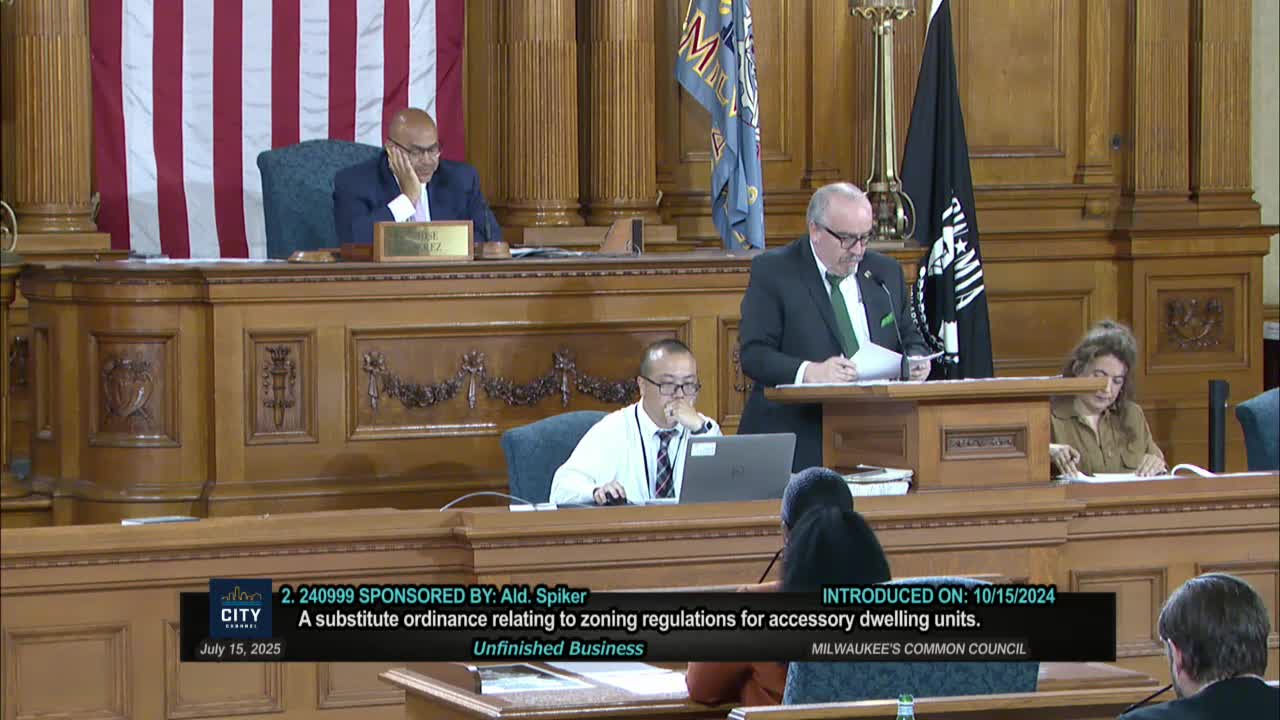
The Milwaukee Common Council passed a substitute ordinance (file 240999) to allow accessory dwelling units (ADUs) in single‑family zones as a matter of right, after a lengthy floor debate over notification, special‑use review and owner‑occupancy rules. The measure passed 8–7.
The Milwaukee Common Council voted 8–7 to pass a substitute ordinance (file 240999) expanding where and how accessory dwelling units, or ADUs, can be built inside the city.
The vote came after more than two hours of debate during which council members disputed whether internal ADUs (units retrofitted inside an existing house), attached additions and detached accessory units should be allowed as a matter of right or require a special‑use hearing before the Board of Zoning Appeals (BOZA). Alderman Samaripa moved to replace Substitute 6 with Substitute 4 and pass the file as substituted; the council adopted that amendment 8–7 and later passed the ordinance as substituted by the same margin.
The ordinance, as adopted, was authored originally by Alderman Jose Perez and Alderman Bob Baumann and was the subject of competing substitutes on the floor. Supporters said ADUs provide an accessible path to more housing options — internal units are typically the least costly option and can help aging residents remain in place. Opponents argued that allowing ADUs as a matter of right cuts neighbors and local alderpersons out of a process that can address block‑by‑block concerns.
A chief point of contention was whether internal ADUs should be treated differently from attached or detached units. Alderman Speicher proposed amending the ordinance to require special‑use review for all three ADU types in single‑family (RS 1–6) districts; that substitute was defeated by an 8–7 margin. Alderman Samaripa’s proposal to permit ADUs in RS 1–6 parcels as a matter of right (with limited design and use standards) then prevailed.
Council members also debated an owner‑occupancy verification requirement in the ordinance. The adopted text requires that at the time a building permit application is submitted for an ADU, at least one owner of the existing principal dwelling must occupy the principal dwelling as the owner’s primary residence — documented by at least two forms such as motor vehicle registration, driver’s license, voter registration, federal or state tax return or a utility bill. City staff told members the Development Center would verify that documentation at permit application, and the ordinance links false representations to existing enforcement remedies in the municipal code; penalties can include revocation of a permit or certificate of occupancy and assessment of enforcement fees. Council members noted that the ordinance does not create an iron‑clad deed restriction preventing a later sale to an investor, and that financing constraints limit legally enforceable long‑term owner‑occupancy covenants.
How the ordinance will work in practice remained a focus. Supporters said practical obstacles — building‑code limits and the difficulty of retrofitting older houses — will likely limit the number of internal ADUs, while detached ADUs and attached additions are more likely on larger lots. Opponents said even limited changes could accelerate investor purchases of two‑unit properties.
Alderman Pratt summarized the transparency argument in favor of a special‑use requirement: “If you’re putting up a billboard, you have to get a special‑use permit. If you’re building a building behind your house where someone will live on your lot, you should have to get a special use,” he said on the floor. Alderman Dimitrijevich argued the city faces a housing crisis and urged tools that make it easier to add units: “Accessory dwelling units are one component… They’re a step in the right direction,” she said.
The council’s action does not immediately change tax‑parceling rules: tax keys cannot be split as part of an ADU permit. Nor does the ordinance create an immediate penalty regime specific to owner‑occupancy beyond existing code enforcement remedies; staff said the development center will require documentation and that falsifying permit information may subject applicants to enforcement under the building code.
What happens next: The ordinance as passed will go to the mayor for signature. Implementation will require the Development Center and neighborhood services to publish permit submittal requirements and to update public guidance on what documents will be accepted to show primary residence. Members on both sides of the floor urged additional follow‑up work to monitor investor purchases and the ordinance’s effects on neighborhoods.
Votes at a glance: The amendment to substitute 6 with substitute 4 and pass as substituted was adopted 8–7. A later substitute by Alderman Speicher to require special‑use review for all ADU types in RS 1–6 was defeated, 7–8. The final passage of file 240999 as substituted passed 8–7.
The ordinance includes specific limited‑use standards (F‑3 in the draft) about owner occupancy and the Development Center’s documentary verification procedure, and it preserves BOZA review where applicants seek variances or fail to meet design standards.
The measure drew sharp floor disagreement and several additional substitutes were previewed during the meeting; members said more technical refinements and monitoring will follow.