Get Full Government Meeting Transcripts, Videos, & Alerts Forever!
Get email alerts on the Transit Funding And Operations topic
No spam. Unsubscribe anytime.
SFMTA board hears funding working group findings, details Muni service reorganization and technology needs
Summary
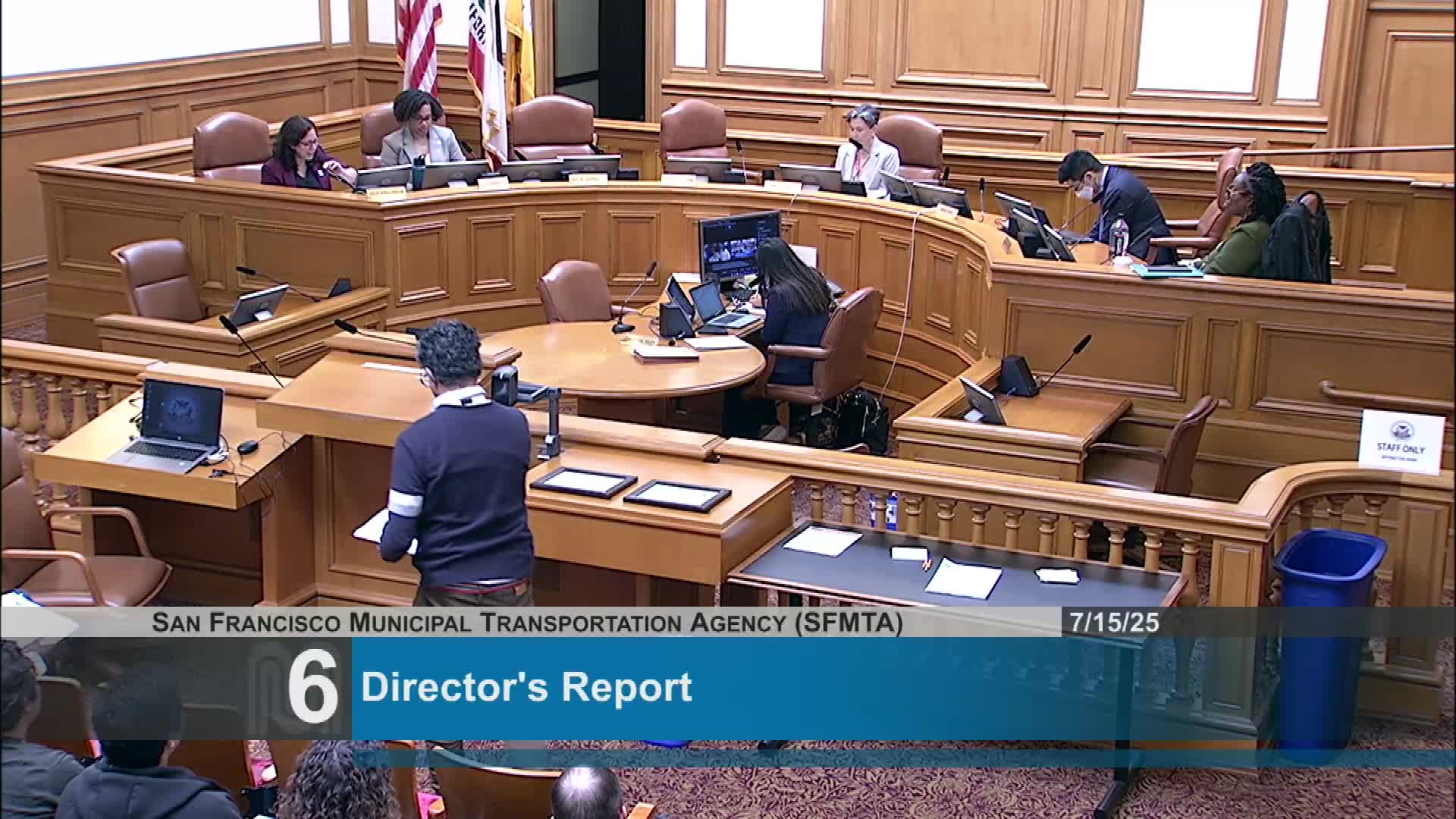
The San Francisco Municipal Transportation Agency Board of Directors on July 11 received the Muni Funding Working Group's report and a quarterly Muni service update outlining organizational changes, service-management priorities and technology gaps that the agency says must be addressed to sustain recent service gains.
The San Francisco Municipal Transportation Agency Board of Directors on July 11 received the Muni Funding Working Group's report and a quarterly Muni service update outlining organizational changes, service-management priorities and technology gaps that the agency says must be addressed to sustain recent service gains.
The board was told that the Muni Funding Working Group, convened with the Controller's office, found broad agreement that revenue solutions will be needed to avoid deep expenditure cuts that could hurt service. City Controller Greg Wagner told the board the group's work produced a roadmap of options for addressing a projected deficit and urged a public policy conversation about revenue and spending priorities.
In a longer briefing, Transit Director Brent Jones described a reorganization intended to better align planning, operations, maintenance and technology. Jones said the reorganization creates a single service-management team that integrates the Transportation Management Center with street operations, and expands a Transit Performance and Technology team (TPAT) to drive data-driven decisions. He said the agency is moving from a time-point model to headway-based service on high-volume lines and reported that roughly 70% of Muni service is now operating on headway principles, with headway adherence commonly in the mid-80th percentile on those lines.
Jones told the board that customer satisfaction is at 72%, the highest in 20 years, and the agency is aiming for an attainable 80% benchmark. He reported ridership of roughly 521,000 weekday trips and 343,000 weekend trips, and said May 2025 service levels were at 97% of pre-pandemic weekend service and 77% of weekday service.
The presentation also flagged near-term funding wins: the California Transportation Commission awarded a $41,000,000 "Solutions for Congested Corridors" grant to support a train-control upgrade project and a $14,000,000 grant for a Howard Streetscape safety and livability project. Jones said the train-control program is expected in two phases, with Phase 1 focused on surface segments and completion by 2028 and Phase 2 covering the subway.
Board members pressed Jones on where headway service would not apply and why: hilltop, low-frequency connector and overnight "owl" routes often do not meet the criteria for headway-based operations. Director Henderson and others asked whether lines excluded from headway service showed lower customer satisfaction; Jones and colleagues said complaints and performance data are being analyzed through focus-line workshops that deploy staff and take operator input to diagnose line-specific problems.
Jones emphasized technology constraints. The current service-management system, Oracle/Orbcad (referred to as ORBCAD in the briefing), was originally designed for a time-point schedule and is now being pushed past intended capabilities. Jones said the agency is mapping out a replacement Fleet Management System (FMS) that would be customizable to support headway operations, improved predictions for customers and better operator recovery tools; he cautioned such investments are expensive but would deliver decades of value.
TPAT staff were credited with giving the agency the data to show preventive-maintenance gains and reductions in service-affecting breakdowns since 2015. Jones said Market Street subway delays are down substantially (moderate delays down about 70%, long delays down about 50%) following infrastructure work done during the pandemic.
On safety and workforce supports, Jones said operator safety remains a priority and previewed that next-generation 40-foot buses will include enclosed operator barriers. He also described an employee performance and appraisal program (three touchpoints per year for supervisors and operators) intended to support training, retention and career development.
Public comment supported the train-control work and called for continued attention to equity and neighborhood impacts. Alita Dupree told the board she supports staying the course on the train-control program. Other speakers asked the agency to consider impacts on riders with disabilities resulting from service changes on Market Street and called for more neighborhood-directed investments.
The board did not take formal action on funding recommendations in the presentation; members instead asked staff to return with more detailed options and follow-up reports.
Why it matters: The briefing summarized the crossroads at which Muni finds itself: service and customer-satisfaction gains are visible, but sustaining them will require revenue choices, targeted capital investment (notably train-control modernization) and upgraded service-management technology.
The board will receive additional materials as staff translate the working group's findings into specific policy options and budget proposals.