Get Full Government Meeting Transcripts, Videos, & Alerts Forever!
Get email alerts on the Transportation Planning topic
No spam. Unsubscribe anytime.
Consultants kick off Riverton transportation master‑plan update, cite rising crashes and trip growth
Summary
Avenue Consultants presented initial traffic, safety and origin‑destination data and began citywide outreach, urging council direction on vision and goals; consultants and council agreed to further data updates and public engagement this fall and spring.
A consulting team hired to update Riverton’s transportation master plan told the City Council on July 22 that residents are driving more than in prior years and that the city has seen a pronounced recent rise in crashes, especially rear‑end and angle crashes at congested intersections.
Thomas McRintree, project manager for Avenue Consultants, told the council the firm plans to finish the master plan next spring and used the session as a kickoff to present initial traffic, safety, bicycling and transit data. “The plan is to deliver it next spring, maybe April or May,” McRintree said. He asked the council to identify a concise set of goals (the team suggested 4–6) and offered to return with refined analysis and candidate projects.
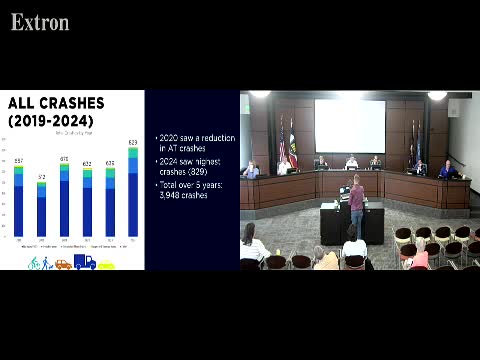
The presentation summarized several data sources the team is using, including 2023 traffic counts, a six‑year crash analysis and aggregated cell‑phone/mobile device movement data (Replica) to map trip ends and modal shares. Key findings the consultants highlighted were: a 22% rise in trips by Riverton residents from 2019–2024 while population rose roughly 3%; about 37% of daily trips begin and end inside Riverton; and collision counts rose sharply in 2024, driven largely by congestion‑related rear‑end and left‑turn angle crashes.
Consultants also mapped bicycle and pedestrian trip ends and early transit boarding counts for newly introduced UTA routes. They cautioned that travel‑mode datasets have limits — for example, cell‑phone trip‑end data undercounts purely recreational loops — and said they will supplement Replica with other sources such as Strava where appropriate.
Council members pressed for timing and additional detail. Council member McDougall said he preferred postponing some public outreach until after major nearby projects finish: “I’d rather not do these this fall and do them in the spring,” McDougall said, citing temporary construction impacts that can distort resident feedback. Several council members said they want both early engagement and later follow‑up so the plan reflects post‑construction travel patterns.
Avenue Consultants outlined a public‑engagement program that includes an August online survey, targeted open houses and a return to the council in October with more analysis and a system‑level project brainstorm. The consultants agreed to provide the slide deck and the underlying trip‑matrix data to staff and council for use in regional discussions.
The council and consultants also discussed operational fixes the plan will analyze, including signal coordination on 126 South and multimodal East–West connections. The consultants said the plan will combine safety, multimodal access and capital‑improvement priorities and will recommend implementation steps, funding strategies and coordination with UDOT, UTA and neighboring cities.
The consultants invited further council feedback on draft goals and said they will return at scheduled points in October, December and next March with additional data, modeling and proposed projects.