Get Full Government Meeting Transcripts, Videos, & Alerts Forever!
Get email alerts on the Public Health Tobacco topic
No spam. Unsubscribe anytime.
Redding council approves tobacco retail licensing ordinance with 600-foot school buffer and new licensing fee
Summary
The City Council voted to adopt an updated tobacco retail licensing ordinance that applies to all sellers of tobacco products, establishes a $11.76 annual program fee to fund enforcement, and bans new retailers within 600 feet of K–12 schools; council requested a staff review at six months.
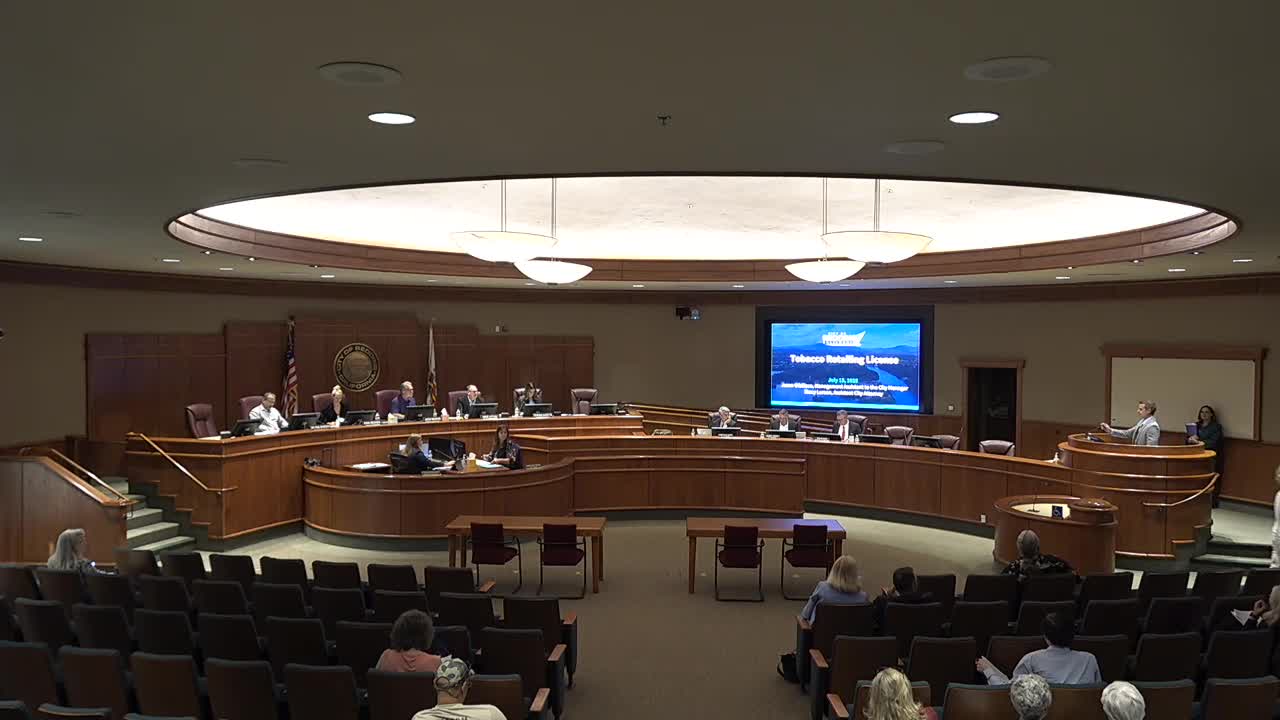
The Redding City Council on Wednesday adopted a tobacco retail licensing ordinance that requires all businesses selling tobacco products to obtain a local license, bans new tobacco retailers from opening within 600 feet of kindergarten-through-12th‑grade schools and sets an annual program fee of $11.76 per retailer to fund enforcement.
The ordinance applies to all establishments that sell tobacco, including convenience stores, grocery stores and specialty vape shops, and includes provisions prohibiting flavored tobacco sales, sales to anyone under 21, mobile vending and self-service displays. City staff said the fee will fund a full‑time neighborhood preservation/code enforcement officer and a half‑time administrative assistant to run inspections, enforcement and education.
City attorneys presented the ordinance and staff said the draft was updated the day of the meeting to (1) clarify that retailers may only sell to people 21 and older (removing a prior military exception) and (2) make the proximity restriction measured from K–12 schools at 600 feet. Assistant City Attorney Stacy Larson reviewed eligibility and enforcement provisions and said the ordinance includes multiple enforcement tools — denial, suspension, revocation, civil and criminal prosecution, administrative fines and nuisance abatement. She said enforcement need not follow a strict formulaic ladder and could go directly to strong remedies depending on the seriousness of violations.
Local advocates who helped craft the language urged adoption. Mark Mazano, representing local public‑health advocates, described repeated inspection failures and urged the council to act; he also recommended clarifying that costs for seized illegal products be borne by the violator. Council members discussed whether the proximity buffer should be wider or limited to vape shops; Councilmember Resner moved approval with a request for staff to report back in six months on enforcement and outcomes, a motion the council approved.
The ordinance is effective after the required administrative steps; staff said existing retailers within 600 feet of a K–12 school are grandfathered and will not be forced to close. Councilmembers and advocates said they expect the new local enforcement position and inspections to reduce youth access over time.
Council asked staff to return with a six‑month implementation and enforcement report that could recommend additional measures targeted at vape shops and retail density if needed.