Lifetime Citizen Portal Access — AI Briefings, Alerts & Unlimited Follows
Council approves towing ordinance and parking-management contract to back new enforcement policy
Loading...
Summary
The Birmingham City Council on July 15 adopted an ordinance allowing towing for vehicles with three or more unpaid parking citations and approved a $395,239.89 contract with Gtechna USA for cloud-based parking enforcement software, license-plate readers and related services.
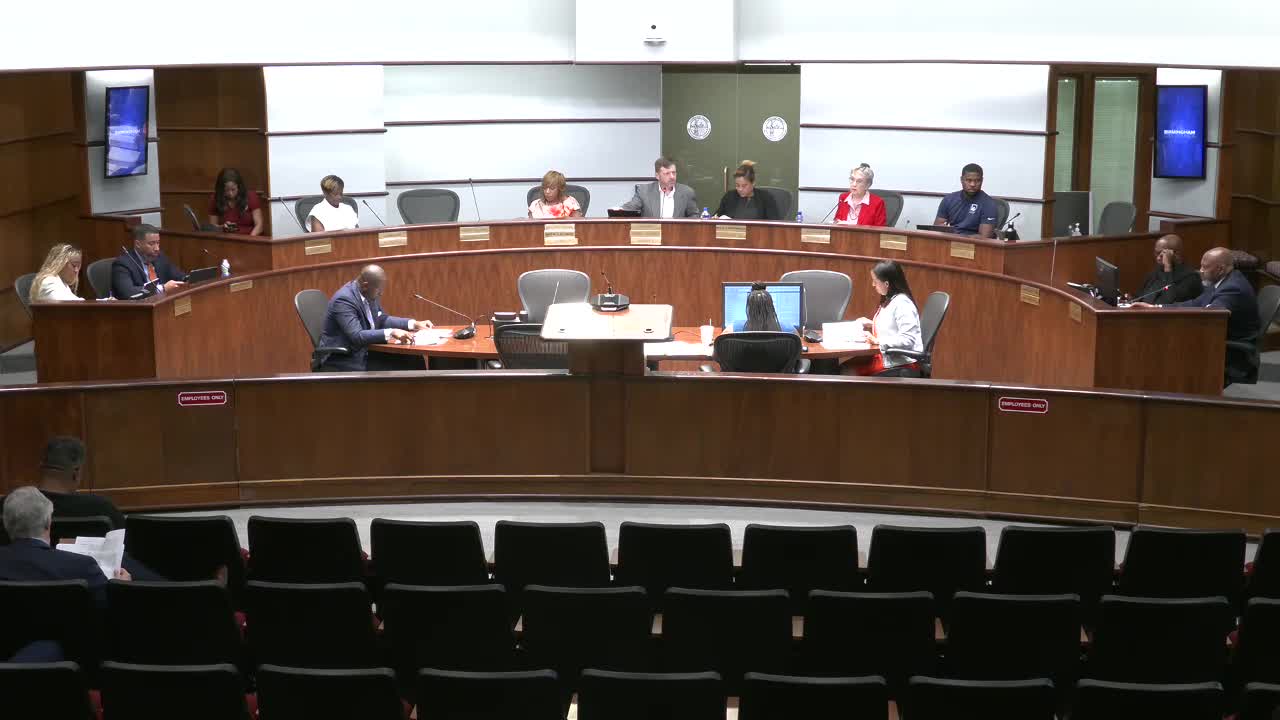
The Birmingham City Council on July 15 approved changes to the traffic code that allow vehicles to be towed from the public right of way when they have three or more unpaid parking citations, and it approved a related technology contract to support enforcement.
Assistant City Attorney Julie Bernard told the council the city has researched legal precedent and designed a process that includes a post-deprivation hearing in municipal court for motorists who contest a tow. Bernard said the ordinance also clarifies towing for public-safety, posted-notice and special-event situations and formalizes notice and redemption procedures for impounded vehicles.
Council also approved a five-year (three years with a two-year renewal option) procurement with Gtechna USA (through a Sourcewell cooperative contract) for about $395,239.89 to provide cloud-hosted ticketing software, in-vehicle or handheld devices, license-plate-reader (LPR) cameras, printers, a new web portal for ticket payment and related professional services. Deputy Director Christina Argo of the Birmingham Department of Transportation said Gtechna will enable real-time access to parking-payment and citation status (including ParkMobile data integration), permit automatic checks by enforcement vehicles and allow the city to send reminders and notices.
Council members asked how the legal change and the technology will work together. Argo said the city does not intend immediate towing on the ordinance’s effective date; officials plan an education and outreach campaign and a staged rollout. Municipal court staff are adding clerical positions to handle increased case volume, and enforcement teams will receive new hardware and training. Staff told council enforcement will begin later this fall after the portal and equipment come online and after public outreach.
Council members sought specifics about fees and procedural safeguards. The ordinance preserves towing and storage charges set by the city’s existing contract with the towing vendor; a city surcharge (the portion returned to the city) remains in the code and was not changed in this session. City staff said the private tow vendor’s contract sets the actual vehicle tow fee (a number the staff cited in discussion but which is set by contract), and storage fees are charged per day per the vendor contract; staff agreed to revisit older code language dating to the 1980s that still lists historic fee amounts and to propose updates where needed. The assistant city attorney noted the ordinance provides a post-deprivation municipal-court hearing to contest tows.
Councilor Kendra Smith asked whether motorists will receive an explicit multi-ticket warning before their third unpaid citation; staff said the city will include reminder mailings and public education and that future operational rules (itemized in later items on the agenda) will define notice pathways. Councilor Abbott and others emphasized that LPR and real-time data are needed so officers can enforce reliably: Argo said the current system requires nightly uploads and is not real time; the Gtechna system will provide continual updates and AI-assisted plate matching to flag unpaid or overstay vehicles.
Chief Mitchell and municipal-court staff joined staff to describe enforcement logistics; municipal-court staffing additions were included in the administration’s personnel plans to handle anticipated case volume. Officials said ParkMobile will continue to operate as an online payment option; the new system will integrate ParkMobile payment data so officers can see whether a vehicle’s paid session has expired.
The council approved the ordinance and the Gtechna contract by voice vote. Officials said they will publish FAQs, use social media and direct-mail notices, and coordinate with council offices to ensure elderly residents and people without internet access have alternatives to check and pay outstanding tickets.