Get Full Government Meeting Transcripts, Videos, & Alerts Forever!
Get email alerts on the City Budget topic
No spam. Unsubscribe anytime.
Parker finance director outlines budget calendar, heavy reliance on property taxes at July 15 workshop
Summary
Finance Director Grant Savage told the Parker City Council the city’s fiscal 2024–25 budget relies on property taxes for roughly three-quarters of revenue, reviewed fund structure and staffing, and laid out a schedule that will culminate with a public hearing and likely final action in September.
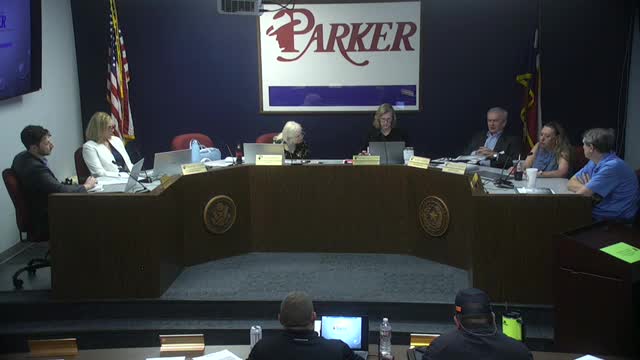
Parker’s finance director, Grant Savage, presented a budget overview at a July 15 council workshop that set the schedule for the city’s 2025–26 budget process and detailed the city’s revenue mix, staffing levels and outstanding debt.
Savage told the council the city’s current (2024–25) budget shows roughly 75% of Parker’s general revenue comes from property taxes and that interest income has become a larger revenue source since interest rates rose three years ago. He said the certified preliminary taxable value used for initial budget calculations is about $2,000,000,000, an increase of roughly $135,000,000 from the prior year that yields an estimated $418,000 in additional revenue based on existing rates.
The presentation summarized Parker’s fund structure, distinguishing government funds (general fund, special revenue, debt service, capital projects) from proprietary enterprise funds (water, wastewater, solid waste). Savage described special revenue accounts such as the law enforcement forfeiture fund, equipment replacement and technology replacement funds, court security and technology funds and child safety funds, and explained many of those are restricted for specific uses.
Savage reviewed staffing counts across departments, noting the city has been largely “lean” with minimal net staffing growth over five years. He said the administration added an administrative assistant position that was later retitled deputy city secretary; police staffing has remained at 12 authorized positions with one known vacancy (assistant chief), and fire positions are part time. Savage said the city’s public works staffing is smaller than comparable nearby cities and that some duties have been reassigned after retirements rather than replaced.
On debt and tax rates, Savage said Parker has two bonds currently supported by property taxes: a 2015 CO bond whose final payment is expected in the next few months and a 2019 bond that is scheduled to be paid off in fiscal year 2027–28. He said that, if no new debt is issued, the I&S (interest and sinking) portion of the tax rate will decrease as those obligations are retired.
Savage explained the tax-rate mechanics to the council: the maintenance and operations (M&O) portion funds general government services while the I&S portion pays debt service. He said a 1-cent change in the city tax rate affects the city budget by about $208,000 and changes the typical homeowner’s Parker portion of the bill by about $114.
Savage also outlined the budget schedule: a line‑item budget and departmental supplemental requests will be presented at a budget workshop on Tuesday, July 22 (10 a.m.–4 p.m.); the council will review proposed changes in August and set a proposed tax rate, and the required public hearing and final action on the tax rate and budget is slated for Sept. 9 (with the option to extend one week if necessary because Collin County requires the budget by noon on Sept. 17).
Council members asked for clarifications on staffing counts, vacancies and position title changes; Savage said the line-item budgets and supplemental requests will be emailed to council members by 5 p.m. Friday before the July 22 workshop. The director also said he would contact Collin County to request a run of how tax changes would affect homeowners age 65 and older and report back at the July 22 meeting.
Why this matters: the council will use the next two workshops and the September hearing to set a proposed tax rate, adopt line items and decide whether to issue new debt — choices that affect services, capital projects and homeowner tax bills. Savage’s presentation framed those upcoming deliberations by showing Parker’s current dependence on property tax revenue and the projected reduction in debt service needs as outstanding bonds are retired.
Savage’s slides compared Parker to nearby cities (Lucas and Murphy) to show differences in revenue mix and staffing levels and included a breakdown of the city portion of an average single‑family homeowner tax bill (the “city portion” averaged roughly $3,500 in the 2024–25 year on an average home value Savage cited). He told the council that certified totals are expected shortly and that his office prepared the first workshop using the $2.0 billion certified estimate.
The council did not take formal budget action at the workshop; the presentation provided information and staff commitments to provide the line‑item materials, supplemental requests, and follow‑up county estimates before the July 22 workshop.
Ending: The council’s next scheduled step is the July 22 budget workshop; staff will deliver the line‑item materials and supplemental requests to council by 5 p.m. the preceding Friday and will bring updated certified valuations and proposed tax‑rate options for the August session and September public hearing.