Get Full Government Meeting Transcripts, Videos, & Alerts Forever!
Get email alerts on the Water System Failure topic
No spam. Unsubscribe anytime.
Victoria council forms investigative committee after TCEQ-flagged water failure; city weighs fast-tracking SCADA upgrade
Summary
Mayor Crocker announced a council committee to investigate a recent water-quality failure flagged by the Texas Commission on Environmental Quality; City Manager Jesus Garza presented a confirmed timeline of testing, flushing and a chlorine conversion and outlined options to accelerate a long‑planned SCADA upgrade.
Mayor Crocker announced a council committee on the evening of the meeting to investigate a recent water-quality failure flagged by the Texas Commission on Environmental Quality (TCEQ), saying the incident “was unacceptable and it demands a thorough review and accounting.” The committee will be chaired by Crocker and include Mayor Pro Tem Dr. Andrew Young and Councilwoman Jan Scott.
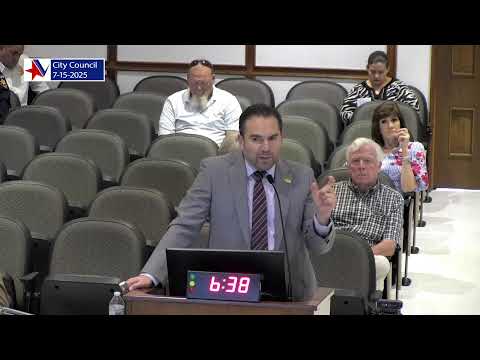
City Manager Jesus Garza gave a detailed, timeline-focused briefing on the response, saying TCEQ was on site July 8 after tests at a single intersection showed low chlorine residuals. Garza said staff first attempted a localized flush, then a systemwide flush when the localized measure failed to restore the required chlorine residual within the 24-hour period TCEQ commonly allows. When those measures did not fully resolve the residual issue, staff moved up the utility’s scheduled annual chlorine conversion and began that work on Saturday; Garza said the conversion restored residuals and that bacteria samples — 16 sites chosen in consultation with TCEQ, 13 of them between Mockingbird and Red River — require 24 hours to incubate. Garza said the city expected results by 7 p.m. the night of the meeting and that those results would determine whether the boil-water notice could be rescinded.
Why it matters: The council framed the episode as a public-safety and public‑trust issue. The committee will examine technical, operational and organizational causes; the city is also weighing near-term steps to reduce the risk of future failures, including technology upgrades and revised oversight.
What city staff said and did
- Responsibility: Garza said he “takes full responsibility as city manager” for any preventable elements of the incident and for ensuring city services meet professional standards.
- Testing and remedies: Garza described the sequence as TCEQ on-site July 8, an initial localized flush that was ultimately insufficient, two overnight systemwide flushes (two towers each night), and an accelerated chlorine conversion that began the Saturday after TCEQ’s involvement. He said staff followed TCEQ notification requirements and sampling protocols; the bacterial test set selected by staff and TCEQ covered 16 sample points and required roughly 24 hours to yield results.
- Localized geometry: Garza said the problem originated in the low-pressure service plane — the area he described as “below Mockingbird” — and that the city asked but was not permitted by TCEQ to issue a boil-water notice limited only to that plane because the agency treated the system as interconnected.
- Communications and support: Garza said the city used traditional media, social media, live press briefings and the Everbridge mass-notification system (the city’s Alert Center) to reach more than 23,000 subscribers. He described outreach to hospitals, nursing homes and dialysis centers via the Office of Emergency Management and the STRAC medical network.
- Utility rebate implemented: Garza described a $10 credit the city applied broadly to utility accounts to offset the disruption. He said the figure was derived from combining water and sewer base rates and rounding to approximate one week’s proportionate charge; applying the credit across accounts was estimated at about $234,000.
SCADA and capital‑funding discussion
City staff and several council members discussed prioritizing a long-planned SCADA (Supervisory Control and Data Acquisition) modernization that monitors and controls water and wastewater systems. Garza said the current SCADA components date to about 2001, are out of date and do not provide the monitoring or cybersecurity protections of modern systems. He said a full replacement for both water and sewer SCADA systems was in the range of $6 million, with the water portion roughly $3.6 million.
The city has an outstanding CDBG-MIT (Community Development Block Grant — Mitigation) application that included SCADA among several projects tied to Hurricane Harvey mitigation funding administered through the regional planning commission and the Texas General Land Office (GLO). Garza said the CDBG-MIT approval process has been slow and that grant-pricing estimates are now two years old; those remaining projects (an influent screen replacement and a drainage project) may also rise in cost. To accelerate SCADA work now, staff proposed two options: (1) press the GLO and elected officials to finalize the existing CDBG-MIT awards quickly; or (2) reprioritize the city’s local match and Victoria Sales Tax Development Corporation (VSTDC) commitments in the fiscal‑year 2026 budget to free roughly $2 million already set aside and stretch VSTDC contributions to the community center project over a longer period to cover the remaining SCADA cost.
Garza said staff is not asking council to decide that funding reallocation at the meeting but presented it as an option to consider if council wants to accelerate a SCADA replacement rather than waiting on federal/state grant disbursements.
What the council decided (and what remains under discussion)
- Committee: Mayor Crocker announced the formation of a council investigative committee (chair Crocker; members Dr. Andrew Young and Jan Scott). The announcement constituted an official formation of the committee; no formal vote was recorded for the committee’s creation during this meeting.
- Rebate: Garza reported the city had applied the $10 rebate across accounts; he characterized the decision as done under the constraints of his office, explaining he had to justify the expenditure and that it was structured to fit within the adopted budget.
- SCADA: Council received the reprioritization option; no binding budget reallocation or contract award was made at this meeting. Garza asked council to consider coordinating a “full court press” with state elected officials to expedite remaining grant approvals from the GLO while staff develops a local funding fallback.
Public‑health update
At the end of the discussion Garza said the 24‑hour bacterial tests had come back and, “I’m happy to report that, we received the test back from the health department, and as expected, all is good.” He said staff planned to issue a public notice based on those results. (Transcript excerpt: Garza announcement about test results and pending press release.)
Clarifying details
- TCEQ on site: July 8 (staff confirmed). - Sampling: 16 sample sites; 13 were between Mockingbird and Red River (city staff/TCEQ selection for coverage of the affected low-pressure plane). - Utility rebate: $10 per account applied citywide; estimated total cost about $234,000. - SCADA cost estimates: roughly $6,000,000 to replace water and sewer SCADA; ~$3,600,000 for the water portion alone (city planning estimate).
What the committee will examine (as announced)
- Full timeline reconstruction of the events and response. - Review of treatment protocols, equipment performance and infrastructure condition. - Oversight and accountability measures, including staffing, training and technology gaps. - Feasibility and timing of a SCADA modernization and other monitoring upgrades.
Speakers quoted (first reference includes title)
- Mayor Crocker, Mayor of the City of Victoria: “this incident with our water supply was unacceptable and it demands a thorough review and accounting.” - Jesus Garza, City Manager: “I take full responsibility as city manager for any element of this that might have been preventable.” - Jesus Garza, City Manager (on test results): “I’m happy to report that, we received the test back from the health department, and as expected, all is good.”
Ending
Council directed staff to continue updates and to provide the committee’s findings and recommendations to the public when available. Garza said staff will return with more detail on potential budget impacts and timelines if council opts to accelerate SCADA funding rather than waiting for federal/state grant disbursements.