Get Full Government Meeting Transcripts, Videos, & Alerts Forever!
Get email alerts on the County Memberships And Legislative Advocacy topic
No spam. Unsubscribe anytime.
Cochise County supervisors review association memberships, press for clearer notice on lobbying and flag water and transport concerns
Summary
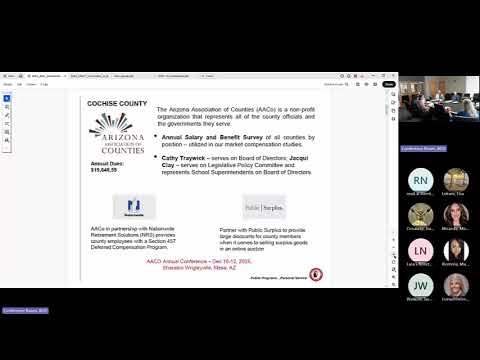
Cochise County supervisors met in a July 15 work session to review the county’s membership in a range of state, regional and national associations and to discuss how those groups influence legislation, transportation funding and regional water projects.
Cochise County supervisors met in a July 15 work session to review the county’s membership in a range of state, regional and national associations and to discuss how those groups influence legislation, transportation funding and regional water projects.
County staff opened the presentation with an inventory of boards and associations the county pays dues to and said the list — and which officials represent the county on each body — would be returned for final approval at a later meeting. County Treasurer (speaking as “Treasurer” in the transcript) described long-standing participation in national and state associations and defended the dues as a cost-effective alternative to hiring private lobbyists. “What we pay in dues … is very minimal compared to … lobbyists are very expensive,” the Treasurer said.
Why it matters: supervisors debated the tradeoff between maintaining access to information and influence at the state and federal level versus the risk that elected county officials or appointed staff might advance legislation without the full board’s knowledge. Several supervisors pressed for a formal process to route any proposed association-driven legislation back to the Board of Supervisors before it reaches lawmakers or is formally presented by the county’s representatives.
During the discussion supervisors mentioned specific associations and roles, including continuing participation in state and national county organizations, the Western Interstate Region (WIR) and the National Association of Counties (NACo). Board members also described regional cooperative groups — such as the Cochise / regional organizations that handle transportation programming (CIGO and the Sierra Vista metropolitan planning organization, MPO) — and their role in steering federal highway funds through ADOT to local projects.
On transportation, supervisors said participating in CIGO and the MPO gives the county earlier information about ADOT priorities and project funding. Some supervisors warned that federal transportation funds carry regulatory requirements — including provisions referenced generically in the meeting as federal conditions and affirmative-action–style requirements — and said the board should “read the fine print” on grants before accepting them. Staff and supervisors agreed the county should stay engaged on transportation planning while ensuring the board understands any regulatory strings attached.
Water and regional conservation work drew strong concern. Supervisors discussed the Upper San Pedro Partnership and the Cochise Conservation Recharge Network (CCRN), describing a history of federal and regional projects aimed at reducing groundwater overdraft around Fort Huachuca and the San Pedro River. Several supervisors said those programs and proposed water districts can shift control of local groundwater planning to nonelected regional bodies and urged pushback. One supervisor asked staff to put the CCRN, the Upper San Pedro Partnership executive committee and related water-district items on a future agenda so the board can consider withdrawing or revising participation in specific agreements.
No formal votes were taken on membership removals at the work session. Instead the board directed staff to return with a proposed membership list and recommended changes for consideration at a future meeting (the presenter said August was likely). Staff also agreed to ensure board members receive legislative-policy committee (LPC/AECO) notifications and bill rundowns so the board is informed before proposed legislation is presented to the state legislature.
The meeting closed with administrative items and an announcement that a separate work session on a proposed wolf-resolution amendment would follow immediately after adjournment. The board did not take final action on membership changes, water agreements or transportation items at the July 15 meeting.
Quotes (selected)
County Treasurer: “What we pay in dues … is very minimal compared to … lobbyists are very expensive.”
Unattributed summary of several supervisors’ remarks: “Any proposed legislation should somehow make it back to us before it goes to the legislature,” and staff should forward LPC/AECO notices to supervisors promptly.
Ending: Staff will prepare a proposed membership list and circulation plan for notifications and return to the Board of Supervisors for formal consideration at a future meeting. The board scheduled a follow-on work session on the wolf-resolution immediately after the July 15 session adjourned.