Get Full Government Meeting Transcripts, Videos, & Alerts Forever!
Get email alerts on the Committee Roundup topic
No spam. Unsubscribe anytime.
Senate committee advances a slate of health, housing, consumer and energy bills; votes send most measures to appropriations
Summary
The Senate Committee on Business, Professions and Economic Development met July 14 and advanced a package of health, consumer‑protection, licensing and energy bills — sending most to the Appropriations Committee or the Senate floor for further review.
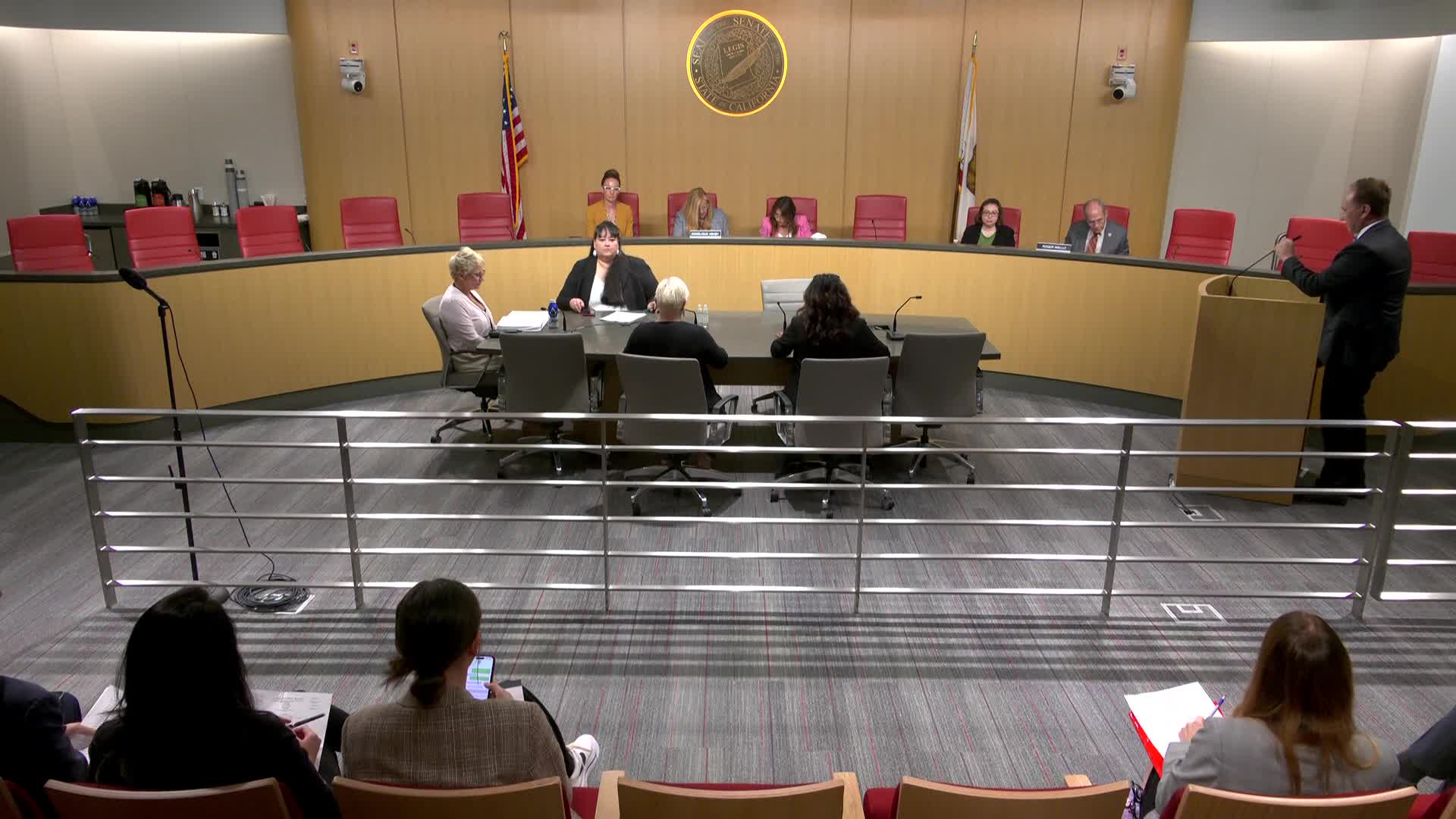
The Senate Committee on Business, Professions and Economic Development met Monday, July 14, in Sacramento and advanced a broad set of bills on public health, consumer protection, professional licensing and energy affordability, sending most to the Senate Appropriations Committee or the Senate floor for further action.
Committee Chair Ashby opened the hearing and the panel took testimony on roughly 16 items. Committee members and outside witnesses debated public-health measures (notably AB 309, which would remove sunset provisions allowing nonprescription syringe sales), animal-safety and shelter reforms (AB 478 and AB 631), construction and licensing reforms affecting developers and professionals (AB 782, AB 1175, AB 759), pharmacy and nursing practice changes (AB 1503, AB 876, AB 968), consumer protections for delivery platforms (AB 578), cannabis-testing oversight (AB 1027), and a multifaceted energy and transmission financing proposal (AB 825).
AB 309 — syringes and public health
Assemblymember Zibur presented AB 309 as a public-health bill that would remove sunset dates on statutes allowing pharmacists to sell sterile syringes without a prescription and clarifying that possession of sterile syringes for personal use is not a crime. Michelle Rivas of the California Pharmacists Association testified the measure “removes a sunset on a vital public health provision allowing pharmacists to continue providing nonprescription access to syringes,” noting pharmacies help patients adhere to prescribed medication regimens. Laura Thomas, senior director of HIV and Harm Reduction Policy at the San Francisco AIDS Foundation, testified that “these types of syringe access programs do not increase syringe litter” and that increased syringe access reduces syringe sharing — a key driver of HIV and viral hepatitis transmission. The committee voted to move AB 309 to the Senate Appropriations Committee (motion passed; recorded vote in committee: 5 yes, 1 no).
Why it matters: Testimony cited state and national public-health studies and cost estimates; the bill keeps in place a set of syringe-access tools that sponsors say lower transmission of HIV and viral hepatitis without increasing drug use.
AB 478 — pet rescue procedures in evacuations
Assemblymember Zibur also presented AB 478, which would require cities or counties, at their next update of emergency plans, to include procedures for rescuing pets in mandatory evacuation zones, post online resources on pet evacuation and reunification, and extend reclaim time for rescued animals before transfer or adoption to allow owners time and dignity to reclaim pets. Nicholas Sackett of Social Compassion in Legislation described incidents during recent wildfires when residents entered evacuation zones to rescue animals and urged planning that reduces those risks. The bill passed out of committee to Appropriations (motion passed; committee vote 6–0).
AB 782 — developer bonding for private improvements
Assemblywoman Quirk Silva presented AB 782, which limits double-bonding practices in which local governments require developers to post separate bonds for private improvements in addition to bonds administered through the Department of Real Estate (DRE) or other state instruments. Sponsor Silvio Ferrari of the California Building Industry Association said double bonding imposes unnecessary costs that are passed to consumers and developers. The committee voted to move AB 782 as amended to Appropriations (motion passed; recorded committee vote 6–0).
Licensing, workforce and consumer measures
- AB 667 would allow applicants for certain Department of Consumer Affairs business licenses to use an interpreter for written licensing exams not offered in an applicant’s preferred language. Denae Joseph of Immigrants Rising described the bill as an access and equity measure to open career pathways. The committee moved the bill to Appropriations (motion passed; committee vote 5–0).
- AB 578, presented by Assemblymember Bauer-Kahan, would require delivery platforms to refund payments in the same form the customer paid in most nonfraud cases and protect tips for workers. Bauer-Kahan described a chain of events from a personal experience in which she ordered 12 pizzas and received one; she said that experience exposed gaps in how platforms return funds. The bill passed to the Senate floor as amended (motion passed; committee vote 5–0).
Pharmacy and allied-practice changes
- AB 1503 is the four‑year sunset-extension and reform package for the California State Board of Pharmacy. The bill includes revisions arising from the board’s sunset review and would narrow some proposed standard-of-care enforcement language while adding a 3:1 pharmacy technician-to-pharmacist supervision ratio (amended in committee). Sung Oh, president of the California State Board of Pharmacy, and pharmacists who testified described the changes as a modernization effort. The measure moved to Appropriations as amended (motion passed; committee vote 7–0).
- AB 968 (presented for Assemblymember Burner) would allow pharmacists to prescribe nonhormonal contraceptives; sponsor testimony positioned the bill as expanding equity and contraceptive choices in community pharmacy settings. The bill advanced to Appropriations (motion passed; committee vote 5–0).
- AB 876 would codify longstanding state executive‑order and regulatory practice recognizing certified registered nurse anesthetists’ (CRNAs) ability to provide anesthesia services consistent with hospital policies and local decisions; testimony focused on preserving access in rural and underserved settings while retaining local clinical oversight. The committee forwarded the bill to Appropriations (motion passed; committee vote 5–0).
Animal-shelter reporting and related debates
AB 631 would require public animal shelters to post intake and outcome data on their websites (with rescues encouraged, rather than mandated, to report). The author, Assemblymember Lee, and supporters said the measure would give policy makers and funders better data to target resources. Opponents — including several rescue organizations and Fix Our Shelters — said the bill fails to capture animals turned away under some shelter intake policies and expressed concerns about unintended harms to rescue-shelter relationships. The committee moved AB 631 to Appropriations (motion passed; committee vote 8–0).
Professional licensure and workforce pipeline measures
- AB 1175 (presented by Assemblymember Lee for Assemblymember Erwin) would modernize CPA licensing pathways — adjusting education and experience requirements and clarifying interstate mobility — to address shortages in accounting professionals. The California Board of Accountancy and California Society of CPAs testified in support; the measure advanced to Appropriations (motion passed; committee vote 5–0).
- AB 759 would create an optional, time-limited ‘‘architect in training’’ title for candidates who have made demonstrated progress toward licensure. Supporters compared the approach to existing titles in engineering and surveying and said the change helps retain licensure candidates; the bill moved to Appropriations (motion passed; committee vote 5–0).
Cannabis testing, restaurant permitting and other items
- AB 1027 (Sharp Collins) would strengthen the Department of Cannabis Control’s authority over product testing, add blind proficiency and random quality assurance reviews for labs, and expand recall authority after reporting of inaccurate potency and contaminants. Industry groups and licensed operators testified in favor; the bill was advanced to Appropriations (motion passed; committee vote 5–0).
- AB 671 (Wicks) would streamline front-end plan review for restaurants converting existing spaces by allowing qualified licensed architects or engineers to self‑certify certain plans, subject to randomized audits and required inspections. Restaurant industry witnesses said the measure would lower delay and cost barriers to opening small businesses; the committee advanced the bill to Appropriations (motion passed; committee vote 5–0).
Energy and transmission financing (AB 825)
Assemblymember Petrie-Norris presented AB 825, a comprehensive energy-affordability and transmission proposal that includes: securitization of certain undergrounding costs, a public transmission financing program supported with Proposition 4 funds and I-Bank financing, and a task force to review value-for-money of prior energy programs. Dr. Adria Tinnan of TURN and Net0 California’s Samu Dan testified that public ownership / public-private financing of transmission could lower long-term costs to ratepayers and that securitization of wildfire-related and undergrounding costs could reduce bills.
Opposition and concerns: Investor-owned utilities and clean-energy organizations raised concerns about some governance provisions, creation or repurposing of a state public-power financing authority, and technical language about permitting and undergrounding that could complicate on-the-ground coordination. In the Committee on Energy the bill passed out of that committee with an 8–3 vote; it will return to the Senate fiscal process for budget-related review.
Votes at a glance (committee-level outcome)
- AB 309 (syringe access) — Advanced to Appropriations (committee vote recorded in materials: 5 yes, 1 no). - AB 478 (pet rescue procedures) — Advanced to Appropriations (6–0). - AB 782 (developer bonding) — Advanced to Appropriations as amended (6–0). - AB 667 (exam interpreters) — Advanced to Appropriations (5–0). - AB 578 (delivery-platform refunds) — Advanced to the Senate floor as amended (5–0). - AB 1503 (Board of Pharmacy sunset/reforms) — Advanced to Appropriations as amended (7–0). - AB 631 (animal shelter data) — Advanced to Appropriations (8–0). - AB 1175 (CPA licensing reform) — Advanced to Appropriations (5–0). - AB 876 (CRNA statutes) — Advanced to Appropriations (5–0). - AB 968 (pharmacist nonhormonal contraceptives) — Advanced to Appropriations (5–0). - AB 1027 (cannabis testing oversight) — Advanced to Appropriations (5–0). - AB 671 (restaurant plan review/self-certification) — Advanced to Appropriations (5–0). - AB 759 (architect-in-training title) — Advanced to Appropriations (5–0). - AB 825 (energy/transmission financing) — Passed out of Senate Energy, Utilities and Communications Committee (8–3); next steps remain in fiscal committees and floor scheduling.
What was not decided
Many bills were advanced subject to committee amendments and will next be reviewed by Senate Appropriations or go to the Senate floor. Several witnesses and members asked for further technical fixes or disclosures — for example, opponents of AB 631 sought more explicit reporting on animals turned away, and opponents of AB 825 requested clearer community‑benefit and local‑hiring language for any state financing program.
Meeting context and next steps
The hearing involved many stakeholder witnesses across public health, animal welfare, licensed professions and energy sectors. Most bills were moved forward; bills that raise budgetary issues or that were amended to add fiscal components will be considered by the Senate Appropriations Committee before any floor vote. Committee staff indicated some measures may return with technical or sponsor-submitted amendments.
Ending note
Committee Chair Ashby and members praised extended stakeholder engagement on several items, noting that the multi‑interest negotiations produced amended texts the committee was willing to advance. For most of the measures, the committee’s action Wednesday was to send bills on to the fiscal review stage or to the floor, where they will face additional policy and budget scrutiny.