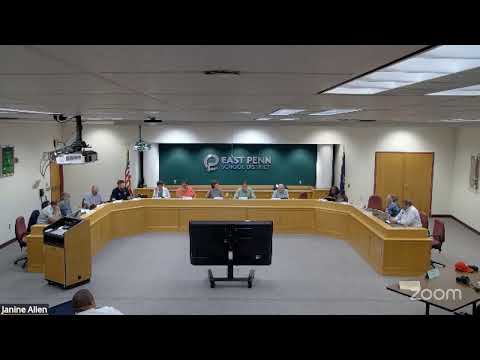
East Penn board debates K–8 realignment as costs, equity and communication concerns mount
Loading...
Summary
The East Penn School District Board of School Directors on July 14, 2025 held an extended discussion of the proposed K–8 realignment schematic design, with no final vote on the schematic itself.
The East Penn School District Board of School Directors on July 14, 2025 held an extended discussion of the proposed K–8 realignment schematic design, with no final vote on the schematic itself. Superintendent Dr. Campbell summarized prior presentations by Breslin Architects and financial advisers from PFM and Raymond James and described schematic approval as the next step that would allow land-development analyses, design development and eventual bidding.
The schematic under discussion would reconfigure grade bands (K–4, 5–6 and 7–8) and build or renovate facilities at Ayers and Lower Macungie Middle School to address uneven enrollment and programmatic equity across the district. Dr. Campbell told the board the district’s October 2024 enrollment projections continue to show capacity pressures at several elementary schools and that the district has presented multiple options over the last three years, including a redistricting plan that would have required facility additions at two elementary schools.
Why it matters: Board members repeatedly framed the issue as a trade-off among academic program design, equity of access, and financial sustainability. The realignment’s current facility estimate cited in public comment is about $95 million; speakers also cited past estimates of roughly $60 million and mentioned district borrowing of about $120 million under one financing approach. Board members warned that rising construction costs, new tariffs and possible reductions in federal funding could further affect budgets and the district’s ability to fund other priorities, such as a substantial renovation at Emmaus High School.
Public comment reflected those concerns. Paul Garbahan, who was announced as the first speaker, said he supported the plan’s goals but urged the board to pause and clarify its position because costs “have ballooned from roughly $60,000,000 … to $95,000,000” and taxpayers could face repeated Act 1 index increases. Garbahan said the public deserves “clarity and transparency on where each of you stand.” Another public commenter, Edwin Cruz, used the public-comment period to raise a separate but serious concern about his son’s individualized education program, saying supports had been removed: “They removed all his supports. … They took the 1 on 1 away completely without any parental involvement.”
Board discussion was lengthy and divided. Several board members urged more and clearer public information. Board member Smith asked for a prominent project tracker and easier access to the project page on the district website so residents can find up-to-date slides, enrollment projections and milestones. Doctor Whitney and others said better public presentation of enrollment data and clearer explanations of how the plan will improve equity would help gain community buy-in. Several board members asked administrators to explain alternatives, including the redistricting option (previously referred to as “option 1”), and whether a smaller, targeted high-school project could be phased instead of pursuing the multi-site realignment now.
Concerns about cost and financing were a recurring theme. Board member Bowman said that the plan’s price tag leaves “no room to grow” if tariffs or other costs increase and questioned whether borrowing at the projected levels would constrain future budgets or teacher compensation. Board member Filleggi said he “loved the plan” but was “hung up on the fact of the cost,” noting the jump from the earlier $60 million estimate to roughly $95–120 million. Several members referenced the district’s long-range capital plan and asked for more clarity about how needed maintenance and high-school upgrades (Dr. Campbell said the long-range capital plan includes about $34 million of high-school upgrades over nine years) would interact with any realignment financing.
Supporters of moving forward argued that waiting would push needed capacity solutions farther out and likely increase costs. The board chair (who opened and guided the discussion) said schematic-design approval allows architects and construction managers to begin necessary land-development and design-development work so the district will be positioned to bid and refine actual project costs next year. The chair emphasized that a schematic-design authorization is a relatively modest investment compared with the full construction cost and that proceeding would preserve the district’s timetable to be ready for the 2028–29 school year if the board ultimately pursues the plan.
Administration said the schematic-approval step would trigger site and environmental analyses, local permitting work and traffic/transportation studies for the affected campuses, along with detailed design work with teacher leaders to specify room types and program spaces. The administration also noted the district has presented financial scenarios and that final bid results—expected well into next year—will provide firmer cost data and additional options to refine scope and timing.
Other business and votes: The board conducted routine business during the meeting, approving minutes from the June 23 meeting, personnel appointments, business-operations items and two curriculum items (educational conferences and the K–8 curriculum presentation shown at the prior meeting) by roll-call votes. Each of those motions passed unanimously by the nine board members present when the roll was called.
The meeting closed after reports from LCTI, an executive session on personnel, and a motion to adjourn. The board’s next regular meeting is scheduled for Aug. 11, 2025 at 7:30 p.m. in the same room.
Ending: Board members asked the administration to provide clearer, digestible enrollment and cost information to the public — for example a timeline or milestone tracker on the district website — and many said they want additional detail on alternatives (redistricting or phased high-school work) before deciding whether to approve construction documents or move further into borrowing.