
Valley Center board reviews three boundary options as new elementary school opens in 2026-27
Get AI-powered insights, summaries, and transcripts
Subscribe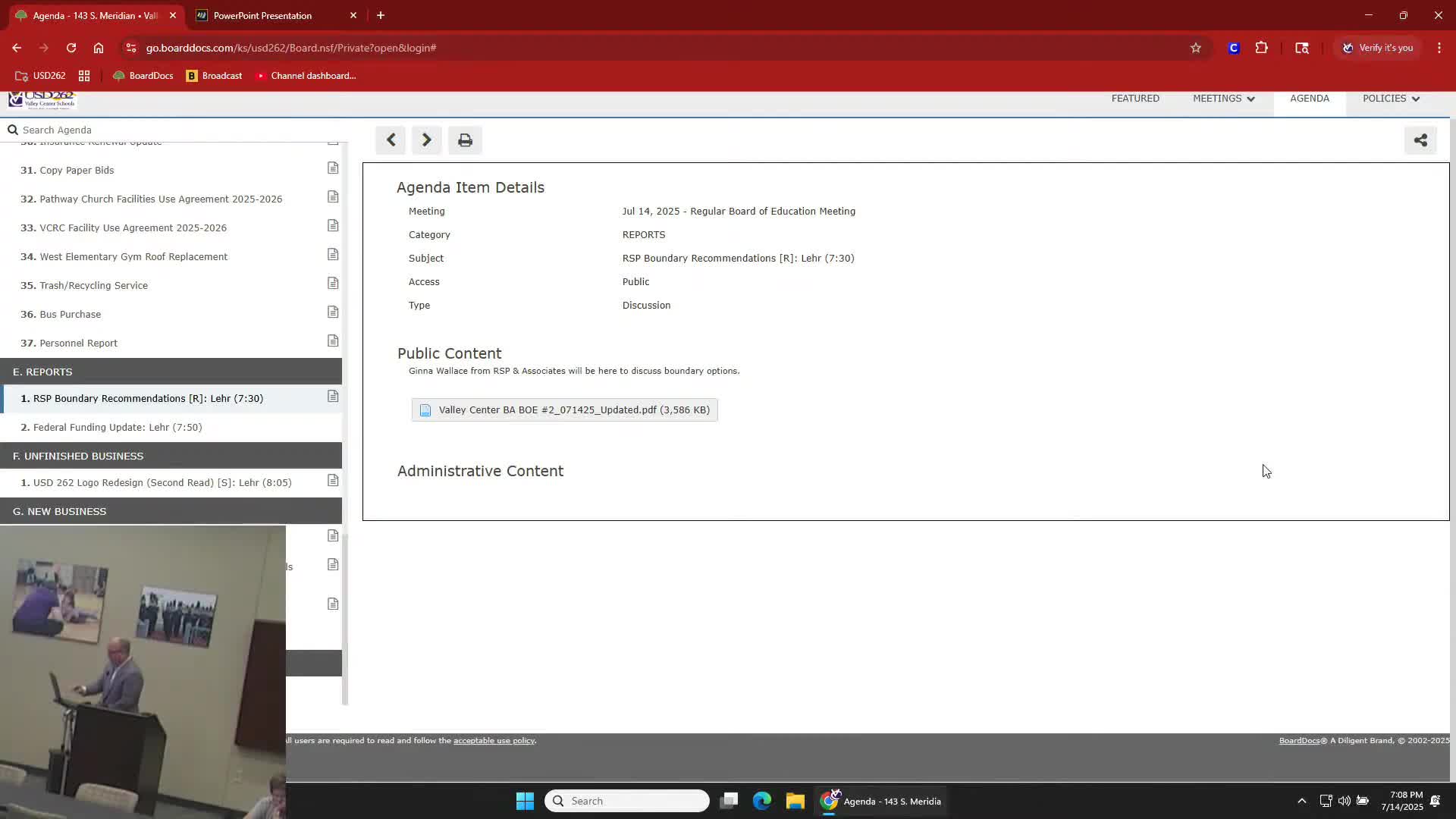
Summary
Consultant Jenna Wallace presented enrollment projections, three boundary models (school choice, attendance boundaries, a hybrid), survey results and grandfathering scenarios as the district prepares to open a new elementary in 2026-27.
Valley Center USD 262 trustees on Monday heard a detailed enrollment and boundary planning presentation from Jenna Wallace of RSP and Associates as the district prepares to open a new elementary school for the 2026-27 school year.
Wallace summarized a multi-month analysis of enrollment trends, housing development and student geography and presented three options for placing students in four elementary buildings: maintain the current school-choice model; establish attendance boundaries (two variants labeled 2a and 2b); or adopt a hybrid approach that limits choice to two-school zones on either side of Meridian.
The consultant said the district’s statistical enrollment model accounts for birth rates, household geography and more than 2,700 potential housing units within the district. “We were contracted with you all to go through an enrollment report and then start facility planning and future considerations as you open your new school and change your grade configuration,” Wallace said during her presentation.
Why it matters: the board’s decision will determine how many students move to the new school, how families will be assigned or choose schools, transportation routing and potential grandfathering policies for currently enrolled students.
Key findings and figures - Current districtwide trends show modest growth (about 1–2% per year recently), but kindergarten cohorts are currently smaller than 12th-grade cohorts, a factor that can limit near-term growth. - RSP’s model counts roughly 2,700 potential new housing units in the district’s pipeline; however the firm notes a declining “yield rate” (fewer students produced per new house) in some new developments. - Under the district’s planned grade-configuration change for 2026-27, RSP projects roughly 550 middle-school students, 460 intermediate-school students and about 1,000–1,100 total elementary students across the four-elementary configuration. - If boundaries are used, two attendance-boundary options would open the future elementary between roughly 260 and 360 students depending on preschool placement and how pre-K is distributed (RSP’s Concept 2a vs. 2b). - RSP’s impact analysis estimates that a pure attendance-boundary approach (concepts 2a/2b) would affect roughly 440 current students in the cohort most immediately impacted; the hybrid model (option 3) would affect about 285 students, approximately 44% of that cohort. - The district survey produced 385 responses; maintaining the school-choice model (option 1) received the most support at about 48.3% while the attendance-boundary option received about 20% support. The optional open-ended survey question produced 83 comments.
Grandfathering and other policy levers Wallace walked the board through several grandfathering scenarios, including (a) allowing all current third- and fourth-grade students to remain at their current schools and (b) limiting grandfathering only to students who would not be assigned to the new school under a boundary map. RSP noted sibling matches are not visible in their student‑ID dataset and recommended the district cross‑check IDs if it wishes to model sibling impacts.
Board members questioned transportation and staffing implications. One board member suggested doing a follow-up survey after school starts to measure parent interest in the new school under a choice model; RSP and district staff noted that the district’s transportation planner, Mark, will run routing scenarios using routing software and return that analysis to the board.
Quotes “We’re giving you that most likely forecast based on our firm and then our experience working with school districts,” Jenna Wallace said while explaining the enrollment model.
“...the new school was not currently representative of choice—would you choose that? That could definitely be now I will tell you that not every family will fill it out,” a board member said while discussing the idea of a follow-up family survey at the start of school.
Next steps and timeline District staff told the board they expect continued discussion over the next months. Staff indicated a likely decision window of November–December so that staffing and parent planning can proceed; the transportation analysis will be developed and brought back to the board before a final determination.
Ending: The board did not vote on boundaries at the meeting; members thanked RSP for the analysis and directed staff to run transportation scenarios and refine grandfathering options ahead of later meetings.