Get Full Government Meeting Transcripts, Videos, & Alerts Forever!
Get email alerts on the Land Use And Development topic
No spam. Unsubscribe anytime.
Hemet council denies Newland Simpson warehouse project after lengthy public hearing
Summary
After more than three hours of public testimony and developer rebuttals, the Hemet City Council voted 3–2 to deny certification of the final environmental impact report and to deny approval of the Newland Simpson warehouse project, citing significant unavoidable environmental impacts and community concerns.
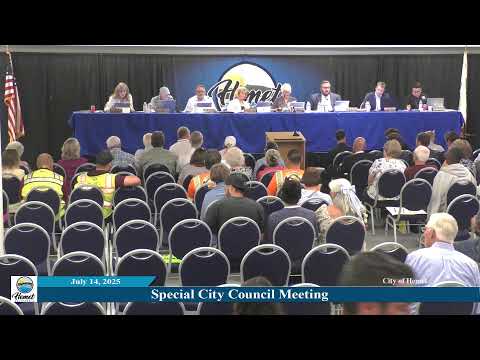
The Hemet City Council on July 14, 2025 refused to certify the final environmental impact report (EIR) and denied approval of the Newland Simpson warehouse project, a proposed logistics development on approximately 74.88 gross acres west of the Warren/Simpson intersection.
Community Development Director Monique Alanis Flater opened the re-noticed public hearing, identifying the items before the council as a General Plan amendment, conditional use permit, tentative parcel map and a building height exception for the “Newland Simpson warehouse project.” She told the council the property owner is HSL Hemet Land LLC and the applicant Newland Capital Group.
The council’s denial followed more than four hours of public comment in which several hundred residents signed speaker cards and roughly 60 people addressed the council. Speakers were sharply divided: many residents and community groups urged denial on air quality, traffic and quality-of-life grounds, while construction and union representatives and some residents supported the project for its local jobs and infrastructure commitments.
The developer, Tom Donahue of Newland Capital Group, told council members the applicant had returned with a reduced proposal after earlier hearings. “We’ve come back with a 40% reduction in the project,” Donahue said, and described elimination of a second building and a large trailer-storage lot as part of the amended plan. He and the project team said the reduced proposal removes about 309,338 square feet of previously proposed building area and focuses development on a single high-cube warehouse estimated at about 884,760 square feet on Parcel 1.
Consultants for the applicant and Rialto Distribution representatives said the project would provide direct jobs and local hiring opportunities. “We had over 800 applicants from the city of Hemet” at a prior job fair, Economic Development staff reported, and Rialto representatives said they were interviewing Hemet residents and intended to recruit locally.
Opponents stressed environmental and traffic impacts. Multiple residents cited concerns about diesel truck traffic, noise, and long-term air quality in the valley, noting Hemet’s bowl-like topography. Public commenters and some council members referenced the EIR’s finding of unavoidable impacts in areas that include greenhouse gases, vehicle miles traveled and noise.
The council conducted two formal motions on the item. A motion to certify the final EIR and approve the project (as presented in the staff report) failed on a 2–3 roll call vote. A subsequent motion to deny certification of the EIR and deny approval of the related entitlements carried on a 3–2 vote. The final vote was recorded as: Council Member Clark — yes; Council Member Lodge — yes; Council Member Mayles — no; Mayor Pro Tem Krupa — no; Mayor Peterson — yes. The council returned the item to the record as a formal denial.
City staff and the applicant noted several mitigation and community-benefit elements in the reduced proposal, including street and sewer improvements along Simpson and Warren roads, a contribution to a signal synchronization study, a proposed pedestrian trail segment, and community artwork and job fair commitments. The applicant also described onsite landscaping and a 1,000-foot setback from certain existing road intersections as design responses to earlier council and community concerns.
During rebuttal and technical response, the applicant’s traffic consultant, Megan Macias (EPD Solutions), clarified how truck and vehicle trip statistics are reported in traffic studies and how the project’s trip generation was calculated using the city’s adopted guidelines. Macias said some public descriptions of “trucks per hour” were based on counting one-way truck trips and that when trips are split across multiple routes the headline numbers can appear smaller than total site movements. On greenhouse gases and other CEQA issues, staff reminded the council that CEQA requires balancing any demonstrable benefits against unavoidable environmental impacts and that a statement of overriding considerations is needed if the council elects to approve a project despite significant unmitigable impacts.
The council’s action to deny certification leaves the original EIR findings in place and returns the proposal to the applicant’s discretion for next steps. The denial does not, by itself, prohibit the applicant from submitting a further revised proposal, filing legal challenges, or pursuing other entitlements; it simply rejects the current EIR certification and entitlements as presented to the council on July 14.
Speakers relevant to the project’s presentation, technical defense and public testimony included Community Development Director Monique Alanis Flater; Tom Donahue (Newland Capital Group); Jeremy Kraudi and Megan Macias (EPD Solutions); Greg Lansing (property owner, Lansing Company); Gustav(o) Lua (Rialto Distribution vice president of operations) and a cross-section of Hemet residents and union representatives. Council members who actively debated and voted were Council Member Clark, Council Member Lodge, Council Member Mayles, Mayor Pro Tem Krupa and Mayor Peterson.
The council did not take separate votes on conditions or mitigation because the final motion denied certification and entitlements. Staff will update the project record and advise on procedural next steps for any revised submittal or appeal.
Ending: The council’s denial was immediate; staff said applicants can revise and return. The city manager and planning staff said they would post any future revisions and recommended changes to the public hearing schedule on the city website and notify interested parties per the city’s public-noticing procedures.