Get Full Government Meeting Transcripts, Videos, & Alerts Forever!
Get email alerts on the Land Use Rezone And Subdivision topic
No spam. Unsubscribe anytime.
Richland hearing examiner hears rezone and 74‑lot preliminary plat for Estates at White Bluffs; record left open for follow‑up
Summary
Gary McLean, the City of Richland hearing examiner, conducted an open‑record public hearing on a site‑specific rezone and an associated preliminary plat for a development called the Estates at White Bluffs.
Gary McLean, the City of Richland hearing examiner, conducted an open‑record public hearing on a site‑specific rezone application and an associated preliminary plat for a development called the Estates at White Bluffs. The rezone request is to change roughly 29.2 acres from suburban agricultural to R‑1‑10 (single‑family residential, 10,000 sq. ft. average lots). The preliminary plat application, submitted by Story Family 5, LLC and represented by Nathan Machiella, seeks approval to divide the property into 74 residential lots and several tracts for infrastructure and open space.
Staff planning manager Mike Stevens told the examiner that the proposed R‑1‑10 zoning is consistent with the city’s low‑density residential comprehensive plan designation and recommended the rezone. Stevens urged that the rezone be considered before final action on the preliminary plat because the plat design assumes the R‑1‑10 standards. Stevens said agencies reviewed the project and that the applicant addressed prior Washington Department of Fish and Wildlife comments by hiring a biological consultant and proposing mitigation for shrub‑steppe habitat.
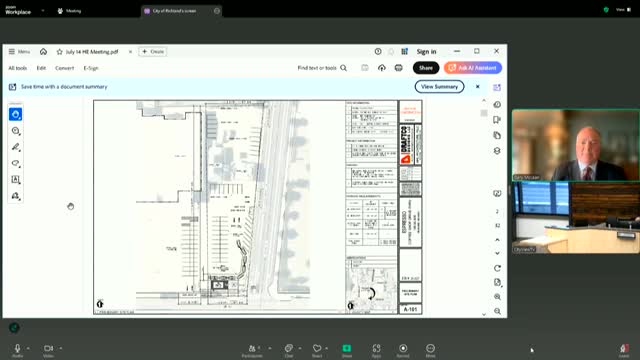
The applicant’s representative, Nathan Machiella, said surrounding properties are already R‑1‑10 and that the site is an infill parcel with stubbed utilities. Machiella and staff described the proposed plat layout (access to Jasper Street, Tomich Avenue and Saron Avenue) and said the applicant has dedicated a Tract C to preserve and expand shrub‑steppe habitat. Stevens and the applicant said the mitigation proposal follows the Department of Fish and Wildlife guidance by replacing impacted shrub‑steppe at a 2:1 ratio, and staff recommended extending monitoring to seven years to improve establishment success.
Several neighbors and nearby property owners spoke during public comment, raising traffic and public‑safety concerns. Speakers cited existing congestion and crashes near Saron Avenue and Kennedy Road, school access and pedestrian exposure near White Bluffs Elementary School, street pavement conditions on Kensington, and the potential for increased irrigation demand. Tony Adams and other neighbors asked the city and applicant to address traffic calming, off‑site pavement condition, and emergency egress during evacuation scenarios.
Daniel Tissell, engineering manager for Kennewick Irrigation District (KID), said KID had requested that the project comply with recommended conditions of approval in the staff packet and described recent drought‑related irrigation restrictions in the Yakima River basin. Tissell said KID serves more than about 26,000 customers and that adding 74 homes was unlikely, by itself, to trigger changes in district water restrictions tied to basin supply.
Stevens said the City of West Richland has sought proportionate SEPA mitigation fees from the applicant for improvements that would mitigate trips funneling to West Richland intersections (examples cited: a phase of Kennedy/Keane improvements and prior work at the Bombing Range light). The city’s traffic analysis found that Richland streets would continue to operate at acceptable service levels with the proposed development and so no additional off‑site improvements were required by Richland’s traffic staff; West Richland’s SEPA requests remain separate.
The applicant objected to condition of approval number 20, which would require the developer to contribute a proportionate share for construction of Cayuse Drive off the site (including curbs and sidewalks) and to deposit funds the city would retain and later disperse to a developer north of the site. Machiella said that Cayuse Drive is not proposed to serve the subdivision, that the portion falls outside the plat, and that the applicant is willing to dedicate right‑of‑way but not to pay for off‑site work that does not serve the project.
Hearing examiner McLean said he would leave the administrative record open to allow staff, public works, and the applicant to confer on condition 20 and on long‑term maintenance arrangements for the shrub‑steppe mitigation area. He set a deadline for the record to remain open until close of business on Monday the 20th (two‑week window), and said he would accept any revised proposed conditions or clarifications submitted in that period. McLean also reiterated that any written decision on the preliminary plat would be conditioned on city council approval of the rezone; the hearing examiner issues a recommendation on rezone requests and the council makes the final legislative decision.
The hearing closed for oral testimony after the record was left open; no final administrative decision was made at the hearing.